

 Emergency Plumbing
 Plumbing Repairs
 Water Heaters
 Drain Cleaning
 Sewer Service
 Faucets & Fixtures
 Repiping
 Toilet Plumbing
 Trenchless
 Plumbing Leaks
 Air Conditioning
 Heating
 Minisplit Systems
 Heat Pumps
 HVAC Components
 HVAC Rebates
An air conditioner leaks water when condensation cannot drain properly or when internal components fail to manage moisture as designed. Common causes include clogged condensate drain lines, damaged drain pans, frozen evaporator coils, dirty air filters, low refrigerant levels, and failed condensate pumps, all of which allow water to back up or overflow inside the unit. Installation errors, disconnected drain lines, damaged insulation, high humidity, faulty safety switches, thermostat malfunctions, aging equipment, cold outdoor operation, and excessive system use can also trigger leaks.
To resolve these issues, start by turning off the AC immediately and clearing drain-line clogs with a wet-dry vacuum and a distilled white vinegar flush. If mechanical failures, electrical safeguards, or refrigerant leaks are suspected, professional air conditioning services are recommended to avoid costly AC repairs over time. Addressing water leaks early with the AC system helps prevent mold growth, electrical hazards, and long-term water damage to your home’s walls and flooring.
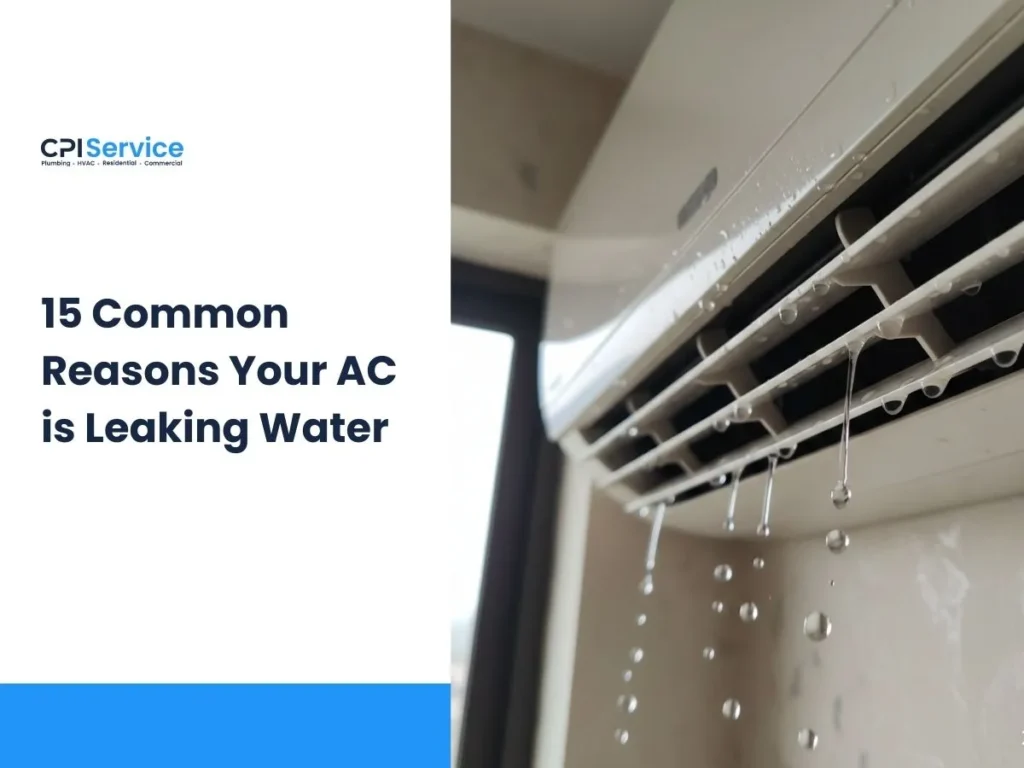
15 common reasons for AC leaking water:
- Clogged Condensate Drain Line
- Damaged or Rusted Drain Pan
- Frozen or Blocked Evaporator Coils
- Dirty Air Filter
- Low Refrigerant Levels
- Broken or Faulty Condensate Pump
- Improper Installation
- Disconnected Drain Line
- Damaged Insulation
- High Humidity Levels
- Broken or Faulty Float Switch
- Malfunctioning Thermostat
- Old or Worn-Out AC Unit
- Outdoor Temperatures Too Cold to Run AC
- Excessive Condensation Due to Overuse
Clogged Condensate Drain Line
A clogged condensate drain line causes AC water leakage by blocking the normal path moisture uses to exit the system. As the AC removes humidity from indoor air, condensate flows from the evaporator coils into the drain pan and through the PVC drain pipe, carrying dirt, dust, algae, and organic debris along the way. Over time, this buildup restricts water flow, causing condensate to back up into the unit and fill the internal drain pan until it overflows, resulting in water leaking from the AC unit, dripping at the air handler, or seeping into ceilings, walls, or floors.
Here are solutions to fix a clogged condensate drain line in an AC system to avoid water leakage:
- Locate the drain line access point (usually a T-shaped pipe near the indoor unit).
- Use a wet-dry vac to suction out the clog from the outdoor end of the pipe.
- Pour one cup of distilled white vinegar into the line for 30 minutes to dissolve algae.
- Flush the line with clean water to ensure the blockage is fully cleared.
Damaged or Rusted Drain Pan
When the primary reservoir that collects moisture from the evaporator coils loses structural integrity, a damaged or rusted drain pan causes water to leak from the AC system. In older AC systems, constant exposure to water can corrode metal pans and create rust holes, while newer plastic pans may crack due to temperature changes or improper handling. Once the pan is compromised, condensate escapes through cracks or rusted areas instead of draining properly, resulting in puddles beneath the indoor AC unit, water collecting in the secondary drain pan, or moisture spreading across nearby floors.
To resolve the AC water leakage issue from a damaged or rusted drain pan, follow these steps:
- Use a flashlight to check for visible signs of rust, corrosion, or hairline cracks in the pipe.
- For minor leaks in plastic pans, apply a specialized water-resistant sealant or epoxy as a temporary measure.
- Replace the drain pan entirely if it is made of metal and showing significant rust-through, as patching is rarely a permanent fix.
- Ensure the new pan is properly tilted toward the drain hole to prevent standing water from causing future corrosion.
Frozen or Blocked Evaporator Coils
Frozen or blocked evaporator coils cause AC water leakage because the ice that forms on them eventually melts, releasing more water than the drain system can handle at once. This condition develops when airflow across the coils is restricted or when refrigerant pressure drops, preventing the coils from absorbing enough heat to keep condensation in liquid form. As ice accumulates, cooling efficiency drops, or the system shuts off. When airflow improves or the AC cycles off, the frozen coils thaw rapidly, overwhelming the drain pan and causing water to overflow around the air handler.
Try these to stop AC water leaks caused by frozen or blocked coils:
- Turn off the AC system immediately to stop the cooling process and prevent compressor damage.
- Switch the fan setting from Auto to On to circulate warm air over the coils and accelerate thawing.
- Check for and remove any airflow obstructions, such as closed vents or heavy furniture blocking return air grilles.
- Schedule AC tune-up services from a professional to clean the coils and ensure the system is operating at the correct pressure.
Dirty Air Filter
When an air filter becomes dirty, it restricts airflow and disrupts normal heat exchange, which can cause AC water leakage. As dust and debris clog the filter, less air passes over the evaporator coils, causing them to become excessively cold. This allows moisture in the air to freeze on the coil surface instead of draining away as liquid condensate. When the ice eventually melts, a large amount of water enters the drain pan at once, often overwhelming the drainage system and resulting in leaks.
Steps to prevent AC leaks caused by a dirty air filter are:
- Turn off the power to your AC system to ensure safety during the inspection.
- Locate the filter slot (usually in the return air duct or the air handler cabinet) and slide out the old filter.
- Replace it with a new filter that matches the manufacturer’s recommended size and MERV rating.
- Set a recurring reminder to check the filter every 30 days, especially during high-use summer months.
Low Refrigerant Levels
Low refrigerant levels can cause AC water leakage by reducing system pressure and allowing the evaporator coils to freeze during operation. Refrigerant leaks can occur due to corrosion in copper lines, vibration at connection points, or physical damage during installation or maintenance, reducing the coils’ ability to absorb heat. As pressure drops, moisture freezes on the coils. When the ice thaws, a large amount of water enters the drain pan at once, often exceeding its capacity, while extended system runtime further increases condensate production and worsens leakage.
Follow these steps to stop water leakages in the AC caused by low refrigerant levels:
- Avoid attempting to add refrigerant yourself, as it requires specialized tools and EPA certification.
- Contact a licensed AC technician to perform a leak test and locate damaged coils or refrigerant lines.
- Have the AC technician seal the leak and recharge the system to the manufacturer’s specified refrigerant level.
Broken or Faulty Condensate Pump
When an AC condensate pump is broken or faulty, it causes water leakage by preventing collected condensate from being lifted to a drain in installations where gravity drainage is not possible, such as basements or attics. The pump relies on a motor and a float switch to detect rising water and discharge it, but if they fail, condensate can become trapped in the reservoir and overflow. This often leads to pooling around the indoor unit, buzzing or gurgling noises, or continuous motor operation due to improper drainage.
Here are solutions to prevent water leakage in the AC caused by a broken or faulty condensate pump:
- Check the power supply to ensure the pump is plugged in and the circuit breaker has not tripped.
- Inspect the discharge tube (the plastic hose leading out of the pump) for kinks or blockages that might be creating backpressure.
- Manually test the float by pouring water into the pump reservoir. If the water rises but the pump does not kick on, the motor or switch is likely dead.
- Clean the pump’s internal tank with a mixture of water and a small amount of bleach to remove algae that may be pinning the float down.
Improper AC Installation
If an AC is installed improperly, it causes AC water leakage by preventing condensate from flowing properly toward the drain outlet. When the indoor unit, drain pan, or drain line is not level or properly sloped, gravity cannot remove water from the system as intended. As condensate collects in the wrong areas of the pan, it eventually spills over the edge, leading to leaks inside the unit, ceiling damage, or water dripping into living spaces.
Solutions to prevent water leakage in the AC caused by improper installation are:
- Check that the indoor air handler is level or slightly tilted toward the drain outlet.
- Verify that the drain pan sits directly beneath the evaporator coils.
- Inspect the drain line to ensure it has a consistent downward slope.
- Secure all PVC fittings to prevent movement or vibration-related loosening.
Disconnected Drain Line
A disconnected drain line results in immediate water leakage because the intended path for condensate to drain outside is physically broken. Over time, the constant vibration of the blower motor can loosen PVC joints that were not properly cemented, or a person working near the unit might accidentally bump and dislodge the pipe. Because the moisture has nowhere to go, it pours directly out of the AC unit’s outlet and onto the floor or through the ceiling.
Follow these steps to stop AC leaks caused by a disconnected drain line:
- Inspect the connection point between the drain pipe and the air handler.
- Clean and dry both ends of the pipe before reconnecting.
- Reattach the pipe using PVC primer and solvent cement.
- Tighten clamps or fittings to prevent future separation.
Damaged Insulation
When an insulation is damaged, it allows the cold surface of the refrigerant lines to come into direct contact with warm, humid air, causing water to leak from the AC unit. This allows condensation to form on the outside of the pipes, a process often called sweating. Without a thick layer of foam insulation to contain this moisture, the water can drip from the pipes and create damp spots on drywall or lead to mold growth in hidden areas.
Here is how you can prevent AC water leaks caused by damaged insulation:
- Inspect the length of the refrigerant lines for any torn, missing, or brittle foam sleeves.
- Replace old insulation with new closed-cell foam pipe insulation of the correct diameter.
- Use waterproof tape or zip ties to secure the insulation and seal the joints between sections.
- Ensure the insulation is snug against the pipe to prevent air gaps where moisture can collect.
High Humidity Levels
Excess moisture in the air causes AC water leaks by forcing the system to remove more water than the condensate drain can manage during normal operation. During periods of extreme humidity, the evaporator coils extract large volumes of moisture from the air, resulting in a heavy, continuous flow of condensate. If the drain line has even a minor restriction, this increased water volume can overwhelm the drain pan and cause it to overflow.
Ways to reduce AC water leaks during high humidity are:
- Run a standalone dehumidifier in the basement or crawlspace to reduce the AC unit’s workload.
- Keep windows and doors tightly sealed to block humid outdoor air.
- Verify the AC fan speed is set correctly, since slower speeds can improve dehumidification.
- Clean the drain pan and drain line more frequently during humid months.
Broken or Faulty Float Switch
A broken or faulty float switch contributes to water leaks by failing to shut down the system when a backup is detected. This safety device is designed to trip and turn off the AC if water levels in the drain pan rise too high. If the switch is stuck or electronically dead, the unit will continue to produce water even if the drain is clogged, leading to a major flood that could have been avoided.
Follow these steps to correct AC leaks caused by a faulty float switch:
- Locate the float switch near the drain pan or condensate line.
- Manually lift the float while the AC is running to confirm the system shuts off.
- Remove slime or debris that may restrict float movement.
- Replace the float switch if it fails to shut down the system or shows corrosion.
Malfunctioning Thermostat
Incorrect temperature control causes AC water leaks by forcing the system to run longer than it was designed to. When a thermostat misreads indoor temperature, it may keep the compressor running continuously, causing the evaporator coils to become excessively cold and freeze. Once the operation stops, the accumulated ice melts rapidly, releasing more water than the drain system can handle.
Here is how homeowners can address thermostat-related AC water leakage:
- Replace thermostat batteries to ensure accurate sensor operation.
- Confirm the thermostat is not installed near heat sources or direct sunlight.
- Recalibrate or reset the thermostat to factory settings.
- Upgrade to a modern thermostat if the current unit is outdated or unresponsive.
Old or Worn-Out AC Unit
An old or worn-out AC unit can cause water leaks because its internal components have reached the end of their useful lifespan. Over 10-15 years, the internal drain pan may develop pinhole rust leaks, the coils may become permanently etched with grime, and the overall structure may shift. These age-related issues often lead to chronic AC repair expenses that are difficult to resolve individually.
Here is how to correct AC leaks caused by AC water leaks:
- Schedule a professional system evaluation to assess structural condition.
- Replace individual failing components if the system is otherwise stable.
- Consider full replacement if leaks originate from multiple areas.
- Maintain regular professional servicing to slow further deterioration.
Outdoor Temperatures Too Cold to Run AC
Running your air conditioner when outdoor temperatures are too low can cause leaks because the AC system’s internal pressure drops below safe operating levels. When the outdoor temperature is below 60°F (15°C), the refrigerant does not operate properly, causing the indoor evaporator coil to freeze. As temperatures rise later in the day, the ice melts rapidly, causing the drain pan to spill over.
Follow these steps to prevent AC leaks during cold outdoor conditions:
- Do not operate the air conditioner if the outdoor temperature is below 60°F.
- Use fan-only mode or open windows to circulate cool outdoor air into the house.
- Install a low-ambient kit if you live in a climate where you must run the AC in cold weather (common in server rooms).
- If the coils have already frozen, turn the system off and let it thaw completely for 24 hours before restarting.
Excessive Condensation Due to Overuse
Excessive condensation due to overuse occurs when an AC unit is forced to run 24/7 without cycling off, typically during a heatwave. This constant operation means the AC unit is never allowed to dry out, leading to a perpetual stream of water in the drain pan. If the AC system is slightly undersized for the home, it will overwork itself, producing more moisture than the drain line can comfortably evacuate.
Here is how homeowners can reduce AC water leaks caused by system overuse:
- Use ceiling fans and close blinds during the day to reduce the AC’s heat load.
- Raise the thermostat by a few degrees to allow the unit to cycle off and rest periodically.
- Check that all supply vents are open to ensure maximum airflow and efficient cooling.
- Schedule a professional inspection to determine if your AC unit is the correct size for your home’s square footage.
What to Do if Your AC is Leaking?
If your AC is leaking, turn it off immediately, clean up the water, inspect the drain line, examine the evaporator coils, replace the air filter, check refrigerant levels, and inspect the float switch. If the source of the leak is not obvious or the problem continues after these checks, the system may require professional service to prevent further damage.
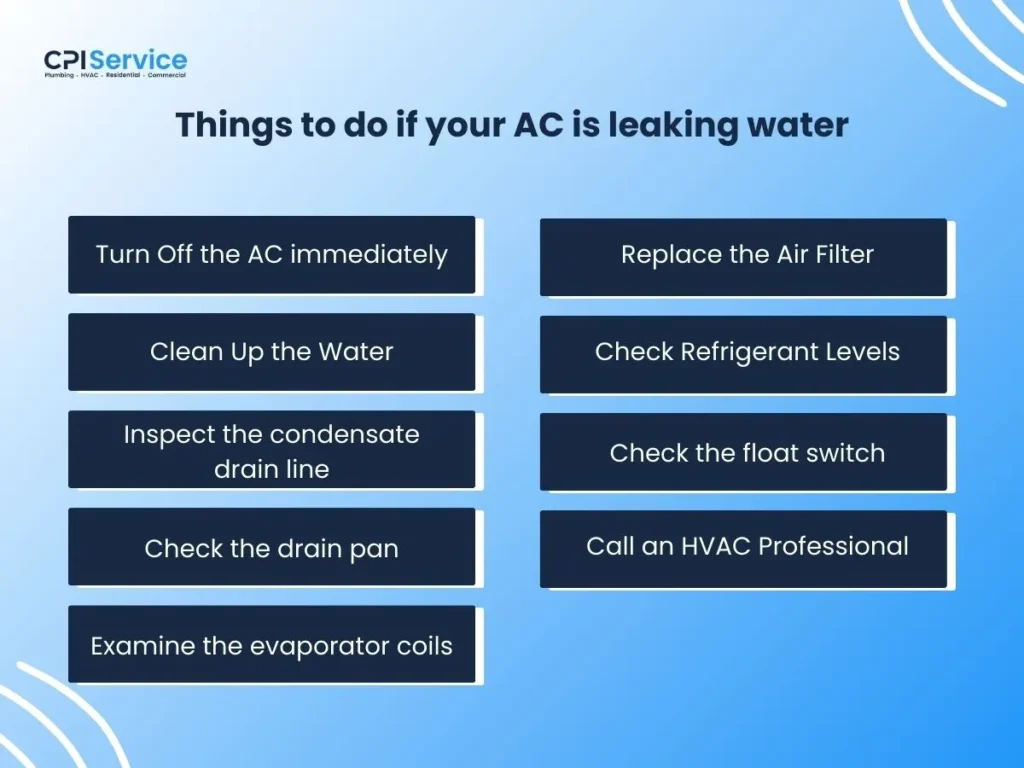
Things to do if your AC is leaking water:
- Turn off the AC immediately: Shut off the air conditioner at the thermostat and breaker to stop additional condensation from forming. This prevents further water buildup and protects internal components from damage.
- Clean Up the Water: Use towels or a wet-dry vacuum to remove standing water around the unit. Drying the area helps prevent water damage to floors, walls, and nearby electrical components.
- Inspect the condensate drain line: Check the drain line (PVC pipe) opening for visible clogs or standing water. A blocked drain line is a common cause of leaks and may require clearing to restore proper drainage.
- Check the drain pan: Look inside the primary and secondary drain pans for cracks, rust, or overflowing water. A damaged or full pan can allow water to spill into the unit or surrounding areas.
- Examine the evaporator coils: Inspect the coils for visible ice buildup, as frozen coils can release a large amount of water when they thaw, which may overwhelm the drain system.
- Replace the Air Filter: A dirty filter restricts airflow, causing coils to freeze and then melt, leading to leaks. Replace or clean it immediately to restore airflow and prevent coil freezing.
- Check Refrigerant Levels: Low refrigerant levels can cause coil freezing and repeated water leaks. This step should be handled by a licensed AC technician due to safety and regulatory requirements.
- Check the float switch: Test the float switch to ensure it shuts off the system when water levels rise. A malfunctioning float switch allows the AC to continue running during a backup.
- Call an HVAC Professional: If the leak continues or the cause is unclear, opt for professional air conditioning services to diagnose the issue and perform proper repairs safely.
Potential Dangers and Risks of AC Leaking Water
When an air conditioner leaks water, it poses numerous risks, including property damage, mold growth, electrical hazards, reduced cooling performance, increased energy costs, and corrosion of AC components. If the leak is ignored, these issues can worsen over time, turning a minor maintenance problem into extensive repairs and long-term damage to both the system and the home.
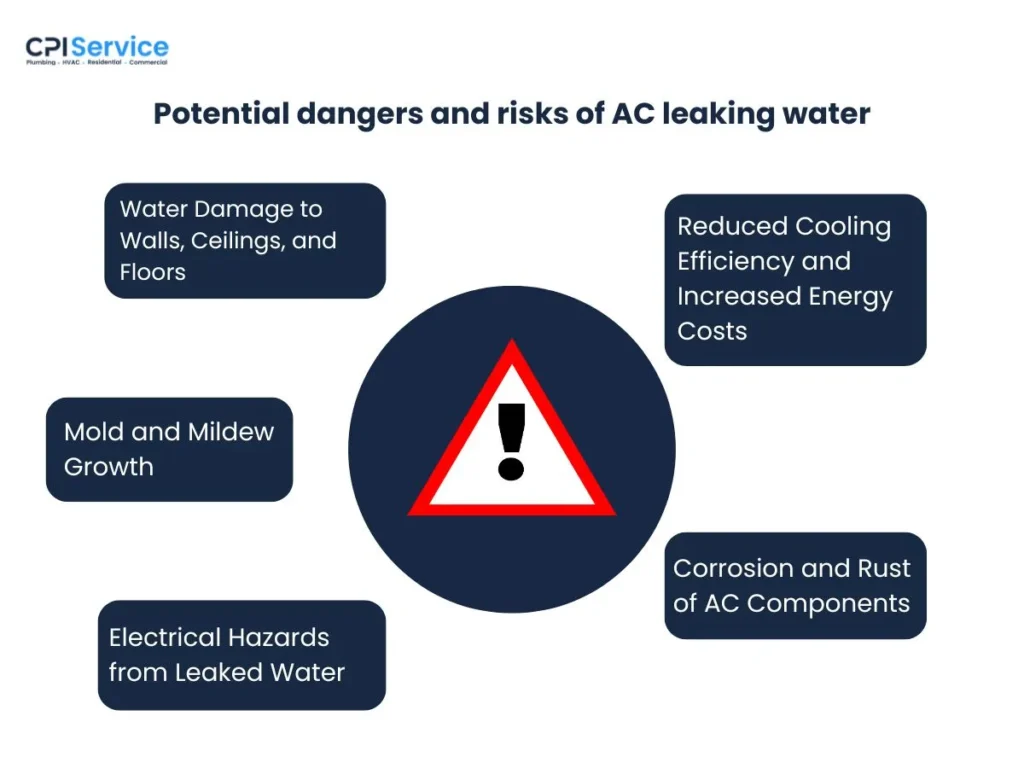
5 potential dangers and risks of AC leaking water:
- Water Damage to Walls, Ceilings, and Floors
When an AC unit leaks, gravity pulls the moisture into the building’s structural materials. Over time, this leads to warped floorboards, sagging ceilings, and crumbling drywall. If the leak occurs in an attic or upper floor, the water can travel along beams and ruin multiple rooms, often necessitating expensive structural renovations.
- Mold and Mildew Growth
Standing water and damp surfaces create the perfect breeding ground for mold and mildew. Within 24 to 48 hours of a leak, fungal spores can begin to colonize damp drywall or insulation. This not only causes a persistent musty odor but can also lead to significant respiratory issues and allergic reactions for the home’s occupants.
- Electrical Hazards from Leaked Water
If water leaks into internal wiring, circuit boards, or nearby outlets, it can cause short circuits, complete AC system failure, or even electrical fires. This risk is particularly high for units located in attics or closets near electrical panels.
- Reduced Cooling Efficiency and Increased Energy Costs
When an AC leaks water, underlying issues such as frozen coils, airflow restrictions, or refrigerant problems often force the system to work harder. This reduces cooling efficiency, increases energy consumption, and can lead to costly AC repairs over time if the root cause is not resolved.
- Corrosion and Rust of AC Components
Continuous exposure to moisture accelerates corrosion and rust on internal AC components, including the drain pan, coils, and metal housing. Corroded parts weaken system reliability and shorten the overall lifespan of the air conditioning unit.

