

 Emergency Plumbing
 Plumbing Repairs
 Water Heaters
 Drain Cleaning
 Sewer Service
 Faucets & Fixtures
 Repiping
 Toilet Plumbing
 Trenchless
 Plumbing Leaks
 Air Conditioning
 Heating
 Minisplit Systems
 Heat Pumps
 HVAC Components
 HVAC Rebates
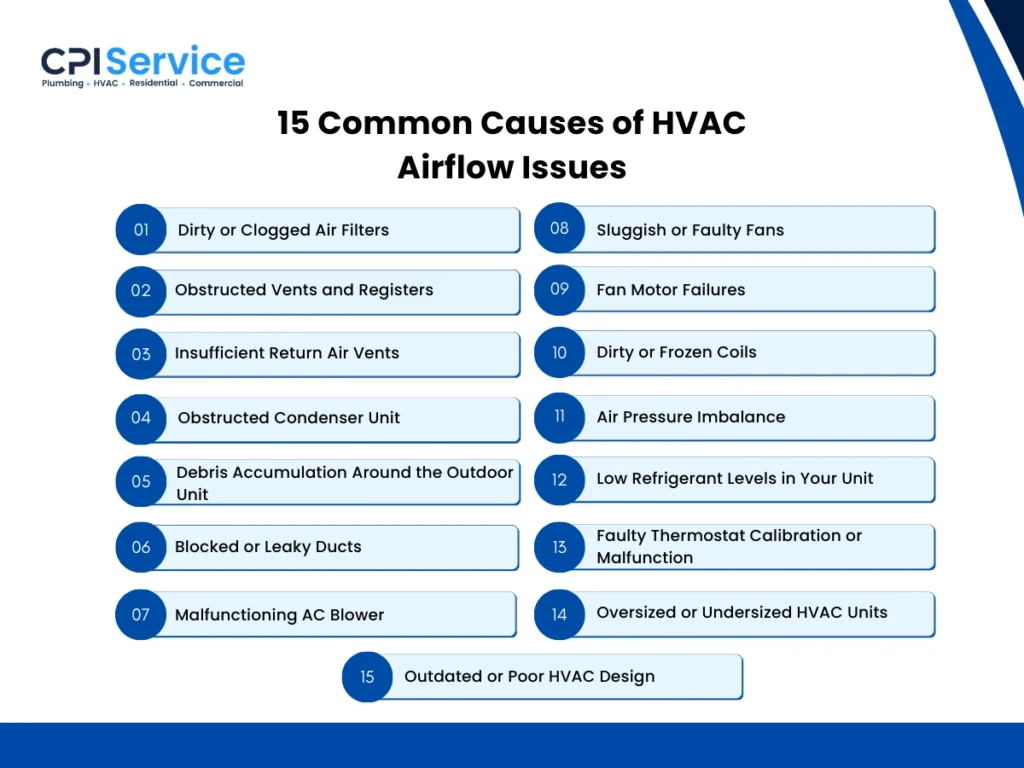
HVAC airflow issues most often occur when air movement is restricted, misdirected, or imbalanced within the system, preventing conditioned air from reaching living spaces efficiently. Common causes of HVAC airflow issues include dirty or clogged air filters, blocked vents and registers, insufficient return air, leaky or obstructed ductwork, malfunctioning blowers, fans, or fan motors, and dirty or frozen coils that reduce heat transfer and airflow capacity.
External factors such as obstructed condenser units, debris buildup, and low refrigerant levels further strain the system, while internal control problems such as faulty thermostat calibration, air pressure imbalance, and improper system sizing create persistent comfort issues. Together, these problems lead to weak or uneven airflow, higher energy bills, longer run times, and an increased risk of mechanical failure if left unaddressed. Preventing these issues requires regular filter replacement, annual or biannual professional inspections, proper duct sealing, balanced vent management, and early correction of airflow restrictions to preserve system efficiency and long-term performance.
1. Dirty or Clogged Air Filters
When your HVAC system’s air filter becomes clogged with dust and pet dander, it creates a physical barrier that forces it to work much harder. The primary symptoms of dirty or clogged air filters include weak or uneven airflow from your vents, rising energy bills, and increased dust in indoor air. This issue develops when filters become clogged with dust, pet dander, and debris, reducing the HVAC system’s ability to circulate air at the required cubic feet per minute (CFM).
To resolve this issue, replace or clean HVAC filters every 1-3 months for 1-inch filters and every 6-12 months for thicker (4-5 inch) filters. Regular inspections during seasonal AC tune-ups also help identify dirty filters early, prevent restricted airflow, and protect internal components from unnecessary wear.
2. Obstructed Vents and Registers
Common HVAC airflow problems often result from obstructed vents and registers when furniture, rugs, curtains, or dust buildup block the path of air entering or exiting a room. Common symptoms include some vents not blowing air, noticeable temperature differences between rooms, and weak airflow from vents even when the HVAC system is running normally. These obstructions prevent air from moving freely, which disrupts balanced air circulation throughout the home.
Homeowners can resolve this issue by conducting a walkthrough of every room and ensuring there is at least 6 to 12 inches of clearance around all registers. Removing these obstructions allows the system to circulate air properly and reduces the backpressure that can damage your blower fan.
3. Insufficient Return Air Vents
Insufficient return air vents cause poor airflow by limiting the amount of air that can flow back into the HVAC system for reconditioning. Symptoms of insufficient return air include air barely coming out of vents, rooms that feel stuffy, doors that slam or stick due to air pressure imbalance, and uneven temperature. This typically occurs when there are too few return vents, returns are blocked, or the system design does not support proper air circulation.
Resolution involves ensuring return vents remain unblocked and clean, and verifying that each level of the home has adequate return air coverage. If needed, also add additional return vents or resize existing ones to restore proper airflow and stabilize air pressure.
4. Obstructed Condenser Unit
The outdoor HVAC unit needs to release heat to the environment, if it is boxed in, the cooling cycle fails, which causes airflow issues. Common symptoms include warm air coming from vents, reduced airflow, longer cooling cycles, and rising energy bills. This problem occurs when objects, fencing, or landscaping block the condenser, limiting outdoor air movement and causing the AC system to work harder to remove heat.
For proper airflow and heat transfer, keep the condenser unit clear on all sides and maintain the manufacturer-recommended clearance. Remove nearby obstructions, such as leaves, branches, or debris, to ensure unrestricted airflow around the unit.
5. Debris Accumulation Around the Outdoor Unit
Debris accumulation around the outdoor unit restricts airflow by blocking the movement of outdoor air needed for heat dissipation. These are among the most common causes of airflow problems and often lead to reduced airflow from vents, longer cooling cycles, and an AC system that runs continuously without reaching the set temperature. Debris accumulation is generally caused by aging ductwork, poor initial installation, or even rodents that have chewed through flexible ducting in the attic or crawlspace.
Solving debris accumulation requires regularly inspecting and clearing debris from around the outdoor unit and maintaining adequate clearance on all sides to support proper airflow. While this can be done DIY, having an HVAC technician perform a duct inspection can make things easier and identify gaps or airflow blockages.
6. Blocked or Leaky Ducts
Blocked or leaky ducts reduce airflow by allowing conditioned air to escape before it reaches living spaces. This problem can reduce HVAC system efficiency by 20-30%, leading to weak airflow from vents, uneven room temperatures, excessive dust, and higher energy bills. Common causes include dust accumulation, torn or poorly insulated ductwork, closed vents, undersized ducts, and pest-related damage that creates air duct blockages or leaks.
To resolve this issue, seal visible duct leaks with approved materials and replace air filters regularly to reduce internal buildup. Persistent airflow loss requires a professional duct inspection to locate hidden leaks or structural damage.
7. Malfunctioning AC Blower
A malfunctioning AC blower often presents as weak or no airflow, caused by failed motors, worn bearings, or electrical faults. Common symptoms include air barely coming out of the vents, uneven temperatures between rooms, and an HVAC system that fails to circulate air properly. This problem is often caused by clogged filters, frozen evaporator coils, leaky or undersized ductwork, or dirty condenser coils, all of which increase resistance and overload the blower assembly.
For proper correction, replace air filters regularly and have an HVAC technician inspect the blower motor and related components if airflow does not improve. This restores proper airflow and reduces strain on the blower assembly.
8. Sluggish or Faulty Fans
Often caused by dirt buildup, failing motors, or worn belts, sluggish or faulty HVAC fans significantly reduce airflow, leading to uneven temperatures, frozen coils, and increased energy consumption. Airflow becomes weak when fan blades spin at reduced speed and fail to generate the required CFM to distribute air throughout the home. Common symptoms include poor airflow that feels like a light breeze, warmer rooms farthest from the indoor unit, and longer system run times. Electrical issues such as failing capacitors, clogged filters, or blocked vents commonly contribute to this condition.
Homeowners should begin by cleaning fan blades and replacing clogged air filters to reduce resistance. If airflow remains weak, a technician should inspect capacitors, motors, and belts for wear that may be limiting fan performance.
9. Fan Motor Failures
HVAC fan motor failures often stem from overheating caused by debris buildup, faulty capacitors, or worn bearings, which can lead to weak airflow or a complete system shutdown. Common symptoms include no air blowing from vents, intermittent airflow, overheating, odors, or an AC unit that turns on without circulating air. These failures are frequently linked to dirty or clogged air filters, blocked vents, leaking ductwork, or prolonged strain on the blower motor that forces it to operate beyond safe limits.
Resolution requires professional testing of the motor, capacitor, and wiring to confirm failure and replace damaged components. In most cases, a failed motor requires replacement rather than repair.
10. Dirty or Frozen Coils
Dirty and frozen HVAC coils are primarily caused by restricted airflow, most often due to dirty air filters, blocked vents, or low refrigerant levels. A dirty evaporator coil reduces heat absorption, causing coil icing and reduced airflow, while a dirty condenser coil traps heat, leading to system overheating. Common symptoms include weak airflow from vents, warm air output, visible ice buildup, and increasing energy bills as the system struggles to operate efficiently.
To correct and prevent recurrence, replace clogged filters and keep vents unobstructed. Frozen coils should be fully thawed before restarting the system, and persistent freezing may require a professional inspection of refrigerant levels and airflow balance.
11. Air Pressure Imbalance
HVAC system airflow becomes irregular and strained when the home’s internal air pressure is not balanced, creating a vacuum that resists airflow. Primary causes of air pressure imbalance include blocked supply/return vents, dirty air filters, leaky or poorly designed ductwork, and undersized/oversized equipment. This is caused by a lack of return air or by homeowners closing too many interior doors, which traps air in some rooms and starves the system in others.
Homeowners can correct minor pressure imbalances by keeping supply and return vents open and unobstructed and by sealing visible duct leaks. If the imbalance persists, it will require professional duct balancing or the installation of a bypass damper, which could increase the potential repair costs.
12. Low Refrigerant Levels in Your Unit
Low refrigerant levels cause reduced airflow and poor cooling performance by limiting the system’s ability to absorb and transfer heat effectively. Common symptoms include weak airflow from vents, warm air blowing indoors, ice forming on evaporator coils, and longer run times with rising energy bills. This issue is most often caused by refrigerant leaks, improper system charging, or long-term wear that allows refrigerant to escape, which places added strain on the HVAC system.
To resolve low refrigerant levels, an HVAC technician must locate leaks, repair damaged refrigerant lines, and recharge the system in accordance with manufacturer specifications.
13. Faulty Thermostat Calibration or Malfunction
A faulty thermostat calibration or malfunction causes airflow and temperature control issues when the HVAC system receives incorrect signals about indoor conditions. Common symptoms include inconsistent airflow, rooms that feel warmer or cooler than the thermostat setting, short cycling, or an AC system that runs without delivering adequate comfort. This problem often results from miscalibrated sensors, dead batteries, wiring issues, outdated thermostats, or incorrect placement near heat sources, which can distort temperature readings.
For thermostat-related airflow problems, replace the batteries and confirm that the thermostat settings match the system requirements. Recalibrate the thermostat if supported, or replace outdated or inaccurate units that no longer regulate airflow correctly.
14. Oversized or Undersized HVAC Units
Oversized HVAC units often cause short cycling, high indoor humidity, and uneven temperatures because they cool too quickly and do not distribute air properly. Undersized HVAC units run continuously but still fail to reach the desired temperature, resulting in insufficient airflow and increased strain on the system. Both conditions reduce system lifespan and efficiency. These airflow problems are often compounded by dirty filters, blocked vents, leaky ductwork, or failing blower motors, which further restrict airflow and disrupt balanced comfort.
By performing a proper load calculation, an HVAC technician can determine the correct system size and identify capacity mismatches. While minor duct or airflow adjustments may reduce symptoms, long-term correction often requires installing a properly sized unit to restore balanced airflow and system efficiency.
15. Outdated or Poor HVAC Design
Chronic airflow restrictions occur when ductwork is poorly engineered, creating excessive friction that prevents air from moving efficiently through the system. Common symptoms include specific rooms or entire sections of the home that never maintain consistent comfort, even when the HVAC system runs continuously. This issue is typically caused by builder-grade duct designs that use sharp 90-degree turns, undersized air ducts, or layouts that cannot handle the blower’s airflow.
To solve this, an HVAC professional can perform a duct retrofit to replace restrictive sections with properly sized ductwork, reducing friction and improving airflow. If redesign options are limited, inline booster fans can be installed to help restore balanced air distribution throughout the home.
How to Prevent HVAC Airflow Problems?
To prevent HVAC airflow problems, schedule regular maintenance, keep vents open, replace filters, monitor energy bills promptly, and address issues quickly. These preventive steps help maintain proper airflow, reduce strain on system components, and lower the risk of unexpected breakdowns caused by restricted air movement.
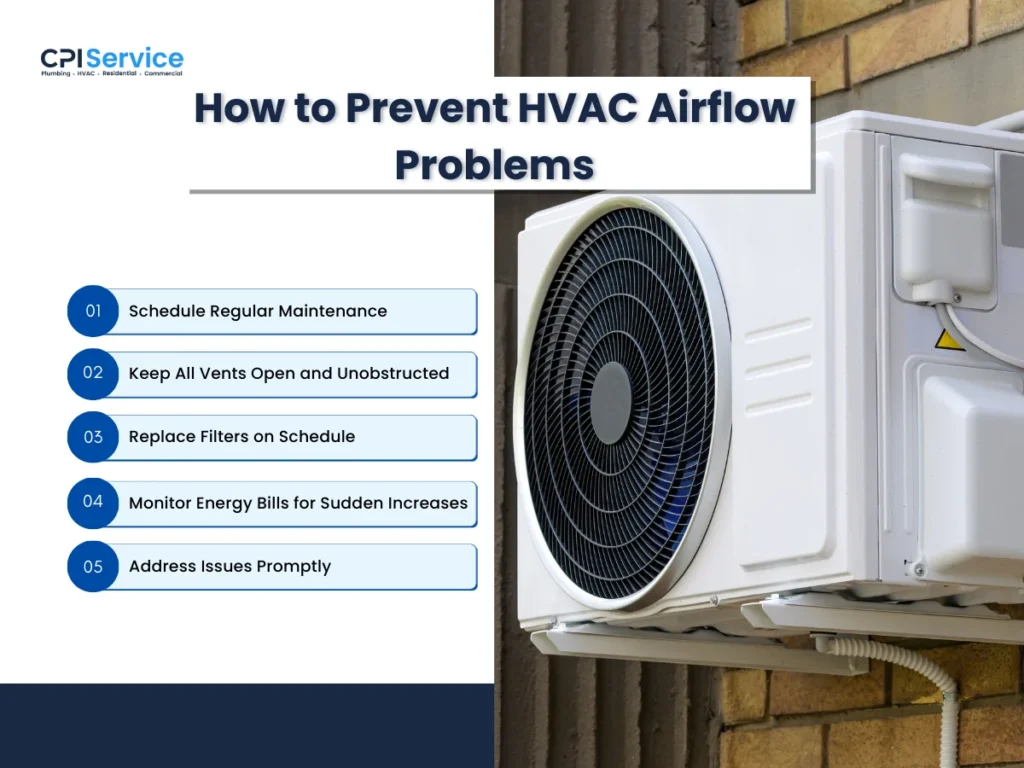
5 key ways to prevent HVAC airflow problems are:
- Schedule Regular Maintenance
Annual or biannual HVAC maintenance, performed by professional HVAC technicians help identify airflow restrictions before they disrupt circulation. These inspections can detect dirty evaporator coils, failing blower motors, or low refrigerant levels early, allowing corrections before performance declines. Routine maintenance also helps HVAC systems operate closer to their original design specifications, which can extend equipment lifespan and reduce energy bills by 5 to 15%.
- Keep All Vents Open and Unobstructed
Maintain HVAC system balance by ensuring air flows freely throughout the home. Closing vents creates high static pressure, which strains the HVAC unit and can reduce airflow or damage internal components, such as the heat exchanger. Ensure all supply and return vents maintain 6 to 12 inches of clearance from furniture or drapes.
- Replace Filters on Schedule
Prevent HVAC system clogging by replacing air filters every 30 to 90 days, so the blower motor does not have to push air through heavy dust buildup. Clean filters help maintain proper cubic feet per minute (CFM), while clogged filters increase strain, cause coils to freeze, and reduce indoor air quality.
- Monitor Energy Bills for Sudden Increases
Watch for unexplained increases in energy bills, as they often signal that the HVAC system is struggling to move air. Dirty filters, blocked ducts, or developing refrigerant leaks force the system to run longer to reach the set temperature. Early monitoring helps identify airflow problems before they escalate into system failure.
- Address Issues Promptly
Stop minor airflow issues from becoming major failures by calling for professional air conditioning services as soon as you notice weak airflow, unusual noises, or uneven temperatures. Ignoring early warning signs can trigger a chain reaction that damages critical components such as the blower motor. Prompt action protects your investment and reduces emergency repair costs.
Fix Your Airflow Problem Today
If your HVAC system is experiencing poor airflow, taking immediate action can restore comfort and prevent further damage. Start with quick checks such as replacing dirty air filters, opening all supply and return vents, and removing obstructions like furniture or drapes. Inspect the outdoor HVAC unit for visible debris, confirm thermostat settings are correct, and listen for unusual noises that may indicate fan or blower issues. These immediate steps often resolve minor airflow restrictions and reduce strain on the system. For recurring or severe airflow problems such as leaky ductwork, failing blower motors, refrigerant leaks, or poor system design, a professional diagnosis and repair are necessary. Scheduling professional HVAC services ensures airflow problems are corrected properly, restores system efficiency, and prevents future breakdowns, helping protect your HVAC investment and maintain consistent comfort year after year.

