

 Emergency Plumbing
 Plumbing Repairs
 Water Heaters
 Drain Cleaning
 Sewer Service
 Faucets & Fixtures
 Repiping
 Toilet Plumbing
 Trenchless
 Plumbing Leaks
 Air Conditioning
 Heating
 Minisplit Systems
 Heat Pumps
 HVAC Components
 HVAC Rebates
A furnace pressure switch is stuck open when it fails to close after the inducer motor starts, causing the control board to block ignition and leave the furnace without heat. The switch must detect sufficient negative draft pressure before the igniter and gas valve can operate. Common causes include blocked intake or exhaust venting, snow or ice at the vent termination, a clogged condensate drain, damaged pressure tubing, restricted tubing ports, or a weak inducer motor. Lennox troubleshooting guidance specifically identifies vent restrictions, condensate drainage, cracked hoses, and inducer problems as causes of pressure switches failing to close.
During winter, common signs include a furnace that will not ignite, an inducer motor that runs repeatedly, short cycling, and fault codes such as Pressure Switch Open or Combustion Air Draft Fault. Check accessible exterior vents for snow, ice, or debris and look for visible condensate or tubing problems. If the fault continues, a professional should test draft pressure, switch operation, and inducer performance. Because the pressure switch prevents ignition when it cannot confirm safe combustion airflow, diagnose persistent faults before they lead to a complete no-heat condition in cold weather.
What Does It Mean When a Furnace Pressure Switch Is Stuck Open?
A furnace pressure switch stuck open means the switch does not close after the inducer motor starts, so the control board blocks ignition and the burners cannot produce heat. The switch verifies that the inducer is creating enough negative draft to move combustion gases through the heat exchanger and vent system before the gas valve opens. Blocked intake or exhaust venting, snow or ice, condensate buildup, damaged pressure tubing, restricted pressure ports, weak inducer performance, or a failed switch can prevent it from closing. This safety sequence keeps the furnace from firing when it cannot confirm proper combustion airflow and venting.
Where Is the Furnace Pressure Switch Located?
The furnace pressure switch is typically located inside the burner or combustion compartment near the draft inducer motor, where it can sense the pressure created during furnace startup. It is usually a small round or disc-shaped component connected to the inducer housing, collector box, or another pressure tap by one or more flexible tubes, with electrical terminals connected to the furnace control circuit. Depending on the furnace design, especially two-stage or high-efficiency condensing models, multiple pressure switches may be located near the inducer, vent connections, or condensate components. Trane furnace diagrams similarly place pressure switches within the burner compartment alongside the inducer and other combustion controls.
What Are the Signs of a Furnace Pressure Switch Stuck Open?
Common signs of a furnace pressure switch stuck open include no burner ignition, an inducer motor running without heat, repeated startup attempts or short cycling, and a pressure-switch diagnostic code. These symptoms occur when the control board does not receive confirmation that adequate draft has been established through the heat exchanger and vent system. In winter, the furnace may respond to a thermostat call but fail to produce warm air, eventually leaving the home without heat.

4 key signs of a furnace pressure switch stuck open are:
- Furnace Won’t Ignite or Start Heating
- Inducer Motor Runs but the Furnace Produces No Heat
- Repeated Startup Attempts or Short Cycling
- Pressure Switch Error Codes or Blinking LEDs
Furnace Won’t Ignite or Start Heating
A furnace may fail to ignite when the pressure switch remains open after the inducer starts because the control board will not advance to the igniter and gas-valve stages without confirmed draft. You may hear the thermostat call for heat and the inducer begin running, but the igniter never activates, and the burners remain off.
This usually means the furnace cannot create or verify the required negative pressure. Common causes include a blocked intake or exhaust vent, restricted pressure tubing or ports, condensate buildup, weak inducer performance, or a defective switch. Lennox specifically directs technicians to inspect vent restrictions, inducer operation, pressure tubing, and operating pressure when the switch fails to close.
Inducer Motor Runs but the Furnace Produces No Heat
An inducer motor running without heat means the furnace has begun its combustion-air sequence but has not received the pressure-switch signal required to continue ignition. The inducer normally starts first and creates negative pressure through the heat exchanger and flue so the switch can close before the gas burners operate.
If draft remains too weak, the inducer may continue running while the furnace waits for the switch to close, or the control board may stop and retry the startup sequence. Leaking or blocked pressure-switch hoses, condensate in the tubing, restricted venting, or an inducer motor that does not produce sufficient draft can all cause this pattern.
Repeated Startup Attempts or Short Cycling
Repeated startup attempts can occur when the pressure switch closes inconsistently or opens again during ignition or furnace operation. You may hear the inducer start, see the furnace begin its ignition sequence, and then notice the cycle stop before the thermostat reaches the set temperature.
Intermittent pressure faults can result from marginal draft, a partially blocked vent, condensate in the pressure tubing, loose hose connections, or unstable inducer performance. Lennox distinguishes between a switch that never closes and one that opens during the ignition trial or run mode, while some Trane controls enter lockout after the pressure switch repeatedly opens during a single heat cycle.
Pressure Switch Error Codes or Blinking LEDs
A pressure-switch error code is one of the clearest signs that the furnace control board is not detecting the expected switch position. Depending on the model, the diagnostic system may identify a Pressure Switch Open, Pressure Switch Failed to Close, or general draft or pressure-switch fault while preventing normal burner operation.
Flash patterns are not universal, so always compare the LED sequence with the diagnostic chart on the furnace panel or in the manufacturer’s manual. One Trane furnace, for example, uses three red flashes for a first-stage pressure switch stuck open or not closing, while Lennox uses diagnostic codes such as E223 for a pressure switch failed open.
What Causes a Furnace Pressure Switch to Stay Open?
Causes of a furnace pressure switch staying open include blocked furnace venting, condensate issues, a faulty or weak inducer motor, loose pressure switch tubing, a defective pressure switch, and improper furnace design. These problems interfere with the draft pressure needed for the furnace pressure switch to close during the ignition sequence, causing the control board to shut down the furnace as a safety response.
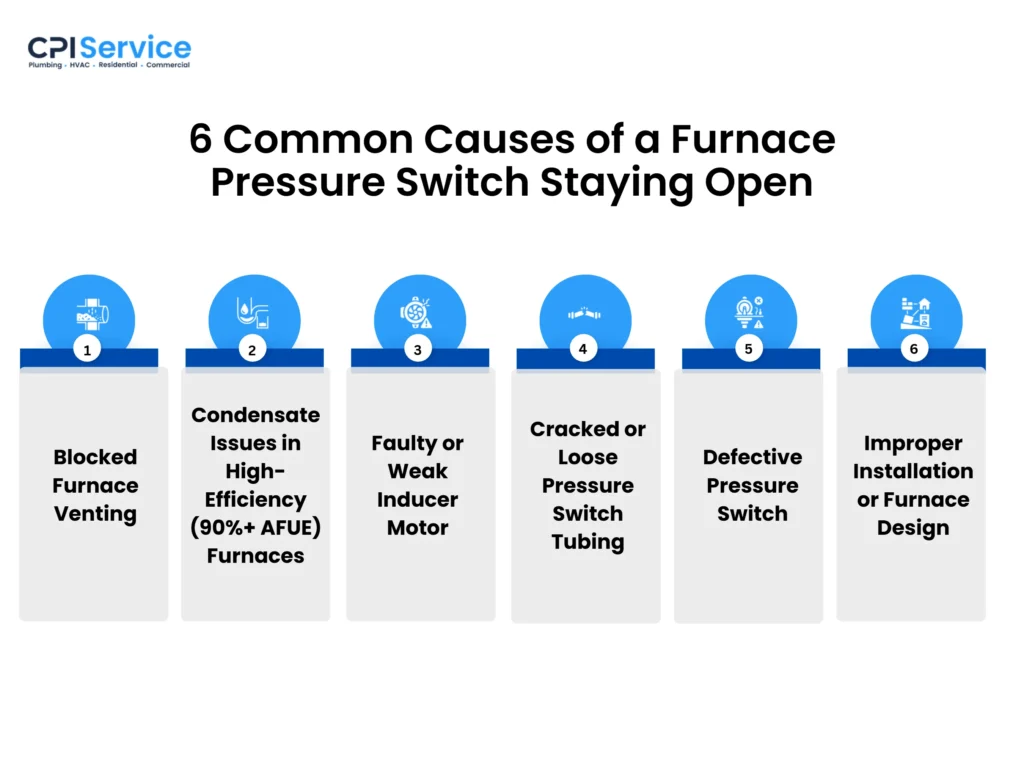
6 common causes of a furnace pressure switch staying open include:
- Blocked Furnace Venting
- Condensate Issues in High-Efficiency (90%+ AFUE) Furnaces
- Faulty or Weak Inducer Motor
- Cracked or Loose Pressure Switch Tubing
- Defective Pressure Switch
- Improper Installation or Furnace Design
Blocked Furnace Venting
Obstructions in the exhaust flue or intake pipes are among the most common reasons a furnace pressure switch stays open, as restricted airflow prevents the draft inducer motor from creating the negative pressure needed to close the switch. When the airflow path becomes blocked, the furnace pressure switch cannot complete the electrical circuit needed for the ignition sequence to continue. In this case, homeowners may notice repeated startup failures, pressure switch error codes, or visible debris such as bird nests, ice buildup, or dead leaves around the exterior vent termination pipes.
To help frame the diagnosis, inspect the visible PVC or metal vent pipes for obvious clogs or restricted airflow. If the blockage appears deeper inside the chimney, heat exchanger, or internal venting system, stop troubleshooting and contact a certified furnace technician, as internal venting problems require specialized tools and carbon monoxide safety testing.
Condensate Issues in High-Efficiency (90%+ AFUE) Furnaces
Clogged drain lines or a full condensate trap can cause water to back up into the inducer housing, keeping the furnace pressure switch open. In high-efficiency furnaces with 90%+ AFUE, condensation forms as a byproduct of combustion, and if the water cannot drain properly, it can collect inside the inducer housing or pressure switch tubing, preventing the furnace pressure switch from closing. Some common signs of condensate issues include water pooling around the base of the furnace, intermittent heating cycles, or a faint sloshing sound when the inducer motor starts.
To help frame the diagnosis, inspect the clear condensate drain hoses for dark sludge, debris buildup, or frozen drain lines restricting water flow. If the water backup has reached the internal heat exchanger or combustion chamber, a professional furnace technician is required to prevent corrosion and additional system damage.
Faulty or Weak Inducer Motor
A draft inducer motor that is failing or spinning below its rated RPM will not generate the suction needed to close the pressure switch, leaving the furnace pressure switch stuck open. Over time, motor bearings can wear out, or the internal fan blades can become coated in soot, reducing the motor’s efficiency even if it sounds like it is running. Symptoms of a faulty or weak inducer motor include a loud screeching or humming noise and the motor feeling excessively hot to the touch during startup.
Diagnosing a faulty or weak inducer motor to ensure the furnace pressure switch operates properly involves verifying that the motor receives full voltage yet fails to produce the required vacuum. Because this involves live electrical testing and gas-combustion components, it is considered a service boundary for a qualified furnace technician.
Cracked or Loose Pressure Switch Tubing
Cracked or loose pressure switch tubing prevents the furnace pressure switch from receiving a stable vacuum signal during startup, leaving it open. The small rubber hose connecting the switch to the furnace serves as the pressure signal’s messenger, and if it is cracked, dry-rotted, or disconnected, the vacuum escapes before it can pull the switch’s internal diaphragm closed. Signs of this issue include the hose falling off its port, visible alligatoring, or tiny holes in the rubber.
For this furnace pressure switch open issue, ensure the hose is snugly attached at both ends and free of cracks. However, if the tubing is clear and the fault persists, the issue likely lies with the switch or motor rather than the seal.
Defective Pressure Switch
An internal mechanical failure of the furnace pressure switch can cause it to become permanently stuck in the open position, as worn internal components can prevent it from responding to normal draft pressure. The internal silicone diaphragm can stiffen over time, or the electrical contact points can become pitted and lose their ability to conduct a signal. While the rest of the furnace might be functioning perfectly, the switch simply fails to respond to the pressure it receives.
Homeowners can often diagnose this by testing for continuity with a multimeter while the inducer is running. If the vacuum is present but the circuit remains open, the switch is defective and must be replaced with an identical OEM part to ensure the unit’s safety.
Improper Installation or Furnace Design
Incorrectly sized venting or improper furnace sloping can lead to persistent pressure switch faults by preventing the heating system from maintaining stable draft pressure. If the vent pipes are too long or have too many elbows, or if a high-efficiency furnace is not tilted slightly forward as per the manufacturer’s specs, the draft pressure will never reach the correct levels. You may notice these issues immediately after a new installation or after a home renovation that altered the venting path.
Framing this diagnosis involves comparing the current vent configuration with the installation manual. Because correcting design flaws requires recalculating BTU loads and rerouting pipes, this work should be handled strictly by a licensed furnace contractor.
How Do You Troubleshoot a Furnace Pressure Switch Stuck Open?
To troubleshoot a furnace pressure switch stuck open, begin by turning off the power supply, then inspect the vent pipes, check and clear the condensate drain, examine the pressure switch tubing, test the inducer motor and furnace pressure switch, and complete the process by resetting and running the furnace. These troubleshooting steps help identify airflow restrictions, weak draft pressure, damaged components, or electrical faults that may prevent the furnace pressure switch from closing during the ignition sequence.
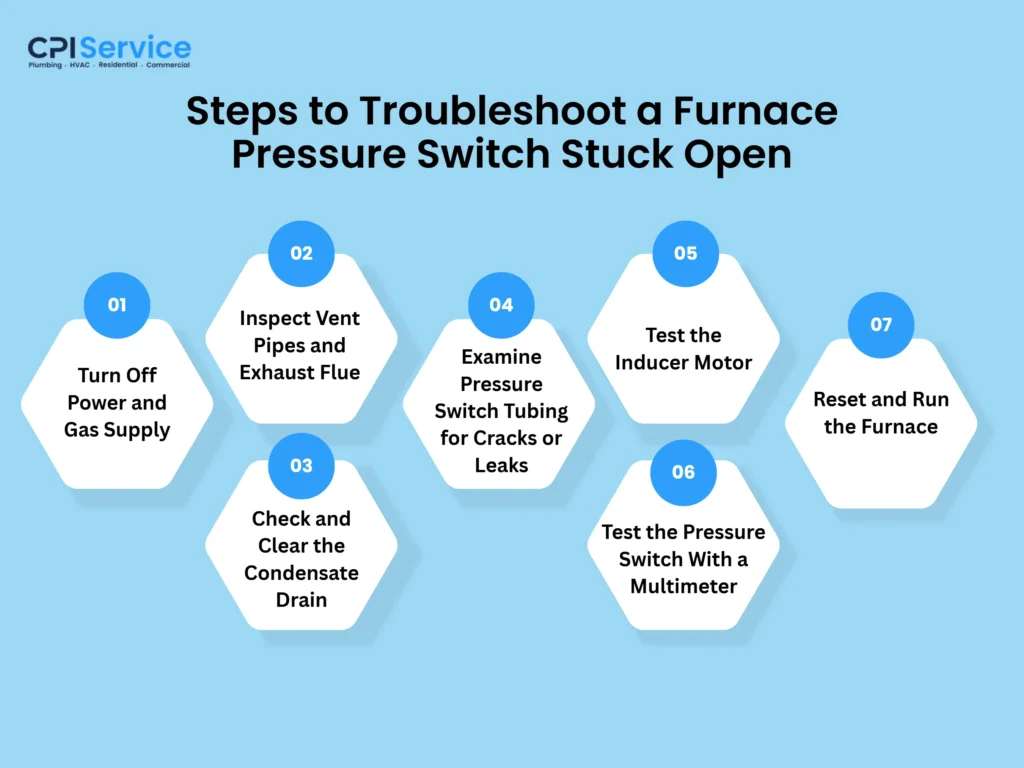
Steps to troubleshoot a furnace pressure switch stuck open are:
- Turn Off Power and Gas Supply
- Inspect Vent Pipes and Exhaust Flue
- Check and Clear the Condensate Drain
- Examine Pressure Switch Tubing for Cracks or Leaks
- Test the Inducer Motor
- Test the Pressure Switch With a Multimeter
- Reset and Run the Furnace
Turn Off Power and Gas Supply
The first step is to switch off the furnace’s electrical breaker and close the gas supply valve to prevent electrical shock, gas leaks, or accidental furnace startup. For this, check that the S switch on the side of the furnace is set to Off and the gas line handle is perpendicular to the pipe. A successful shutoff means the furnace is completely powered down, allowing you to safely remove the service panels. If you cannot locate these shutoffs, stop immediately and call a professional furnace technician.
Inspect Vent Pipes and Exhaust Flue
Examine the entire length of the exhaust and intake venting for any obstructions that may prevent proper draft pressure from reaching the furnace pressure switch. Check the exterior vent terminations for bird nests, ice, or leaves, and look for sagging PVC pipes that might be trapping water. If airflow improves after clearing visible obstructions, the blockage was likely causing the pressure switch to open a fault. Internal chimney or heat exchanger blockages should only be handled by a furnace technician.
Check and Clear the Condensate Drain
Check the condensate drain lines and trap for water backup or sludge buildup that may interfere with airflow in high-efficiency furnaces. Inspect clear drain hoses for standing water, dark debris, or frozen sections restricting drainage. If clearing the drain restores normal furnace startup, the condensate blockage was likely affecting the furnace pressure switch. Persistent water backup or internal drainage issues require professional service.
Examine Pressure Switch Tubing for Cracks or Leaks
Remove the small rubber vacuum hose and inspect it for tiny cracks, brittle spots, or clogs that could weaken the vacuum signal. Ensure the rubber tubing is securely attached and airtight to both the inducer motor and the furnace pressure switch. Visible damage or air leaks can prevent the switch from closing during the ignition sequence. Carefully replace damaged tubing with the correct size and type recommended by the furnace manufacturer.
Test the Inducer Motor
Observe and listen to the inducer motor during the initial startup sequence to ensure it is reaching the RPMs required to generate sufficient draft pressure for the furnace pressure switch. Check for a heavy humming sound, visible wobbling, or a motor that is too hot to touch. If the motor is quiet and powerful, it is likely creating a strong vacuum. In contrast, if it sounds labored or fails to start at all, the motor has likely reached its service boundary and needs professional replacement.
Test the Pressure Switch With a Multimeter
Set your multimeter to the Ohms (Ω) or Continuity setting, and touch the probes to the switch terminals while the inducer is running to determine whether the furnace pressure switch is mechanically failing or successfully closing the circuit. Look for a reading of “0” or a “beep,” which indicates a closed circuit. A reading of “OL” or “1” while the motor is active indicates a defective switch, as this requires testing live, high-voltage components. It is the clear boundary at which most homeowners should seek help from a professional furnace technician.
Reset and Run the Furnace
After completing your checks, reset and run the furnace to see whether the furnace pressure switch fault clears. Restore power and gas supply, then allow the furnace to begin a normal startup cycle. If the furnace ignites and completes a heating cycle, the issue may have been caused by a temporary blockage or loose connection. If the furnace pressure switch fault recurs, a professional furnace technician’s diagnosis is recommended.
Can You Bypass a Furnace Pressure Switch?
Yes, you can technically bypass a furnace pressure switch by jumper-wiring the electrical terminals, but doing so is strongly discouraged because it disables a critical safety device designed to detect unsafe venting and airflow conditions. While bypassing the furnace pressure switch may temporarily allow the burners to ignite, it also removes the furnace system’s protection against blocked exhaust flow, improper draft pressure, and combustion gas buildup.
A furnace pressure switch bypass is sometimes performed by qualified furnace technicians only during short diagnostic testing. Below are the steps to bypass a furnace pressure switch:
- Turning off the power to the furnace.
- Locate the pressure switch near the inducer motor assembly.
- Disconnect the pressure switch wires.
- Temporarily connect the terminals with a jumper wire for testing purposes only.
- Restore power briefly to verify whether the furnace ignition sequence continues.
Note: Because bypassing the furnace pressure switch disables an important safety mechanism, homeowners should never operate the furnace with the switch permanently bypassed. Doing so can increase the risk of carbon monoxide exposure, fire hazards, equipment damage, or explosion. Homeowners are strongly advised to contact a qualified furnace professional before attempting to bypass or test a furnace pressure switch.
When Should You Replace a Furnace Pressure Switch Stuck Open?
You should replace a furnace pressure switch that is stuck open if it remains open after basic checks, the open fault keeps recurring, the switch opens and closes randomly, fails to respond to draft pressure, or shows damaged terminals and worn internal contacts. Each of these conditions indicates the furnace pressure switch can no longer maintain a stable electrical signal during the ignition sequence, even when airflow and draft pressure appear normal.
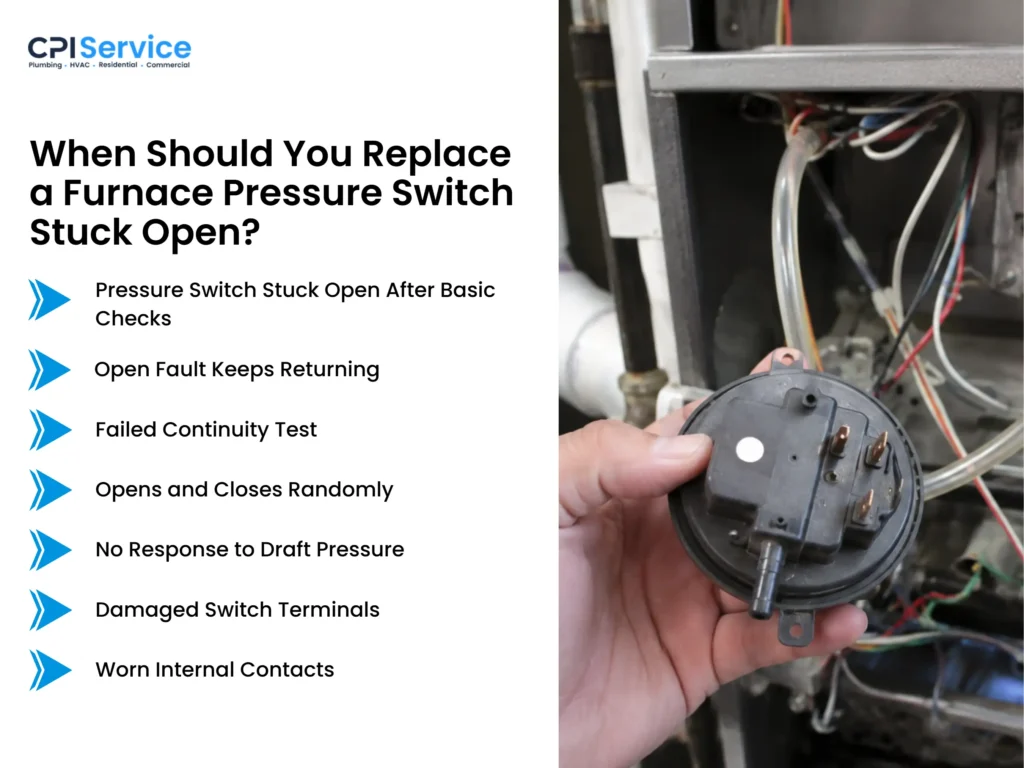
Replace a furnace pressure switch stuck open when you experience these situations:
Pressure Switch Stuck Open After Basic Checks
Open Fault Keeps Returning
Failed Continuity Test
Opens and Closes Randomly
No Response to Draft Pressure
Damaged Switch Terminals
Worn Internal Contacts
- Pressure Switch Stuck Open After Basic Checks
Replace the furnace pressure switch if it remains stuck open after checking the venting system, pressure switch tubing, condensate drainage, and inducer motor operation, as this indicates an internal switch failure rather than an airflow problem. Confirm the furnace is producing proper draft pressure before replacement, and ensure the new furnace pressure switch matches the original OEM pressure rating and specifications.
- Open Fault Keeps Returning
A furnace pressure switch should be replaced if the pressure switch open fault repeatedly after resets, as recurring faults often indicate a weakening diaphragm or unstable switch operation. Frequent fault cycling reduces heating reliability and may eventually prevent the furnace from starting altogether. Check the vent termination for intermittent blockages caused by debris, wind, or ice before replacing the switch. Persistent electrical faults should be diagnosed by a certified furnace technician to prevent damage to the control board.
- Failed Continuity Test
The furnace pressure switch should be replaced if it fails a continuity test while the inducer motor is running, as this confirms the switch can no longer complete the electrical circuit. In many cases, the switch receives proper draft pressure but fails to return the required signal to the control board. Make sure the multimeter probes are firmly connected, and the venting system is clear before replacing the component. Testing live furnace circuits requires caution to avoid electrical shock.
- Opens and Closes Randomly
If a furnace pressure switch opens and closes randomly during operation, it indicates weakened internal contacts or a diaphragm failure, both of which require immediate replacement. Random circuit loss commonly causes short cycling and unstable heating performance. Loose wire connectors or unstable pressure conditions should be ruled out before installing a replacement furnace pressure switch. Using a non-OEM switch may create improper pressure calibration and recurring furnace faults.
- No Response to Draft Pressure
The furnace pressure switch should be replaced if it fails to respond to normal draft pressure, as this often indicates a damaged diaphragm or ruptured internal seal. Homeowners may notice the switch failing to click or close even while the inducer motor appears to operate normally. Inspect the vacuum port and tubing for moisture, debris, or airflow restrictions before replacing the switch. High-precision pressure testing is best handled by a qualified furnace technician.
- Damaged Switch Terminals
Visible corrosion, burn marks, or loose metal tabs on the furnace pressure switch body require immediate replacement to prevent ignition failures and overheating. Poor terminal contact can interrupt the ignition sequence and create electrical resistance inside the furnace cabinet. The wiring harness should also be checked for loose connections or heat damage before installing a new switch. Melted electrical components often indicate a broader furnace safety issue that requires professional inspection.
- Worn Internal Contacts
In the case of worn internal contacts, replacement is often recommended to prevent the furnace pressure switch from sending an unstable electrical signal during startup. As the contact surfaces deteriorate, homeowners may experience intermittent no-heat calls, failed ignition attempts, or inconsistent furnace operation. Proper venting and inducer motor performance should be verified before replacement to rule out airflow-related faults. Since internal switch contacts cannot be repaired, they must be replaced.
How Much Does Furnace Pressure Switch Replacement Cost?
Furnace pressure switch replacement costs between $150 and $400, including the switch and professional labor. The furnace pressure switch itself costs between $20 and $125, while labor charges range from $100 to $200, depending on furnace accessibility, diagnostic time, and local HVAC service rates. A furnace technician may also charge a $75 to $200 diagnostic or service fee, although some companies apply that fee toward the completed repair.
The final cost depends on the furnace brand and model, OEM versus compatible parts, switch accessibility, local labor rates, and whether the furnace uses multiple pressure switches. Costs can increase if diagnosis reveals the switch is not actually defective and the open-switch fault comes from blocked venting, condensate drainage, damaged pressure tubing, or a failing draft inducer motor. For example, an inducer motor replacement can cost $400 to $1,100, so accurate diagnosis matters before replacing the pressure switch.
What Is the Difference Between a Furnace Pressure Switch Stuck Open and Stuck Closed?
A furnace pressure switch stuck open prevents it from closing during the startup sequence, whereas a furnace pressure switch stuck closed keeps it closed even before the inducer motor starts. In a stuck-open condition, the burners cannot ignite because the system cannot verify safe draft pressure, while a stuck-closed condition causes the control board to detect an unsafe or abnormal pressure signal before startup begins. Although both conditions interrupt normal furnace operation, they occur at different stages of the ignition sequence and point to different airflow or electrical faults.
Below is the table highlighting the difference between a furnace pressure switch stuck open and a furnace pressure switch stuck closed:
| Feature | Furnace Pressure Switch Stuck Open | Furnace Pressure Switch Stuck Closed |
| Switch Condition | Switch fails to close during startup | The switch remains closed when it should open |
| Main Effect | The furnace will not ignite | The furnace may lock out before startup |
| Common Cause | Blocked venting, weak inducer motor, cracked tubing | Welded contacts, electrical short, failed switch diaphragm |
| Draft Pressure Status | Insufficient or unstable draft pressure | False pressure signal detected |
| Common Symptoms | No heat, short cycling, pressure switch open fault | Pressure switch stuck closed error code |
How Can You Prevent a Furnace Pressure Switch From Getting Stuck Open?
Preventing a furnace pressure switch from getting stuck open mainly involves keeping the venting and condensate drain lines clear, inspecting the pressure switch tubing, and scheduling annual furnace maintenance. Following these preventive steps helps maintain stable draft pressure, reduce airflow restrictions, and prevent moisture buildup that can interfere with normal furnace pressure switch operation during the ignition sequence.
4 ways you can prevent a furnace pressure switch from getting stuck open are:
- Keep Furnace Venting Clear
Clear exterior vent pipes of snow, bird nests, and debris to prevent backpressure that keeps the furnace pressure switch open. Homeowners should inspect exterior vent terminations regularly, especially during winter. Internal vent cleaning and combustion airflow testing should be handled by a furnace technician at least once a year.
- Keep Condensate Drain Lines Clear
Flush drain lines and traps with warm water or a specialized cleaner to prevent water backup, which can interfere with the furnace pressure switch’s operation. You should also check for standing water, sludge, or frozen drain lines near the furnace. Persistent condensate drainage problems should be cleaned and tested by a furnace technician during seasonal maintenance.
- Inspect Pressure Switch Tubing
Inspect furnace pressure switch tubing for cracks, loose fittings, moisture, or brittle rubber that may weaken the vacuum signal. Also, ensure the tubing remains securely connected during routine furnace inspections. Pressure testing and tubing replacement should be completed by a furnace technician if airflow problems continue.
- Schedule Annual Furnace Maintenance
Book a professional tune-up to verify the inducer motor’s RPM and electrical health before they cause heating failures. A furnace technician should inspect venting, condensate drainage, electrical connections, and draft pressure during the service visit. Annual maintenance is best completed before the heating season begins.
When Should You Call a Professional for a Furnace Pressure Switch Stuck Open?
Call a professional furnace technician if the pressure switch stays open after basic checks, the fault keeps returning, or the furnace has venting, condensate, inducer, wiring, or ignition problems. Persistent faults can come from blocked venting, damaged pressure tubing, condensate buildup, weak inducer performance, or switch failure, which may require draft-pressure and electrical testing. Lennox troubleshooting guidance specifically recommends checking these areas when a pressure switch fails to close.
Call an HVAC technician if you notice:
- Repeated pressure-switch codes: The furnace continues showing an open-switch or draft fault.
- Inducer runs but no heat: The burners never ignite, even though the inducer is running.
- Repeated startup failures: The furnace retries ignition or enters lockout.
- Condensate or venting problems: Blocked drains, intake pipes, or exhaust vents can prevent the switch from closing.
- Damaged tubing or wiring: Cracked hoses or loose electrical connections can interrupt the proving circuit.
- Weak or noisy inducer operation: Poor inducer performance may prevent adequate draft.
- Gas or burning odors: Stop troubleshooting and call a professional. If you smell gas, leave the home and contact the gas utility.
For persistent winter no-heat problems, contact a professional furnace technician rather than bypassing the pressure switch. This furnace safety control prevents burner operation when it cannot confirm proper combustion draft.

