
 Emergency Plumbing
 Plumbing Repairs
 Water Heaters
 Drain Cleaning
 Sewer Service
 Faucets & Fixtures
 Repiping
 Toilet Plumbing
 Trenchless
 Plumbing Leaks
 Air Conditioning
 Heating
 Minisplit Systems
 Heat Pumps
 HVAC Components
 HVAC Rebates
Installing a tankless water heater requires preparing the installation area, selecting the right unit, and following proper building codes and safety procedures during gas, water, and electrical work. A structured installation supports safe combustion for gas units, proper electrical handling for electric units, and long-term heating efficiency for both types.
Before installing a tankless water heater, decide between gas and electric types based on your household’s hot water demand and available utilities. Gas units require proper venting, sufficient combustion air, and correct fuel line sizing, while electric units require adequate circuit capacity, proper grounding, and wiring that meets voltage and amperage specifications. For both types, the mounting surface must be strong, water lines must be accessible, and all utilities must be turned off before work begins.
Ideal for small homes, apartments, or utility rooms, these compact units heat water as it flows, without the need for storage tanks. They are also 34% more energy efficient than tank models according to the Department of Energy, making them a strong choice for homeowners seeking reliable performance and long-term savings. However, achieving these benefits depends on safe, correct installation, and this guide explains the steps, requirements, and common mistakes to avoid in detail.

Things to Consider Before Gas Tankless Water Heater Installation
Before starting the installation process for a tankless gas water heater, it is important to understand the factors that influence how safely and efficiently it will operate. The next sections highlight the tools, safety considerations, and compliance requirements for a secure mounting process and reliable performance.
Tools and Materials Needed
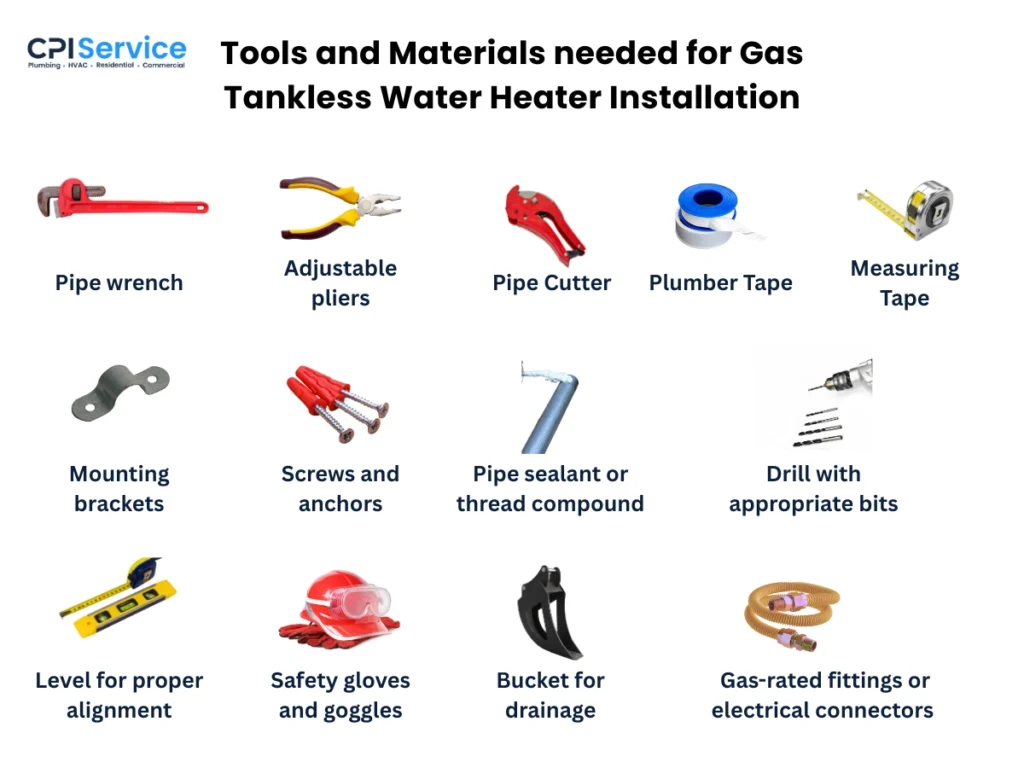
A basic toolkit for safely installing tankless gas water heaters includes pipe wrenches, adjustable pliers, plumber’s tape, mounting brackets, sealants, and cutting tools. Having these items prepared in advance ensures safe and efficient work during mounting, water line connection, and gas or electrical preparation. Here is a detailed list of essential plumbing tools needed for proper installation:
- Pipe wrench
- Adjustable pliers
- Plastic or metal pipe cutter
- Plumber’s tape
- Measuring tape
- Mounting brackets
- Screws and anchors
- Pipe sealant or thread compound
- Drill with appropriate bits
- Level for proper alignment
- Safety gloves and goggles
- Bucket for drainage
- Gas-rated fittings or electrical connectors (based on fuel type)
Safety and Preparation
Safe installation of a tankless gas water heater depends on proper control of gas supply, electrical preparation, and adherence to local building codes. Fulfilling these requirements reduces hazards during installation and supports reliable long-term performance once the system is activated. Follow these preparation steps for safe gas tankless water heater installation:
- Turn off the gas supply and power at the dedicated shutoff points.
- Inspect gas lines for corrosion, improper fittings, leaks, or damage before work begins.
- Confirm that all electrical wiring follows NEC requirements and manufacturer guidelines.
- Provide proper ventilation for exhaust movement and safe combustion.
- Seal water line fittings with plumber’s tape or pipe sealant.
- Wear safety gloves and goggles throughout each step of the installation.
Permits and Code Requirements
A gas tankless water heater must meet local building codes that regulate gas lines, ventilation, and electrical preparation. It is essential to obtain a permit because it confirms that the installation process follows safety guidelines properly and allows inspectors to verify that the system is safe to operate. These steps make sure the water heater operates reliably once it starts being used regularly:
- Check the county’s Building & Safety department rules to confirm permit requirements.
- Apply for the necessary gas and mechanical permits before installation.
- Follow local code guidelines for site plan, gas line size, vent routing, and electrical preparation.
- Schedule required inspections after installation.
- Keep documentation for insurance or future property transactions.
Step-by-Step Tankless Water Heater Installation Process
To install a tankless water heater, remove the old unit, mount the new heater, and connect the gas, water, electrical, and venting components in the correct order. Using a structured sequence ensures safe fuel line handling, accurate placement of mounting hardware, and proper testing of every connection before the heater is activated.
Step 1: Remove Your Old Water Heater
When removing your old water heater, start by shutting off every utility connected to it and clearing the space for the new tankless unit. Work methodically to disconnect power, gas, and water lines, drain the system, and remove the tank safely.
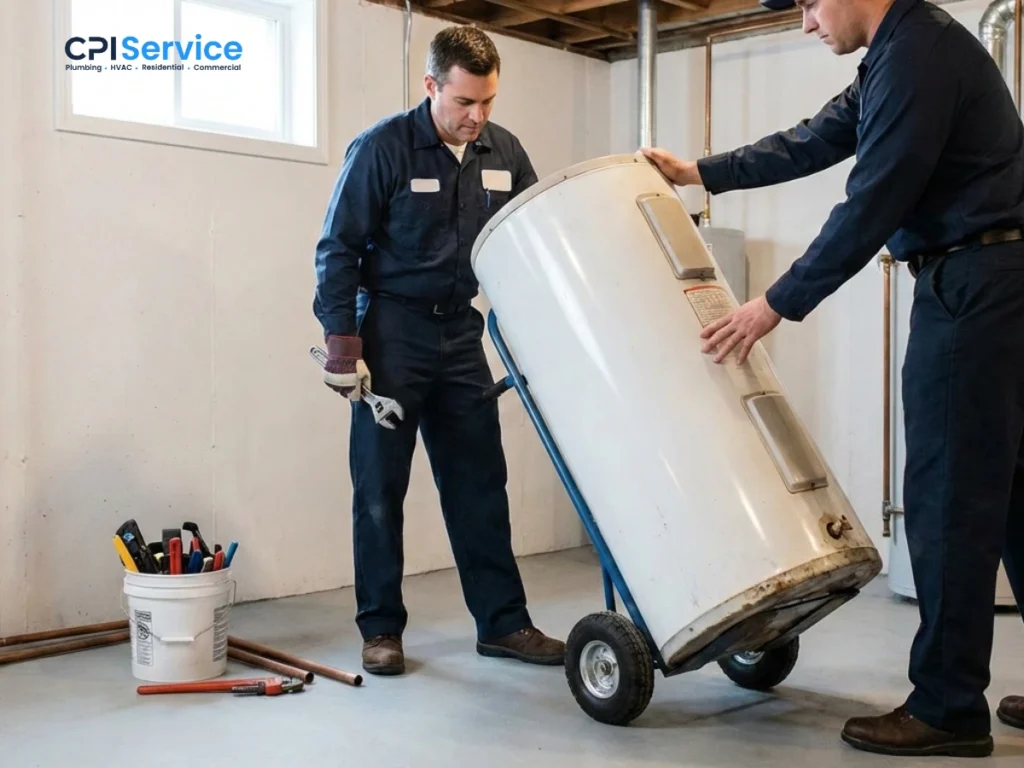
- Turn off the power or gas to the old heater: Switch off the dedicated circuit breaker for electric heaters. For gas units, close the gas shutoff valve located near the heater or along the gas line to stop fuel flow completely.
- Drain any remaining water from the tank: Connect a hose to the drain valve at the bottom of the tank and direct the water into a bucket or floor drain. Use gloves for protection and open the valve slowly to release pressure before fully draining the tank.
- Disconnect the water supply lines: Loosen the cold and hot water supply connections with a wrench and allow the remaining water in the lines to drain into a bucket. Once water stops flowing, detach the lines fully.
- Disconnect any electrical or gas connections if applicable: Confirm power is off before touching any wiring. For gas heaters, close the gas shutoff valve and detach the gas line while keeping the area ventilated.
- Safely remove the old heater from its location: Use a dolly or ask another person for assistance, since old water heaters can be heavy. Maintain proper posture by lifting from the legs to avoid injury while transporting the unit away.
Step 2: Mount the New Unit
Right before mounting the new tankless water heater, mark the exact placement on the wall, locate secure framing, and prepare the brackets before lifting the unit into position. Accurate measurements and proper support ensure the heater is stable and correctly aligned for gas, water, and vent connections.

- Mark the position on the wall for the unit: Measure and mark the mounting area at the correct height and spacing needed for water, gas, and vent connections. Use a pencil to create reference points and ensure the marks are level.
- Use a stud finder to locate the studs for secure mounting: Move a stud finder slowly along the wall to detect framing members that can support the heater’s weight. Studs are often spaced 16 to 24 inches apart, but spacing may vary in some homes.
- Attach the mounting brackets to the wall: Align the brackets with your marked stud locations and secure them using screws or bolts suited for the wall type (drywall, concrete, or masonry). Make sure the brackets sit level and remain firmly attached.
- Hang the tankless water heater on the brackets: Lift the heater with assistance from another person or lifting equipment and place it onto the mounted brackets. Ensure the unit aligns with the mounting holes so it sits correctly and remains stable.
- Double-check alignment and stability before proceeding: Use a level to verify the horizontal and vertical alignment of the mounted heater. Apply gentle pressure to confirm the unit is firmly seated on the brackets and does not shift around.
Step 3: Connect the Gas and Electrical Lines
Attach the fuel supply or electrical wiring according to the tankless water heater’s specifications and confirm that every connection is securely sized, sealed, and properly installed. Careful setup of these components ensures safe heating operation once the system is running.
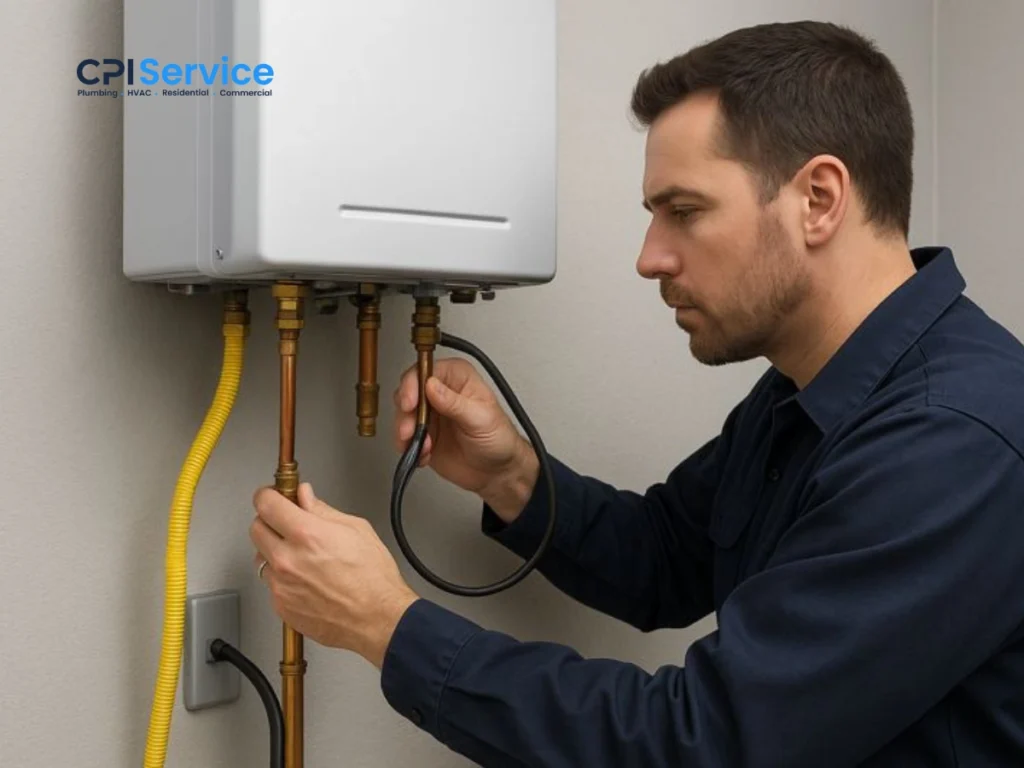
- Attach the gas supply line to the heater’s inlet: Use compression fittings or threaded connectors to secure the gas line to the inlet. Wrap male threads with Teflon tape or apply thread sealant, and confirm that the gas line size and connector type match the heater requirements.
- Wire the unit to the electrical supply according to the manufacturer’s instructions:
Match the wire gauge to the heater’s voltage and amperage requirements. Insert each conductor into the correct terminal, tighten screws firmly, and install a dedicated circuit breaker if the heater requires its own electrical line. - Ensure the electrical connection is properly grounded: Connect the ground wire to the heater’s grounding terminal. If additional grounding is needed, attach the wire to a dedicated grounding rod or connect it directly to the home’s electrical panel.
- Test for gas leaks with soapy water or a gas leak detector: Apply soapy water to every gas fitting and look for bubbles that indicate escaping gas. As an alternative, use a handheld gas leak detector to scan around the fittings and joints for signs of leakage.
- Double-check electrical connections for security and code compliance: Check each wire to ensure it is fully seated with no exposed copper. Verify that the wiring layout follows the manufacturer’s instructions for wire size, breaker rating, and grounding.
Step 4: Connect the water lines
Start connecting the water lines by attaching the cold water inlet and hot water outlet to form the main water pathways for the tankless water heater. Each connection must be properly sealed and tightened to maintain a steady flow and prevent leaks during daily use.
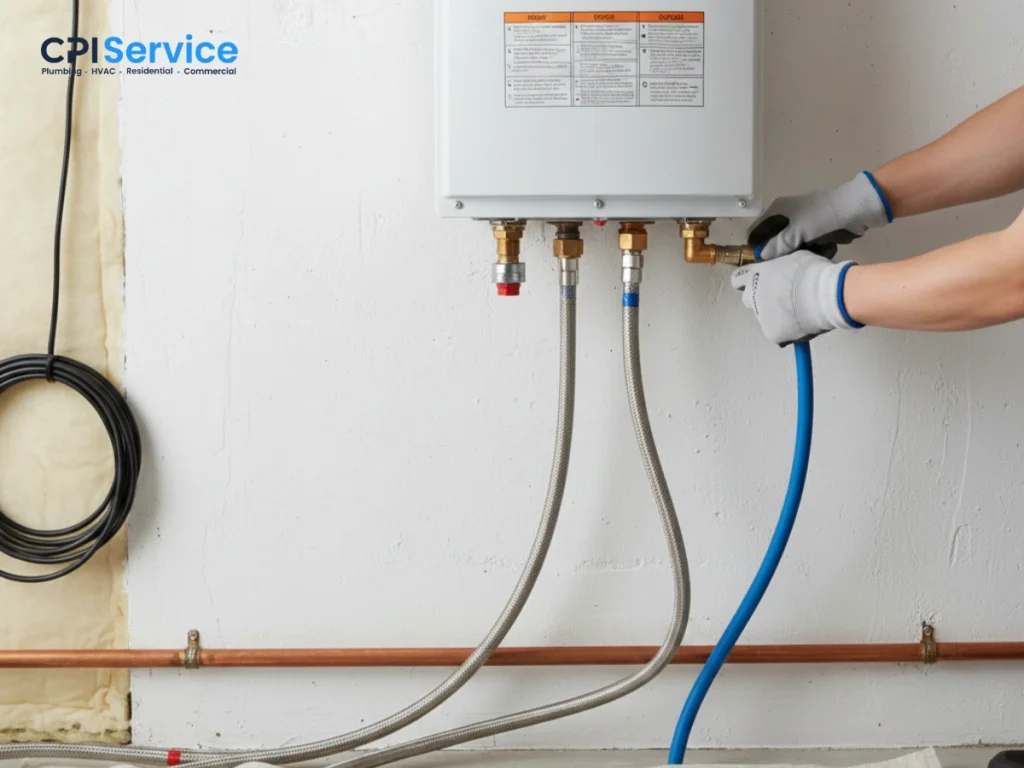
- Attach the cold water inlet pipe to the cold water supply: Use the correct pipe size and type of fitting that matches the cold water supply line. Tighten the connection firmly to prevent leaks, and attach any additional fittings securely.
- Attach the hot water outlet pipe to the water distribution system: Match the pipe and fitting sizes to the home’s hot water distribution lines for proper water flow. Secure the connection tightly using sealants so the outlet remains leak-free during operation.
- Tighten the connections securely to avoid leaks: Use a pipe wrench or adjustable wrench to tighten all connections with even pressure. Avoid overtightening, since it can damage fittings or threads and create sealing issues.
- Use Teflon tape or pipe dope on threaded fittings to ensure a tight seal: Wrap Teflon tape clockwise around male threads or apply a thin, even layer of pipe dope to create a seal. Use only the amount needed to cover the threads without excessive buildup.
- Turn on the water supply and check for leaks at all connections: Open the water valve slowly to allow the lines to pressurize and fill the heater. Inspect every connection with a flashlight or mirror and tighten or seal any fittings where moisture is visible
Step 5: Install the venting
For venting installation, attach the vent pipe to the tankless water heater and create a clear exhaust path to the outside. Proper venting is crucial to safely remove combustion gases and support consistent system performance.

- Attach the vent pipe to the unit’s venting port: Fit the vent pipe to the heater’s venting port using fittings recommended by the manufacturer. Align the pipe carefully with the port so the connection sits straight and forms a tight seal.
- Ensure the vent pipe is properly sloped (if needed) for adequate exhaust flow: Create a slope of about one-quarter inch per foot toward the exterior of the home unless local codes specify otherwise. This slope leads to smooth exhaust flow and prevents condensation from pooling inside the vent.
- Seal all venting connections tightly to prevent leaks: Apply high-temperature sealant or vent-rated tape to each joint to prevent exhaust leaks. Use only materials approved for specific temperatures and combustion gases produced by gas tankless water heaters.
- Ensure that the venting system runs outside the home, with no obstructions: Follow the vent route from the heater to the exterior wall or roof to ensure nothing blocks airflow. Remove debris or vegetation that may restrict discharge at the termination point.
- Double-check that the vent pipe size complies with local code regulations: Compare the vent pipe diameter with the requirements in the installation manual and local building codes, and match the size accurately to prevent backdrafting and maintain safe combustion.
Step 6: Install the safety valve
Attach the pressure relief valve to the designated port and tighten it securely, making sure it is positioned in the correct direction for water flow. After installation, manually activate the valve to confirm it works, then run the system to check for leaks or pressure irregularities.

- Attach the pressure relief valve to the unit’s designated valve port: Locate the pressure relief valve port on the heater and install a pressure relief valve after confirming that it is the correct type and size for the model. Tighten the fitting securely to prevent leaks.
- Ensure the valve is connected securely and is facing the correct direction for water flow: Make sure the valve is firmly attached with no gaps or signs of leakage. Align the flow direction arrow or indicator on the valve with the direction of water movement.
- Test the valve by manually activating it to ensure it functions correctly: Lift or pull the valve lever to simulate a pressure release and confirm it opens and resets smoothly. Proper movement indicates the mechanism is functioning correctly.
- Run the plumbing system to check for any signs of pressure issues: Slowly turn on the water supply and notice any pressure fluctuations, leaks, or disruptions in water flow. Use a pressure gauge to verify that pressure remains within the recommended range.
Step 7: Start up the system
Test whether the tankless water heater is ready for daily use by filling it with water, restoring power or gas, activating the burner or heating circuit, and verifying that all connections function properly under normal operating conditions. This confirms that the system delivers steady hot water, maintains safe pressure, and operates safely.
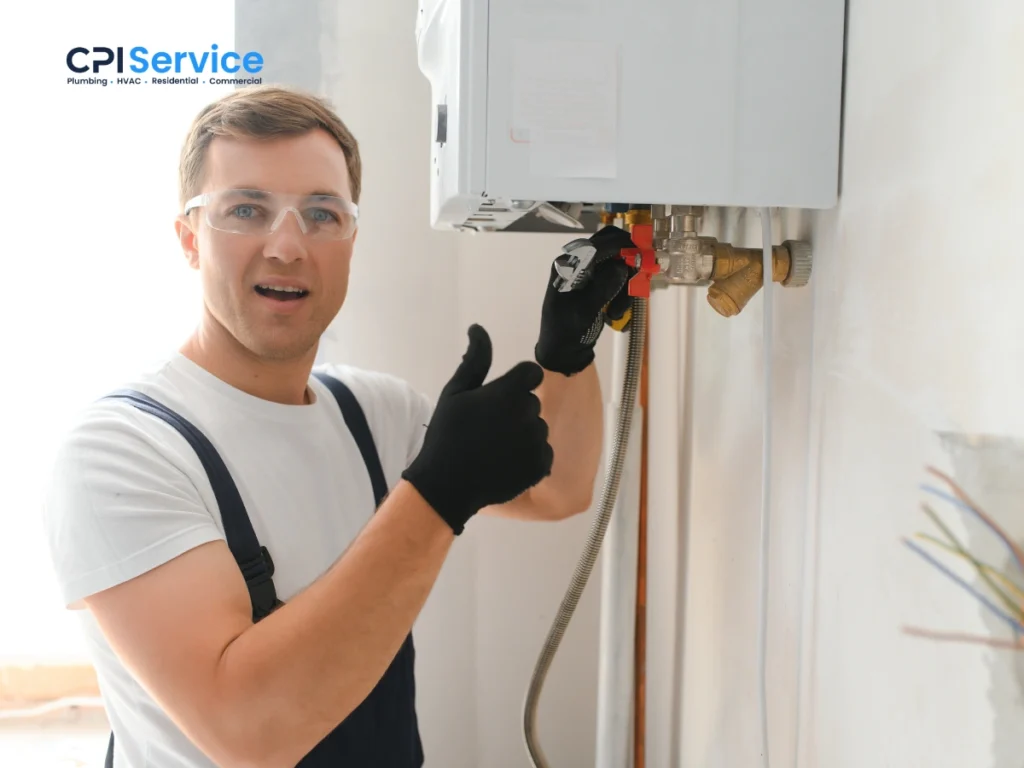
- Turn on the water supply and power to the unit (gas or electricity): Open the water valve slowly to fill the unit gradually. For gas heaters, open the gas shutoff valve and let the burner ignite. For electric heaters, simply turn on the power at the electrical panel.
- Check all connections for any leaks: Look for signs of leakage at inlet pipes, gas supply line, and vent connections with a flashlight. Apply soapy water to gas fittings to detect bubbles that signal a leak.
- Test the unit by running hot water to ensure it’s heating properly: Open a hot water tap and let the heater activate. Monitor the water temperature to confirm it reaches the selected setting within a reasonable time, then ensure steady water flow.
- Adjust the temperature settings if necessary: Set the desired temperature using the digital interface or control knobs. Most tankless heaters allow adjustment within 100 and 140 degrees Fahrenheit, which is a comfortable and safe temperature range.
- Test the system multiple times to ensure it operates without issues: Run hot water at various flow rates and durations to confirm stable water heating. Listen for unusual sounds and watch for temperature fluctuations that may signal an issue.
Gas vs. Electric Tankless Water Heaters: Which One is Right for You?
A gas tankless water heater suits homes with existing gas lines and higher hot water demand, while an electric tankless heater is better for tight spaces, single bathroom homes, or locations where gas lines or venting are unavailable. Homeowners should decide which tankless heater to install based on their budget, existing utilities, long-term operating costs, and hot water demand.
| Criteria | Gas Tankless Water Heater | Electric Tankless Water Heater |
| Energy Source | Uses natural gas or propane | Uses electrical power to heat water |
| Installation Complexity | More complex, as it requires venting and gas line sizing | Simpler, as it needs an adequate electrical capacity, but not venting |
| Upfront Cost | Higher due to venting, gas line work, and professional labor | Lower installation cost and fewer components required |
| Operating Cost | Lower fuel cost, especially with Energy Star models that save about $1,800 in lifetime. | Heavily depends on the electricity rates in the area |
| Heating Performance | Faster heating and higher water flow, suitable for large households | Moderate water flow rates, best for small to mid-size homes |
| Infrastructure Needed | Steady gas supply, venting system, and combustion air | Adequate electrical panel capacity, often a dedicated circuit |
| Maintenance | Requires vent inspection, gas line checks, and burner cleaning | Fewer mechanical components mean simpler maintenance |
| Best Use Case | Large households and high-demand environments | Small homes with low to moderate usage |
How to Install an Electric Tankless Water Heater?
To install an electric tankless water heater, clear the installation area, disconnect and remove the old unit, mount the new heater, connect water lines, install the electrical wiring, check for leaks, and restore power to test the system. Once these steps are completed, the heater should supply consistent hot water and operate safely.
Follow these 8 steps for electric tankless water heater installation:
Step 1 – Prepare the installation area: Clear enough space where the new heater will be mounted for wiring and water line connections. Ensure the wall surface is strong enough to support the weight of the unit and that pipes are accessible.
Step 2 – Turn off power and drain water: Switch off the 220-240 volt circuit that powers the old electric heater and verify it is fully off. Then drain the water from the system by connecting a garden hose to the drain valve or using a portable pump.
Step 3 – Remove the old unit: Disconnect both the water lines and electrical wiring safely, and lift the old heater out of the area and move it aside. Use someone’s assistance if the unit is too heavy.
Step 4 – Mount the new unit: Mark the mounting points on the wall accurately, secure the brackets, and place the heater onto the brackets carefully so it sits level and stable.
Step 5 – Connect the water lines: Attach the cold water inlet and hot water outlet using the correct fittings and Teflon tape or a high-quality pipe sealant. Tighten all connections carefully to prevent leaks.
Step 6 – Install the electric wiring: Match the wire gauge to the heater’s voltage and amperage requirements and ensure all wiring follows National Electrical Code (NEC) guidelines for 240-volt circuits. Connect each wire to the correct terminal and secure the ground wire to the grounding post safely.
Step 7 – Turn on the water supply and check for leaks: Open the water valve slowly and allow the heater to fill gradually. Inspect all connections closely and tighten the fittings where moisture appears.
Step 8 – Restore power and test the heater: Turn on the circuit breaker to activate the water heater. Then run hot water to confirm the unit heats consistently and maintains the selected temperature.
How to Install a Gas Tankless Water Heater?
To install a gas tankless water heater, prepare the installation area, shut off gas and power, remove the old unit, mount the new heater, connect the gas and water lines, install the pressure relief valve, set up the venting, check for leaks, and restore gas and power to test the system. Since gas systems require National Fuel Gas Code-compliant venting and fuel delivery, a licensed inspector is recommended, as they may determine that the gas line must be upgraded to meet the heater’s BTU demand.
Here are 10 key steps for installing a gas tankless water heater:
Step 1 – Prepare the installation area: Ensure there is enough room in the installation area for the venting path, gas line routing, and water line connections. Confirm that the mounting surface is strong enough to support the new unit’s weight.
Step 2 – Turn off gas and power: Close the main gas shutoff valve near the old heater and confirm the supply is turned off completely. Additionally, switch off the electrical circuit that powers any connected components or ignition systems.
Step 3 – Remove the old water heater: Disconnect the water lines, gas line, and electrical connections carefully, and move the old unit away from the working area.
Step 4 – Mount the new unit: Mark the mounting points on the wall accurately, secure the brackets strongly, and place the heater onto the brackets in a level and stable way.
Step 5 – Connect the gas supply line: Attach the gas line to the heater’s inlet using approved fittings and Teflon tape or sealant. When tightening the connection securely to prevent leaks, ensure exact compatibility with the required gas line size.
Step 6 – Connect the water lines: Attach the cold water inlet and hot water outlet using proper fittings and sealing tapes. Tighten each connection evenly to prevent leaks when operations begin.
Step 7 – Install the pressure relief valve: Attach a pressure relief valve that is rated for about 150 psi to the designated port. Ensure the valve is oriented correctly for water flow and tightened securely to prevent water leaks.
Step 8 – Install the venting system: Connect the vent pipe to the venting port with proper alignment. Maintain the required slope, seal every joint tightly, and route the pipe outdoors with no obstructions.
Step 9 – Turn on the water supply and check for leaks: Open the water valve slowly and let the heating system fill. Inspect all water and gas line connections and tighten the fittings if moisture or a gas odor is detected around them.
Step 10 – Restore gas and power, then test the heater: Turn on the gas supply and restore electricity. Run hot water to confirm the burner has ignited properly and the system heats consistently at the user-selected temperature.
Common Mistakes to Avoid During Tankless Water Heater Installation
Common mistakes during tankless water heater installation include undersized gas lines, poor ventilation, or incorrect electrical wiring. These mistakes must be avoided because they can prevent the unit from operating safely or as intended. When these errors begin to disrupt combustion or exhaust flow, the risk of carbon monoxide entering indoor spaces increases, which can lead to severe illness or fatalities.
- Incorrect gas line sizing: Tankless gas heaters need a higher BTU supply. When supply lines are undersized, they restrict fuel flow and reduce heating performance, so it is important to always size the line to the unit’s BTU rating.
- Improper ventilation design: Incorrect vent size, material, or slope disrupts exhaust flow and may allow carbon monoxide to enter the home. Follow all code requirements for vent diameter, slope, and termination.
- Skipping the system flush: Not flushing the old system before connecting a new heater results in leftover minerals, sediment, and rust from older piping entering the new unit. This increases the noise, strains the mechanism, and can lead to early damage.
- Ignoring water pressure requirements: Tankless systems need water pressure within a specific range (typically 30 to 80 PSI) to activate properly. Incorrect water pressure causes weak heating or system errors.
- Inadequate electrical supply: Electric water heaters require a dedicated circuit with the correct wire gauge. Undersized wiring or breakers can overheat or shut down the system.
- Poor location choice: Tight or obstructed spaces limit airflow and make servicing difficult. Install the unit where ventilation and access are sufficiently available.
- Not following manufacturer instructions: Each model has unique requirements for clearances, venting, wiring, and pipe sizing. Ignoring steps leads to malfunctions and code issues.
How Much Does Tankless Water Heater Installation Cost?
Tankless water heater installation generally costs between $1,500 and $6,000 in total, with gas heaters costing more than electric systems. The total cost to install an electric tankless water heater typically ranges from $1,500 to $3,000, while installation of a gas unit costs $2,500 to $6,000. These costs may vary depending on the unit capacity, installation requirements, and any necessary electrical or gas line upgrades.
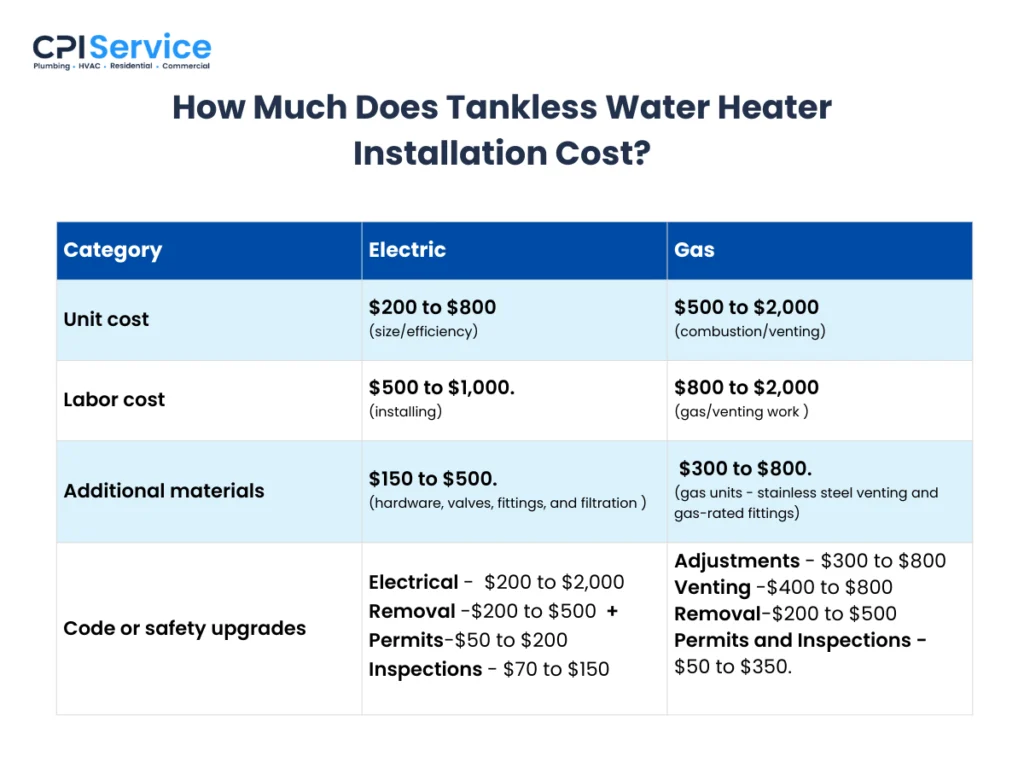
Unit cost
- Electric: Most electric tankless water heaters range from $200 to $800, depending on size and efficiency.
- Gas: Gas tankless units typically cost $500 to $2,000 due to combustion components and venting compatibility.
Labor cost
- Electric: Labor cost for installing an electric tankless heater usually ranges from $500 to $1,000.
- Gas: Labor for gas tankless installation ranges from $800 to $2,000 when gas line work or venting is required.
Additional materials
- Electric: Materials such as mounting hardware, valves, fittings, and filtration components add around $150 to $500.
- Gas: Materials for gas units, including stainless steel venting and gas-rated fittings, also add $300 to $800.
Code or safety upgrades
- Electric: Electrical upgrades range from $200 to $2,000, with removal costs of $200 to $500, plus $50 to $200 for permits and $70 to $150 for inspections.
- Gas: Gas line adjustments cost $300 to $800, venting adds $400 to $800, removal costs $200 to $500, and permits and inspections range from $50 to $350.
Maintenance Tips For Your Tankless Water Heater
Routine maintenance keeps a tankless water heater operating efficiently and extends its service life. The tasks below help prevent scale buildup, improve water flow, and maintain safe system performance.
- Annual descale and flush: Minerals from hard water accumulate inside the heat exchanger over time. Flushing the system with a descaling solution every year removes this buildup, restores efficient heating, and prevents corrosion.
- Filter cleaning and replacement: Many units include inlet filters that trap sediment before it enters the heater. Cleaning these filters or replacing them ensures steady water flow and protects internal components from debris.
- Inspect venting systems (gas models): Tankless gas heaters rely on clear, unobstructed venting to remove exhaust gases safely. Check for blockages, loose fittings, or moisture buildup, and confirm that the vent cap outside is fully secure.
- Temperature optimization: Set the heater to around 120°F to maintain energy efficiency while providing stable hot water. Higher temperatures increase energy use and may create scalding risks, while lower settings can lead to an uncomfortably cold water supply.
- Professional maintenance schedule: Hire a licensed technician to inspect the unit every one to two years. Professional service includes checking gas or electrical connections, testing sensors, verifying venting, and confirming proper pressure.
When Should You Choose DIY Over Professional Plumbing Services for Tankless Water Heater Installation?
Choose DIY installation only if you have plumbing and electrical knowledge and are installing a simple electric tankless heater with existing wiring and plumbing, and choose professional plumbers for all gas heaters or any electric heater that requires new circuits, rewiring, panel upgrades, or code-driven modifications. If any part of the installation involves gas lines, electrical upgrades, venting through walls or roofs, or compliance uncertainty, contacting a professional plumbing service provider is the safer option.
| Factor | Electric Tankless Water Heater | Gas Tankless Water Heater |
| Heater type | DIY is possible for simple electric units with compatible wiring and plumbing. | Always requires a professional due to gas line sizing, combustion safety, and venting requirements. |
| Existing wiring and breaker capacity | DIY only if the 240-volt circuit, breaker size, and wiring already meet the heater specifications. | Professionals are required because gas units also need correct electrical connections for ignition and safety systems. |
| Gas line requirements | Not applicable to electric heaters. | A professional is strictly required for all gas line adjustments, BTU sizing, and pressure testing under National Fuel Gas Code standards. |
| Venting requirements | Electric units do not require venting, making DIY possible when plumbing and wiring align. | Professionals are needed because gas venting must meet specific code rules for materials, routing, and clearances. |
| Plumbing system compatibility | DIY is possible if existing water lines match the new heater without resizing. | A licensed professional is required if plumbing needs reconfiguration or when connecting to gas combustion systems. |
| Homeowner skill level | DIY is suitable for individuals who can follow the manual accurately and understand basic plumbing and electrical work. | Professionals are recommended for all gas installations due to safety and code compliance requirements. |
Frequently Asked Questions About Tankless Water Heater Installation
Can a Tankless Water Heater Be Installed Outside?
Yes, tankless water heaters specifically rated for outdoor use can be installed outside. Outdoor units are built with weather protection, but they still need proper clearance, secure mounting, and freeze protection in cold climates. In areas with severe winters, additional insulation or a freeze-protection kit may be required.
Who Installs Tankless Water Heaters?
Licensed plumbers and HVAC technicians generally install tankless water heaters. Gas units also require professionals who are trained to size gas lines, install venting, and complete combustion safety tests. Electric models may need a licensed electrician if new circuits or panel upgrades are necessary. Hiring trained and qualified installers ensures code compliance and protects the warranty.
Does a Tankless Water Heater Require an Expansion Tank?
Most tankless water heaters do not require an expansion tank because they do not store heated water. However, an expansion tank may still be necessary in homes with closed plumbing systems or high water pressure. If pressure exceeds the maximum limit of 150 PSI, an expansion tank helps protect pipes and components. A plumber can evaluate whether your system needs one.
What Is the Tankless Water Heater Venting Distance?
Tankless water heaters classified as direct vent models typically require at least 12 inches of separation between the intake and exhaust pipes to prevent recirculation. Most codes also require 3 to 5 feet of clearance from windows, doors, and other openings to prevent exhaust gases like carbon monoxide from entering the home. Always follow your tankless water heater’s model-specific installation manual and local regulations to confirm the required distances, pipe materials, and termination clearances.
How to Insulate an Outdoor Tankless Water Heater?
To insulate an outdoor tankless heater from freezing temperatures, wrap exposed pipes and valves with heat tapes and wrap the unit itself using insulation blankets. Check insulation regularly to find and seal gaps, and verify that the heater’s built-in freeze protection features are active.
