

 Emergency Plumbing
 Plumbing Repairs
 Water Heaters
 Drain Cleaning
 Sewer Service
 Faucets & Fixtures
 Repiping
 Toilet Plumbing
 Trenchless
 Plumbing Leaks
 Air Conditioning
 Heating
 Minisplit Systems
 Heat Pumps
 HVAC Components
 HVAC Rebates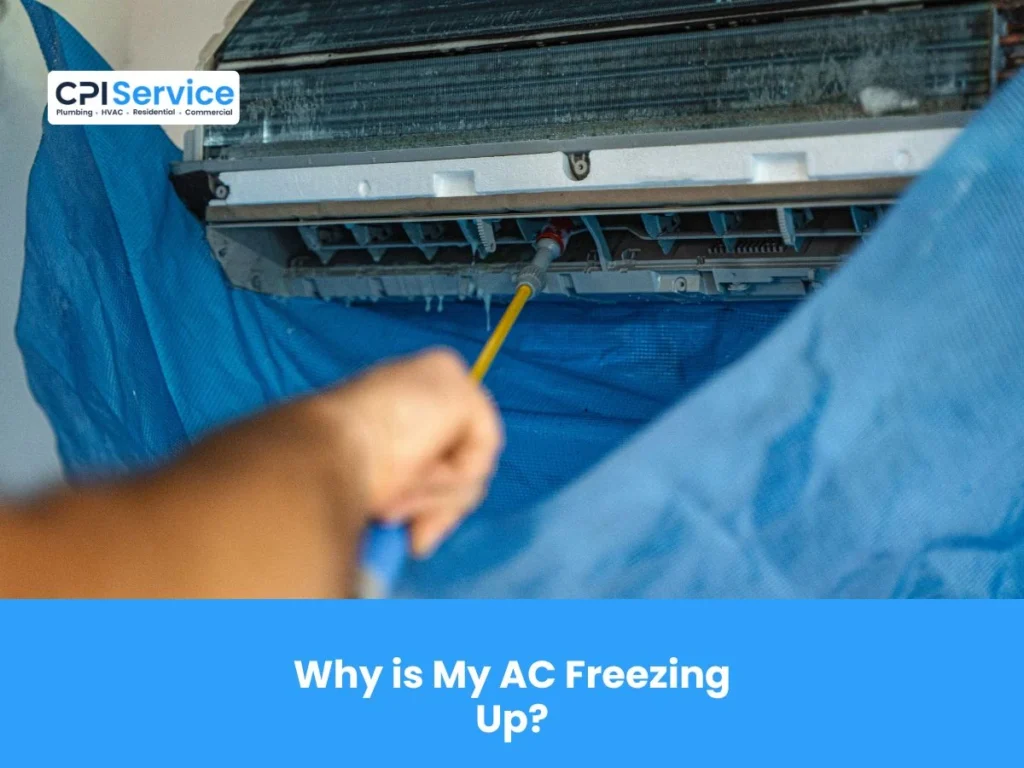
Your AC freezes up when restricted airflow, low refrigerant levels, dirty coils, or blower fan issues cause the evaporator coil temperature to fall below freezing. This thermal imbalance is triggered by restricted airflow from clogged filters, blocked vents, or a failing blower fan. A refrigerant leak may lower internal pressure, causing the coils and refrigerant lines to freeze. As ice accumulates, it acts as an insulator, halting the cooling process and placing mechanical strain on the compressor.
To resolve this, shut down the system immediately to prevent damage to the compressor or motor. Identifying the root cause early, whether it is a simple maintenance issue such as a dirty evaporator coil or a pressure imbalance from a refrigerant leak, helps restore stable performance. Following a proper thawing process and replacing filters every 30–90 days helps protect the system and maintain efficient long-term operation.
What are the Common Causes of AC Freezing Up?
Air conditioners freeze up primarily because of restricted airflow or insufficient refrigerant levels, both of which cause the evaporator coil to drop below freezing. When a dirty air filter, blocked vents, or a failing blower fan prevent warm air from circulating over the coils, the system cannot absorb heat, leading to rapid ice buildup. Similarly, low refrigerant levels or a dirty evaporator coil can disrupt heat transfer, while a clogged drain line can allow trapped moisture to freeze directly on the unit’s components.
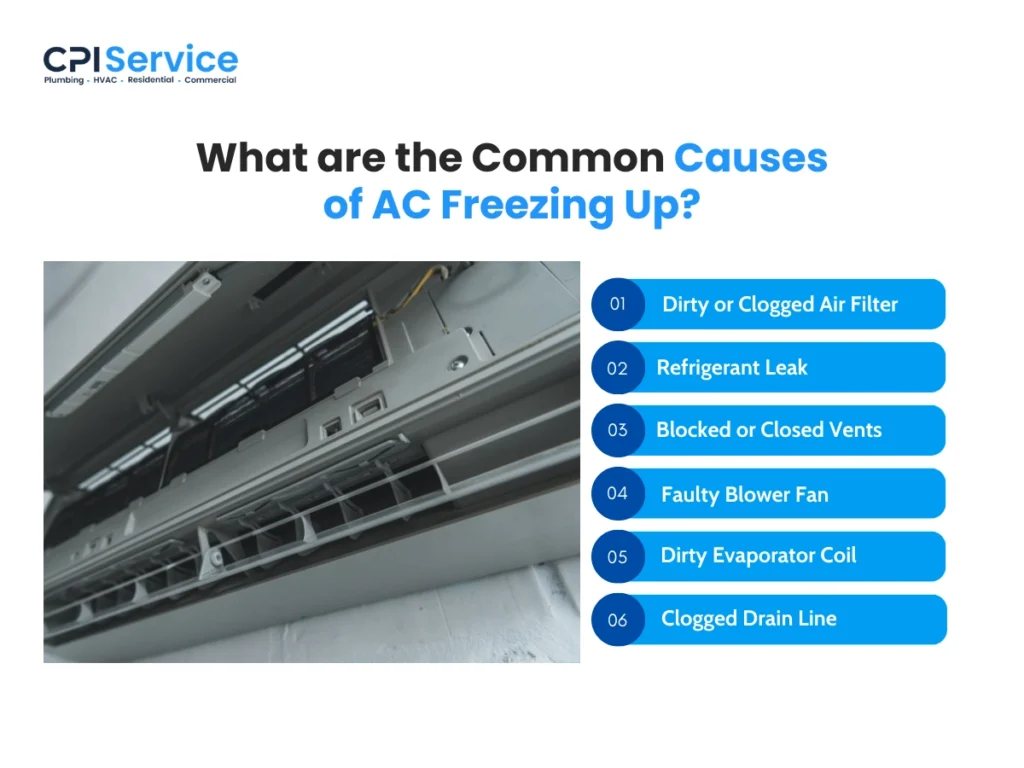
Dirty or Clogged Air Filter
A dirty air filter is the primary reason the AC freezes up, as it directly disrupts the critical heat exchange process required for cooling. When dust and debris accumulate, they create a physical barrier that acts as a primary cause of HVAC airflow issues by preventing indoor air from reaching the evaporator coil. Without sufficient heat to absorb, the refrigerant temperature drops below freezing, causing condensation to freeze. This restriction places significant mechanical strain on the compressor and can lead to total system failure.
Solution: Homeowners should replace standard 1-inch filters every 1 to 3 months, while high-efficiency 4 to 5-inch filters typically last 6 to 12 months. To maintain optimal airflow and prevent the system from freezing, inspect your filter monthly and replace it immediately if it appears visibly clogged. Consistent maintenance ensures proper heat exchange while protecting indoor air quality and the overall efficiency of your HVAC system.
Refrigerant Leak
When pressurized cooling fluid escapes through a line breach, the resulting drop in internal pressure causes temperatures to plummet. This imbalance prevents the coil from absorbing heat effectively, leading to rapid moisture crystallization and continuous system operation. Because AC units do not “consume” refrigerant, a deficiency always indicates a mechanical failure.
Solution: Recharging refrigerant without fixing the leak only restores pressure temporarily and allows the AC to freeze again. Proper repair requires identifying the source of refrigerant loss, sealing or replacing the affected part, and restoring correct system pressure. A licensed AC technician can locate the specific breach, repair the copper lines, and recharge the system.
Blocked or Closed Vents
Obstructions in your home’s air registers disrupt the vital pressure balance required for the evaporator coil to function. When supply or return registers are obstructed by furniture or curtains, the lack of airflow causes the coil temperature to drop below 0 degrees Celsius, triggering a self-reinforcing freezing cycle.
Solution: Verify that at least 80% of your home’s registers are fully open and free of obstructions. Maintaining these air paths ensures the system has enough “breathable” air to facilitate proper heat transfer.
Faulty Blower Fan
A malfunctioning blower motor fails to circulate the necessary volume of air required to keep the cooling fins warm. If the fan spins too slowly or not at all, the refrigerant remains trapped in the coils without a heat source, causing the unit to turn into a solid block of ice and putting the compressor under dangerous stress.
Solution: Consult a professional to repair electrical connections or determine your blower motor replacement cost if the unit has failed. Ensuring the fan operates at peak capacity is essential for moving heat away from the cold coils.
Dirty Evaporator Coil
Accumulated grime on the coil surface creates a thermal barrier that prevents the refrigerant from “seeing” the heat in your air. Because this layer of debris blocks thermal exchange, the coil’s internal temperature stays below freezing, causing surface moisture to rapidly solidify. This restricted state forces the unit to run continuously.
Solution: Prioritize annual professional cleanings, during which a technician uses specialized chemicals to safely remove contaminants. Keeping the coil fins bare maximizes heat transfer, preventing icing and helping you avoid premature AC coil replacement costs.
Clogged Drain Line
Standard condensation can quickly turn into ice if a blockage prevents water from exiting the system. When water backs up into the drain pan, it comes into direct contact with the frigid evaporator fins and freezes, which often triggers safety switches that shut down the entire unit. Identifying and clearing these blockages is critical, as a backed-up line is among the most common causes of air conditioner leaks, which can lead to significant home water damage.
Solution: Flushing helps reduce minor buildup, but recurring water backup signals a mechanical blockage that requires professional tools. A licensed AC technician can clear the drain line, inspect the evaporator housing, test the float switch, and ensure proper drainage flow. Addressing the root cause prevents both ice formation and long-term water damage inside the system.
What Causes the Evaporator Coil Freeze?
An evaporator coil freezes because insufficient heat absorption causes its surface temperature to drop below 0 degree celsius. When a dirty filter, airflow restriction, or a lack of refrigerant prevents the compressor from extracting enough heat from the indoor air to balance the cooling process, the compressor condenses into solid ice.
What Causes the AC Coils to Freeze?
AC coils freeze due to poor thermal exchange caused by dirty filters, clogged coils, or a malfunctioning blower fan. When these components fail to deliver a steady stream of warm air, the refrigerant inside the coils remains excessively cold, forcing the surrounding condensation to crystallize into a solid block of ice.
What Causes the Refrigerant Pipes Freeze?
Refrigerant pipes freeze due to a pressure drop in the system, forcing the copper lines to drop below freezing. This low-pressure state is caused by a refrigerant leak, which allows moisture in the surrounding air to condense on the exterior of the pipes, forming visible frost or ice.
What Causes the Compressor to Freeze?
A compressor freezes when it experiences mechanical failure caused by liquid refrigerant slugging or lubrication loss. While not a thermal freeze like the coils, this condition occurs when the system runs under extreme stress of a frozen evaporator, leading to a complete mechanical lock-up.
What Causes the Condenser to Freeze?
The condenser freezes when a heat pump operates in heating mode during cold weather and cannot effectively shed the frost accumulated from the outdoor air. In standard cooling mode, the condenser remains hot; however, mechanical failures or debris blockages during cold weather can cause a solid ice buildup on the outdoor unit.
What Causes the Outdoor Unit to Freeze?
The outdoor unit freezes when a malfunction in the defrost board or fan motor prevents the system from shedding moisture during low temperature operation. When high humidity meets cold exterior metal surfaces of a heat pump, the unit can become encased in ice, requiring professional repair to restore defrosting.
How Can You Tell If Your AC Is Frozen?
You can tell your AC is frozen by observing reduced performance and physical warning signs, such as visible ice buildup, weak or warm airflow, unusual sounds, frost or frosting on coils, water leaks around the AC, and higher energy bills. Ice on the evaporator coil or refrigerant lines confirms a temperature imbalance. Weak airflow and unusual noises signal internal strain. Frost indicates early freezing, while water leaks appear during thawing. Rising energy bills occur when the system runs longer to maintain cooling.
- Visible Ice Build Up
Confirming a frozen state is most easily done by identifying thick frost accumulation on the evaporator coil, refrigerant lines, or within the cabinet. Ice formation is a clear cue that the coil temperature has dropped below normal, and the AC is frozen. If you see frost or solid ice on internal components, the cooling system is no longer transferring heat properly and has entered a frozen state.
- Weak or Warm Airflow
Diminished or warm airflow from your supply vents is a primary indicator that an ice buildup is obstructing the evaporator coil. The ice buildup creates a physical barrier, preventing the blower fan from pushing air effectively through the ductwork. Thus, if the airflow volume drops suddenly while the system is running, the AC unit may be frozen.
- Unusual Sounds
Mechanical strain from ice formation often manifests as distinct audible cues, such as humming, clicking, or high-pressure noises originating from internal components. If you hear any of these unusual sounds, they are associated with a frozen AC due to ice formation and restricted airflow, which can cause mechanical strain and malfunctions in the blower fan and compressor.
- Frost or Frosting on Coils
Early-stage freezing is often signaled by a light, snowy coating visible on the refrigerant pipes or coil fins. Frost develops before heavy ice forms, indicating that system pressure has dropped. If frost continues to accumulate, the AC is actively freezing up.
- Water Leaks around the AC
Water pooling near the indoor air handler or an overflowing drain pan indicates that an iced-over system has entered the thawing phase. Water pooling near the indoor air handler or overflowing from the drain pan is a common sign that a frozen system has started to thaw. When the unit is turned off, the accumulated ice melts rapidly, often overwhelming the drainage system and causing a visible leak.
- Increased Energy Bills
Significant spikes in monthly energy usage frequently occur when a frozen system is forced to run extended cycles to compensate for lost cooling capacity. A sudden increase in energy bills occurs when the AC is frozen and runs longer cycles to reach the thermostat setting. Reduced heat exchange forces the system to operate continuously. Higher energy consumption combined with poor cooling performance strongly indicates a frozen AC.
What Steps Should You Take When Your AC Freezes Up?
To address an AC freezing up, follow a structured recovery process that begins by completely turning off the cooling system and switching the fan to “On” mode. This prevents further ice buildup while forcing warm air over the evaporator coil, accelerating the thawing process. While the system melts, you should check and replace the air filter and ensure all vents are unobstructed to restore proper airflow. Once the unit is fully thawed, you can restart it and monitor performance. However, if freezing returns, professional service is likely required.
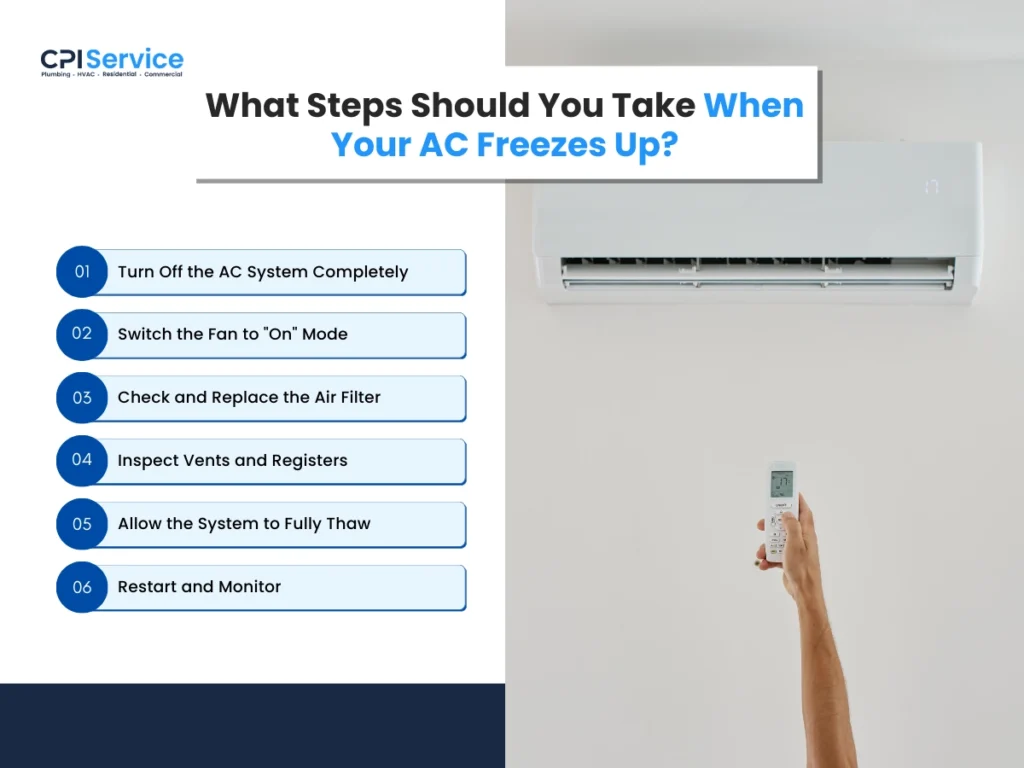
Step 1: Turn Off the AC System Completely
The first step is to switch your thermostat to the “off” mode to stop the cooling cycle entirely. It is critical because it halts the flow of sub-zero refrigerant, preventing the ice block from expanding and protecting the compressor from liquid slugging. To carry out this, locate your thermostat interface, ensure the cooling mode is deactivated, and verify that the outdoor condenser unit has stopped running.
Step 2: Switch the Fan to “On” Mode
Change your thermostat’s fan setting from “Auto” to “On” to run the blower motor independently. By doing this, you force warm indoor air to circulate directly over the frozen evaporator coils, which accelerates the thawing process without using the cooling system. Simply go to your thermostat, find the fan toggle, and set it to “On”. Make sure you hear the indoor blower start up immediately.
Step 3: Check and Replace the Air Filter
Inspect the air filter and replace it if it looks dusty, gray, or clogged. A dirty filter restricts the warm airflow required to keep the evaporator coil above freezing temperature. When airflow drops, the coil temperature falls and ice forms. Remove the existing filter from the return air slot or air handler cabinet, hold it up to a light source to check for blockage, and install a clean replacement if light cannot pass through easily.
Step 4: Inspect Vents and Registers
The next step is to walk through your home and verify that all supply and return vents are fully open and unobstructed. Ensuring these vents are clear prevents pressure drops and restricted heat transfer that can cause frozen AC coils. Physically move any furniture, rugs, or curtains away from the grates, and flip the vent louvers to the fully open position to maximize airflow to your cooling system.
Step 5: Allow the System to Fully Thaw
The AC unit must remain off until all ice buildup has melted from the coil and surrounding components. Any leftover ice on the fins can rapidly reform once the compressor resumes operation. Wait approximately 2 to 4 hours and monitor the condensate line and drain pan to ensure water drains correctly and does not overflow into the indoor area.
Step 6: Restart and Monitor
The final step is to turn the cooling mode back on at the thermostat and observe the system’s performance for the next hour. This allows you to confirm whether the maintenance steps you took (such as changing the filter) solved the problem or whether a more serious refrigerant leak is present. Set your thermostat to your desired temperature, wait for the compressor to start, and check the copper pipes outside. If frost begins to reform within 30 minutes, shut the system down and call a licensed HVAC technician.
How Can I Prevent My AC from Freezing in the Future?
You can prevent your AC from freezing by maintaining consistent upkeep through regular AC maintenance, timely inspection and servicing of system components, and early detection of mechanical issues. Regularly change air filters, keep vents and ducts clear, and monitor refrigerant levels to avoid pressure drops. Additionally, inspect the drain lines for moisture buildup and ensure the blower fan is functioning correctly to maintain steady airflow across the evaporator coils.
- Regular AC Maintenance
Schedule an annual professional AC tune up to ensure a licensed technician can clean and calibrate your entire system. This proactive care protects your unit from freezing by verifying that all components operate within safe temperature and pressure ranges. It prevents freeze ups by identifying early mechanical issues, like a failing blower motor, before they cause the system temperature to drop.
- Change Air Filters Regularly
Replace your AC air filter every 1 to 3 months for standard 1-inch models, or every 6 to 12 months for high-efficiency 4 to 5-inch filters, to maintain proper airflow. A dirty filter chokes off the system, reducing heat absorption and causing the unit to freeze up. Installing a clean filter restores steady, warm airflow, stabilizes your refrigerant temperature, and prevents common frozen evaporator coil problems during the peak of the cooling season.
- Keep Vents and Ducts Clear
Ensure that at least 80% of your supply and return registers stay fully open to maintain balanced airflow across the evaporator coil. When furniture or curtains block these vents, the airflow inside the ductwork drops significantly. This causes the coil temperature to fall below the normal range, allowing atmospheric moisture to freeze on the coil surface and create icing problems.
- Monitor Refrigerant Levels
Maintaining proper internal pressure in the AC ensures your coil temperature remains stable. Watch for signs of a leak, such as oily residue or ice on the refrigerant lines, which causes a drop in system pressure. A proper refrigerant charge allows the coil to absorb heat effectively. Without it, the evaporator becomes excessively cold and develops a freezing condition.
- Check Drain Line Regularly
Inspect the AC’s condensate line to ensure water is exiting the air handler properly. During operation, the coil removes humidity and sends water through this line. A clog causes water to pool in the air handler, where it contacts cold coil surfaces. This excess moisture, combined with low temperatures, significantly increases the risk of ice formation on components.
- Ensure Proper Airflow and Fan Function
Verify that your AC’s blower motor is circulating air at the correct speed to maintain balanced heat exchange. Verify that your blower motor is circulating air at the correct speed to maintain balanced heat exchange. If the fan fails or slows down, the lack of warm airflow will cause the evaporator coil to freeze almost immediately.
When Should You Call a Professional for Your Frozen AC?
Call a licensed AC technician immediately if your AC continues to freeze after basic troubleshooting, exhibits mechanical strain, such as grinding noises, or fails to reach the set temperature despite running continuously. These symptoms often point to internal failures that go beyond simple maintenance.
- When your AC runs continuously without reaching the set temperature, or begins blowing warm air in cooling mode. It indicates a refrigerant imbalance, airflow restriction, or compressor strain, all of which require professional air conditioning services.
- If you notice complex issues such as motor failure, refrigerant imbalances, or frequent circuit breaker trips, they can lead to permanent damage.
- If the unit makes grinding noises, leaks water or refrigerant, or shuts down entirely during extreme weather.
- If your system continues to freeze up after you have replaced the filter and cleared the vents, it indicates a deeper mechanical or pressure imbalance that basic troubleshooting cannot resolve.
If your system continues to freeze after you thaw it and replace the filter, you likely have a deeper mechanical issue.A professional HVAC technician is necessary to perform a static pressure test, locate potential refrigerant leaks, and inspect the internal blower motor or expansion valve. Timely service from a certified HVAC expert helps prevent catastrophic compressor failure, reduces long-term repair costs, and restores reliable cooling performance in your home.

