
15 Common Reasons Your AC Is Leaking Water
Table of Contents
An air conditioner leaks when the water it pulls from the air can’t drain: a clogged line, a damaged pan, a failed pump, a frozen coil melting at once, or an installation fault. Drips from the outside drain pipe are normal. Water around the indoor unit (often in a San Jose attic) or on a ceiling is not.
As it cools, the AC collects that moisture on the indoor coil, and it should run into a drain pan and out through a condensate line. With the unit in the attic, a leak may first appear as a ceiling stain. The first steps are to turn the AC off and clear any drain-line clog with a wet-dry vacuum and a vinegar flush. If you suspect a failed part, a safety switch or a refrigerant leak, call a technician. Dealing with a leak early prevents mold, electrical hazards and water damage to walls and floors. If the AC checks out and water keeps appearing, the source may be a supply pipe or a bathroom above rather than the air conditioner; professional leak detection finds it before any drywall is opened.
The 15 common reasons an AC leaks water:
- Clogged condensate drain line
- Damaged or rusted drain pan
- Frozen or blocked evaporator coils
- Dirty air filter
- Low refrigerant
- Broken or faulty condensate pump
- Improper installation
- Disconnected drain line
- Damaged refrigerant-line insulation
- High humidity
- Broken or faulty float switch
- Malfunctioning thermostat
- An old or worn-out AC unit
- Running the AC when it’s too cold outside
- Excessive condensation from nonstop use
Drainage Problems
Clogged Condensate Drain Line
As the AC removes humidity, condensate flows from the coil into the drain pan and out through a PVC drain pipe, carrying dust, dirt, algae and slime with it. Over time that buildup narrows the pipe until water backs up, fills the pan and overflows, dripping at the air handler or soaking into ceilings, walls and floors. To clear it:
- Turn the AC off and find the drain line’s access point, usually a T-shaped fitting with a cap near the indoor unit.
- Use a wet-dry vacuum on the outside end of the pipe to pull out the clog.
- Pour about a cup of distilled white vinegar into the access port and let it sit for 30 minutes to break down algae.
- Flush the line with clean water to make sure it runs freely.
If it keeps clogging, have it professionally cleared. See AC drain line clogged.
Damaged or Rusted Drain Pan
The pan under the coil collects every drop of condensate. Older metal pans corrode into rust holes from constant contact with water; plastic pans can crack with age, temperature changes or rough handling. Once the pan is compromised, water escapes through the holes instead of draining, leaving puddles under the indoor unit or water in the secondary pan. If water leaks while the drain line is clear, check the pan:
- Use a flashlight to look for rust, corrosion or hairline cracks.
- A water-resistant sealant can stop a small crack in a plastic pan for a short time, but it’s only a stopgap.
- Replace a rusted-through or cracked pan; patches rarely last.
- Make sure the new pan slopes slightly toward the drain opening so water doesn’t stand in it.
Broken or Faulty Condensate Pump
Where water can’t drain by gravity (attics, some closets, garages and basements), a small pump lifts it out. A float inside the reservoir switches the motor on as the water rises. If the motor or float fails, or the discharge tube is kinked or blocked, the reservoir overflows. Signs include water around the indoor unit, buzzing or gurgling, or a motor that runs constantly. To check it:
- Make sure the pump is plugged in and its breaker hasn’t tripped.
- Check the discharge tube (the small plastic hose leading out of the pump) for kinks or blockages.
- Pour water into the reservoir. If the water rises but the pump doesn’t start, the motor or float switch has likely failed.
- With the pump unplugged, clean the reservoir with water and a little bleach or vinegar to remove algae that can hold the float down.
Disconnected Drain Line
Vibration from the blower can loosen PVC joints that weren’t properly cemented, or someone working near the unit can bump the pipe loose. With its path broken, condensate pours straight out onto the floor or through the ceiling. To reconnect it:
- Inspect the joint where the drain pipe leaves the air handler and any joints along the run.
- Clean and dry both ends of the pipe.
- Rejoin them with PVC primer and solvent cement.
- Secure the pipe with straps or clamps so it can’t separate again.
Broken or Faulty Float Switch
The float switch is a safety device that should shut the AC off when water rises too high in the pan or drain line. If it’s stuck or dead, the system keeps making water even with a clogged drain, and a clog turns into a flood. To check it:
- Find the float switch at the drain pan or on the condensate line.
- With the AC running, lift the float by hand: the system should shut off.
- Clear any slime or debris that keeps the float from moving.
- If it doesn’t shut the system off or it’s corroded, have a technician replace it; it’s wired into the AC’s controls.
Coil Freezing
Frozen or Blocked Evaporator Coils
When airflow across the coil is restricted or the refrigerant pressure drops, the coil gets cold enough for moisture to freeze on it instead of running off as water. Cooling drops off, or the system shuts down. When the AC cycles off or the airflow improves, the ice melts quickly and releases more water than the pan and drain can handle, so it overflows around the air handler. To stop it:
- Turn cooling off right away to protect the compressor.
- Switch the fan from Auto to On so air moving over the coil speeds up thawing, which can take a few hours.
- Open closed vents and clear furniture away from return grilles.
- If it freezes again, schedule service so a technician can clean the coil and check the system’s pressures. See why an AC freezes up.
Dirty Air Filter
A clogged filter cuts the air passing over the coil, so the coil gets too cold and moisture freezes on it. When the ice melts, the pan gets a flood of water at once. To prevent it:
- Turn the AC off at the thermostat.
- Find the filter slot, usually in the return air grille or the air handler cabinet, and slide out the old filter.
- Replace it with the size and rating the manufacturer recommends.
- Check it every month during the cooling season.
Low Refrigerant Levels
Refrigerant can leak from corroded copper lines, connections loosened by vibration, or damage during installation or service. As the charge drops, so do the coil’s pressure and temperature, until moisture freezes on it. When the ice thaws, the pan overflows, and the longer run times of a weak system add even more condensate.
- Don’t try to add refrigerant yourself; it takes special tools and EPA Section 608 certification.
- Have a licensed technician run a leak test to find the damaged coil or line.
- The technician repairs the leak and recharges the system to the manufacturer’s specification.
Malfunctioning Thermostat
A thermostat that misreads the indoor temperature can keep the compressor running nonstop, chilling the coil until it freezes. When the system finally stops, the ice melts faster than the drain can carry it away. To rule it out:
- Replace the batteries.
- Make sure it isn’t near a heat source or in direct sun.
- Recalibrate it or reset it to factory settings, following the manufacturer’s instructions.
- Replace an outdated or unresponsive thermostat; see thermostat repair and installation.
Outdoor Temperatures Too Cold to Run the AC
Most home air conditioners aren’t designed to cool when it’s cool outside. Below the minimum outdoor temperature listed in the system’s manual, pressures drop too low and the indoor coil can freeze; when the day warms up, the ice melts and the pan spills over. To avoid it:
- Don’t run the AC on cool days; use fan-only mode or open windows instead.
- If equipment has to cool in cold weather (a server room, for example), ask about a low-ambient control kit.
- If the coil has already frozen, turn cooling off and let it thaw completely, usually a few hours, before restarting.
Installation and Equipment
Improper AC Installation
If the indoor unit, drain pan or drain line isn’t level or sloped correctly, gravity can’t carry water to the drain. Condensate collects in the wrong part of the pan and spills over the edge, leaking inside the unit, staining ceilings or dripping into living spaces. Things to check (or have a technician correct):
- The air handler is level or tilted slightly toward the drain outlet.
- The drain pan sits directly under the coil.
- The drain line slopes steadily downward along its whole length.
- PVC fittings are secured so vibration can’t loosen them.
Damaged Insulation
The large copper refrigerant line is cold. When its foam insulation is torn, brittle or missing, warm, humid air touches the bare pipe and it “sweats,” dripping onto drywall or ceilings and encouraging hidden mold. To fix it:
- Inspect the refrigerant lines along their length for torn, missing or brittle foam.
- Replace it with closed-cell foam pipe insulation of the right diameter.
- Seal the seams and joints with insulation tape or secure them with zip ties.
- Make sure it fits snugly, with no gaps where moisture can collect.
Old or Worn-Out AC Unit
After 10 to 15 years or more, drain pans develop pinhole rust leaks, coils become caked with grime and components shift, causing leaks that keep coming back and repairs that are hard to solve one at a time. What to do:
- Have a technician evaluate the system’s overall condition.
- Replace the failing part if the rest of the system is sound.
- Consider replacement if leaks come from several places.
- Keep up annual maintenance to slow the wear. See how long air conditioners last.
Conditions and Use
High Humidity Levels
On humid days the coil pulls much more water out of the air, so condensate flows heavily and continuously. A drain that’s only slightly restricted may cope on a dry day and overflow on a humid one. To reduce the load:
- Keep windows and doors closed during humid weather to keep moist outdoor air out.
- Have a technician check the blower speed; a slower speed can improve dehumidification.
- Clean the drain pan and line more often during humid months.
Excessive Condensation Due to Overuse
During a heat wave an AC may run almost nonstop, so the coil never dries out and water flows into the pan constantly. An undersized system works even harder and produces more water than a marginal drain can carry. To ease the strain:
- Use ceiling fans and close blinds during the day to cut the heat coming in.
- Raise the thermostat a few degrees so the system can cycle off and rest.
- Keep all supply vents open for full airflow.
- Have a technician check whether the system is the right size for the home; see what size AC unit you need.
What to Do if Your AC Is Leaking?
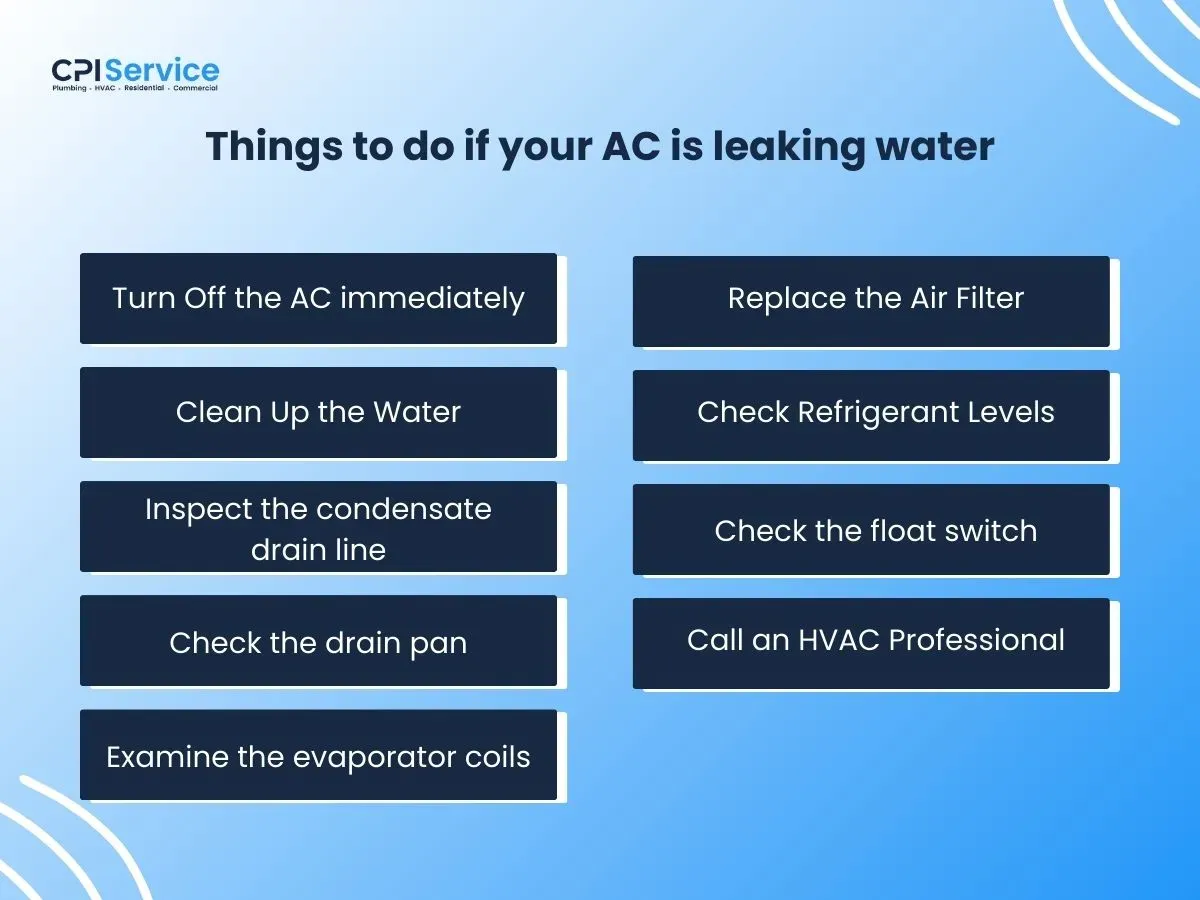
- Turn the AC off at the thermostat to stop more condensate from forming. If water has reached the unit’s electrical parts or an outlet, also switch off its breaker.
- Clean up the water with towels or a wet-dry vacuum and move anything that could be damaged. Drying the area quickly protects floors and walls and keeps water away from electrical parts.
- Check the drain line for a visible clog or standing water at the access port or outside end.
- Check the drain pans, primary and secondary (if you have one), for cracks, rust or standing water.
- Look for ice on the indoor coil or refrigerant lines. If you see any, let it melt with cooling off and the fan on, which can take a few hours.
- Replace the filter if it’s dirty, so the coil doesn’t freeze again.
- Check the condensate pump, if you have one, and test the float switch.
- Leave refrigerant to a technician. If you suspect low refrigerant, a licensed technician has to check it.
- Call a technician if you can’t find the cause, the leak continues, the coil keeps freezing, or water has reached a ceiling or wall.
Potential Dangers and Risks of AC Leaking Water
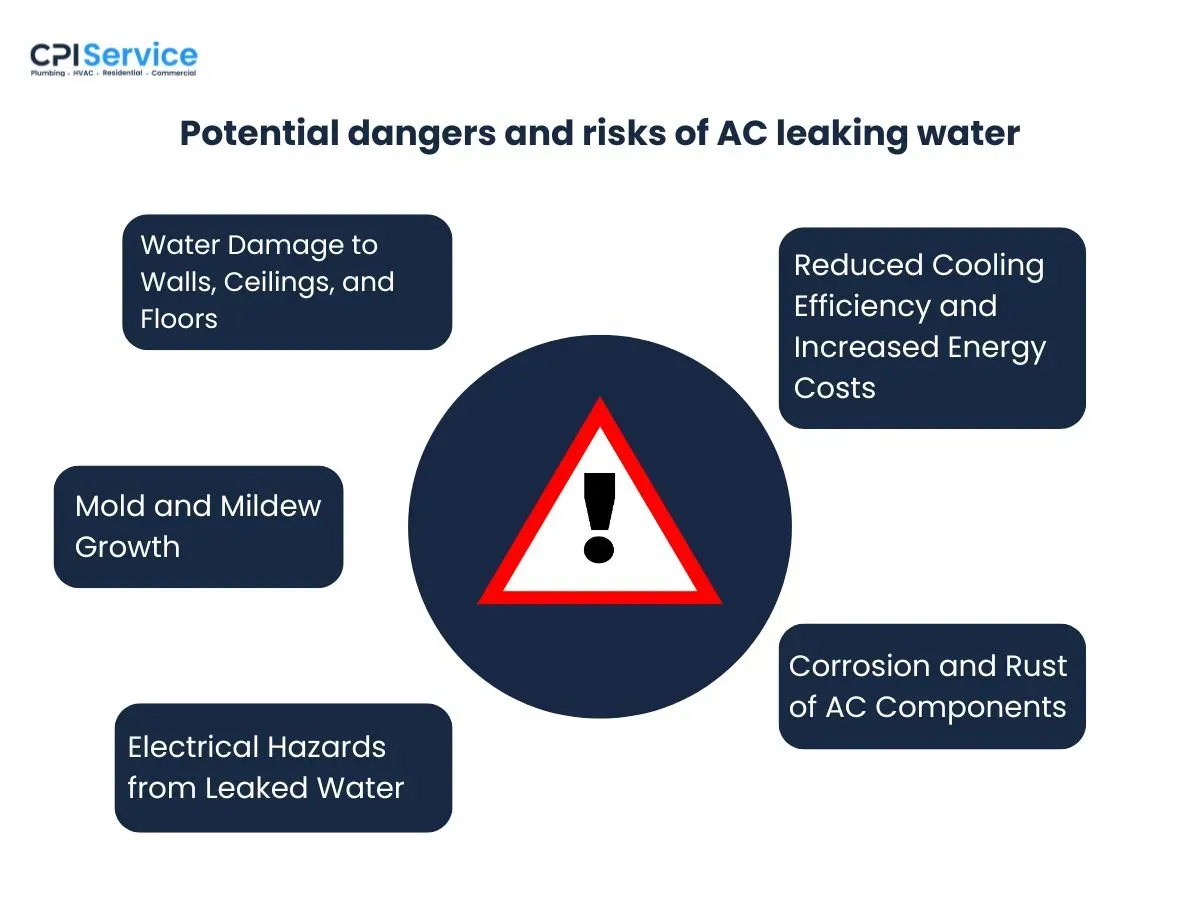
Left alone, a small leak turns into bigger repairs to the house and the system:
- Water damage to walls, ceilings and floors. Water soaks into building materials, warping floors, sagging ceilings and crumbling drywall. From an attic unit it can travel along framing and damage several rooms.
- Mold and mildew. Damp drywall, insulation and the inside of the system can grow mold, with musty odors and possible allergy and breathing problems. The EPA advises drying water-damaged areas within 24 to 48 hours to prevent mold growth.
- Electrical hazards. Water that reaches wiring, the control board or nearby outlets can cause short circuits, system failure or even a fire, especially where the unit sits in an attic or closet near electrical equipment.
- Weaker cooling and higher energy costs. When the leak comes from a frozen coil, restricted airflow or low refrigerant, the system works harder and cools less until the cause is fixed.
- Corrosion. Constant moisture rusts the drain pan, coil and cabinet, shortening the life of the equipment.
AC Water Leaks in South Bay Homes
- Attic air handlers. Many local homes have the furnace and coil in the attic, so a drain problem shows up as a stain on the ceiling below. Equipment above a ceiling should have a secondary drain pan or an overflow switch that shuts the AC off before water spills; if yours doesn’t, ask about adding one.
- Spring start-up. Drain lines sit dry all winter and can clog with dust and debris. The first hot week is when many leaks appear; have the drain cleared during a spring tune-up.
- Garage and closet units with pumps. Condensate pumps fail quietly; check that yours runs when the reservoir fills.
Preventing AC Water Leaks
- Replace the filter every 1 to 3 months
- Have the drain line and pan cleaned and the float switch tested every year; our membership plans include annual maintenance
- Keep refrigerant-line insulation intact
- Don’t run the AC on cold days
- Fix ice, hissing or weak cooling early; see AC repair costs
CPI Service repairs AC leaks and drainage problems throughout San Jose and the South Bay. Schedule AC repair, request a free estimate or call (408) 978-3093.
Frequently Asked Questions
Is it normal for my AC to leak water?
An AC produces water as it cools, but it should drain away through the condensate line, often outside or to a drain. Water dripping from the outdoor drain pipe is normal; water around the indoor unit, on the floor or on a ceiling is not.
Can I keep running my AC if it's leaking water?
Turn it off until you find the cause. Running it can spread water damage, encourage mold, and wet electrical parts. If the coil is frozen, running it longer makes the leak worse when the ice melts.
How do I unclog an AC drain line?
Turn the AC off, find the drain line's access port near the indoor unit, and use a wet-dry vacuum on the outside end to pull out the clog. Then pour about a cup of distilled white vinegar into the access port and flush with water after 30 minutes. If it keeps clogging, have it professionally cleared.
CPI Service is a great company to use for HVAC too! Our A/C stopped working during the recent heatwave & another company wanted to replace our whole unit. Then we called CPI & they found it didn’t need to be replaced, they fixed it that day! I really appreciate a company that responds quickly, is very professional & reasonably priced!!! I’ll be using them for sure in the future.
Jaycee V., Google review
Read more reviews →Serving San Jose and the South Bay
CPI Service is based at 2880 Aiello Dr in San Jose and serves homes and businesses across the South Bay and the Peninsula. See all the areas we serve.