
For property managers, facilities teams and businesses
Commercial AC Installation and Replacement in San Jose
Rooftop packaged units, split systems and condensers replaced or newly installed for offices, retail, multifamily common areas and schools, with the City permit, Title 24 requirements and refrigerant rules worked into the plan, by a contractor licensed for HVAC (C-20) and plumbing.
- 24/7 dispatchEmergency line for every property
- Plumbing + HVACCSLB License #1101278 (C-36, C-20, A)
- 1-year labor warrantyLicensed, bonded and insured since 1986
- Google 4.9130+ reviews
Schedule a Call
Pick a time to talk with our commercial team about your properties.
Who We Work With
Offices
Rooftop units and split systems serving office suites and multi-tenant office buildings.
Retail
Replacements planned around store hours, so the sales floor stays open.
Multifamily common areas
Lobbies, clubhouses, corridors and leasing offices for property managers and HOAs.
Schools
Classroom and office units replaced around the school calendar.
Commercial AC Installation and Replacement
From one rooftop unit to a planned change-out across several buildings.
Rooftop packaged unit replacement
Single-zone packaged rooftop units replaced, with the curb, connections and controls planned before the old unit comes off the roof.
Split systems and condensers
Outdoor condensers, indoor coils and air handlers replaced or newly installed, matched as a system.
Heat pump options
Heat pump units where the Energy Code calls for them or where the building is moving off gas heat. See heat pumps.
Ductwork at replacement
Duct connections, repairs and the duct sealing the Energy Code requires when equipment is replaced. See duct services.
Thermostats and controls
Demand-responsive thermostats and schedules for occupied hours. See thermostats.
Maintenance after the install
Pre-season A/C tune-ups, inspections and scheduled filter and belt replacements. See commercial maintenance plans.
Why Property Managers Choose CPI Service for AC Replacement
HVAC and plumbing under one license (CSLB #1101278), serving the South Bay since 1986.
Licensed for HVAC and plumbing
C-20 HVAC and C-36 Plumbing, so condensate lines and gas connections stay with the same contractor.
Planned, not rushed
Permits, Title 24 requirements and refrigerant rules are checked at the site survey and covered in the proposal.
Clear pricing
Replacements are custom quoted for your approval before work begins.
Standing behind the work
A 1-year labor warranty on our work, and a BBB A+ rating.
How a Commercial AC Replacement Works
Site survey
We record the existing units, roof access, electrical service, ducts and controls, with photos.
Proposal
Equipment options that meet the Energy Code and refrigerant rules, and a custom quote.
Permits
City plan review, and a Planning clearance or engineered plans where the roof installation needs them.
Installation
Scheduled around business hours where possible, with notices for tenants or staff.
Tests and closeout
Start-up, required acceptance tests, City inspection and a summary of the work for your records.
Recent Commercial AC Projects
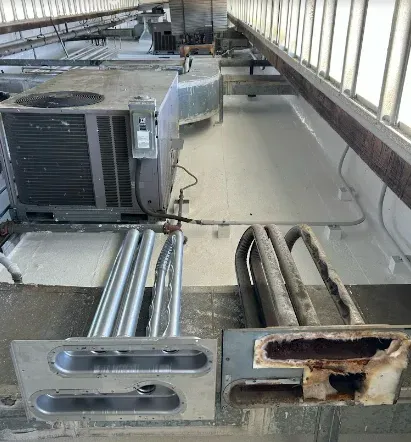
Commercial Air Conditioner Replacement, San Jose
Rooftop commercial air conditioner and ducts during a replacement in San Jose.
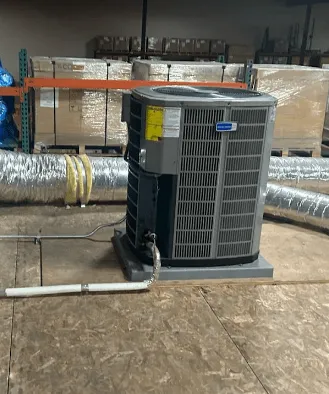
Commercial Air Conditioner Installation, Mountain View
New commercial air conditioner condenser and ductwork installed in Mountain View.
Pricing and Service Agreements
Clear pricing
Service and repair work is priced at a flat rate or on an hourly basis. Larger projects, such as repipes, sewer replacement and equipment installations, are custom quoted.
Service agreements
Flexible service agreements and payment terms for property managers and associations, and scheduled maintenance for plumbing and HVAC. Maintenance plans.
24/7 emergency response
Call (408) 978-3093 any time for leaks, backups and no-heat or no-cooling calls. Emergency work is priced separately.
CPI Service is a great company to use for HVAC too! Our A/C stopped working during the recent heatwave & another company wanted to replace our whole unit. Then we called CPI & they found it didn’t need to be replaced, they fixed it that day! I really appreciate a company that responds quickly, is very professional & reasonably priced!!! I’ll be using them for sure in the future.
Jaycee V.Google review
Our new heat pump system has just been installed and we are very pleased with CPI and the new equipment. We are especially grateful for the knowledgeable and hard-working technician Bunhak, who worked throughout our recent heatwave to finish the job. We would highly recommend CPI for any HVAC installation or maintenance.
Linda G.Google review
CPI and Alex were extremely helpful when our local church’s water heater kept malfunctioning and needed replacing. From the initial diagnosis, explanation and recommendation of replacement, we always felt that our needs were being tailored to. Not only were they extremely kind, knowledgeable and professional, but they also were diligent and efficient during their time.
We’re truly grateful for their excellent work and would highly recommend CPI to anyone in need of plumbing or heating services, especially for those in larger community buildings like churches like ours.
Stephen S.Google review
Commercial AC Replacement in San Jose: What to Plan For
City, state and federal rules that shape a replacement, checked October 2026.
Plan review, not an online permit
San José's online permits table marks air conditioning, heat pumps and duct alterations as not available online for commercial and industrial properties, so these projects go through Standard Plan Review.
Unit weight on the roof
Roof-mounted equipment over 100 lbs. needs a building permit; over 400 lbs., plans and calculations by a licensed engineer or architect. A like-for-like unit of similar weight can reuse the original approved plans.
Planning clearance
Equipment on a roof or exterior wall needs a Planning Division clearance unless it sits lower than an existing parapet or roof screen.
Title 24 unit choice
Since January 1, 2026, the 2025 Energy Code sets which single-zone rooftop units under 65,000 Btu/h may replace an old one in offices, retail, schools and libraries in San José's climate zone.
Refrigerant rules
EPA limits new residential and light commercial AC systems to refrigerants with a GWP under 700. Existing R-410A systems can still be repaired.
Crane lifts
A crane set up in a City street needs a Public Works encroachment permit, and construction crane operators must be certified under Cal/OSHA rules. Lifts and roof access are planned per job.
Commercial AC Replacement in San Jose: The Short Answer
Replacing a rooftop packaged unit, split system or condenser on a San José commercial property takes a City mechanical permit through Standard Plan Review, because commercial air conditioning is not on the City’s online permit list. Since January 1, 2026, the 2025 Energy Code (Title 24, Part 6) decides which replacement units qualify, requires duct sealing and a demand-responsive thermostat in many cases, and calls for acceptance tests by a certified technician. A new system must also meet EPA’s refrigerant limit for its category, while existing R-410A systems can still be repaired.
We replace and install commercial air conditioning for offices, retail, multifamily common areas and schools as part of our commercial HVAC service, under CSLB License #1101278 (C-20 HVAC).
Rules that shape a commercial AC replacement in San José (checked October 2026)
| Topic | What applies | Who sets it |
|---|---|---|
| Mechanical permit | Required for installing or replacing mechanical equipment; commercial and industrial air conditioning, heat pump and duct work is not available as an online permit, so plans go through Standard Plan Review | City of San José |
| Roof weight | Roof-mounted equipment over 100 lbs. needs a building permit; 201 to 400 lbs., plans; over 400 lbs., plans and calculations by a licensed engineer or architect | City of San José |
| Planning clearance | Needed for equipment on a roof or exterior wall unless it is lower than an existing parapet or roof screen | City of San José |
| Replacement unit type | Single-zone packaged rooftop units under 65,000 Btu/h in offices, retail, schools and libraries follow Table 141.0-E-1 | California Energy Commission |
| Ducts and thermostat | Connected ducts sealed and tested on qualifying small single-zone systems; a demand-responsive thermostat | California Energy Commission |
| Acceptance tests | Listed mechanical systems tested by a certified mechanical acceptance test technician | California Energy Commission |
| Refrigerant | GWP limit of 700 for new residential and light commercial AC and heat pump systems | U.S. EPA |
| Crane in the street | Public Works encroachment permit for crane construction in the public right-of-way | City of San José |
Which San Jose Permits Does a Commercial AC Replacement Need?
The City’s Building Division says that installing or replacing ducts, furnaces and other mechanical equipment requires a mechanical permit. For commercial and industrial properties, it sends applicants to its online permits table: a project marked “Yes” can use SJPermits.org, and one marked “No” needs Standard Plan Review. In that table, air conditioning, heat pumps, and duct or flue alterations are all marked “No” for commercial and industrial properties. Standard Plan Review starts at SJPermits, with plans uploaded through SJePlans, and the permit is issued after the plans are approved and fees are paid.
Rooftop units add two more checks:
- Weight. Equipment mounted on a roof needs no building permit under 100 lbs., a building permit from 101 to 200 lbs., plans from 201 to 400 lbs., and plans and calculations by a licensed engineer or architect over 400 lbs. In all cases it must be positively attached. A like-for-like replacement follows the same chart; if plans were approved for the original unit, the City accepts the original plan set showing the new unit’s listed weight, but a heavier unit may need new plans. Modifying the roof structure to carry a unit always needs plans and a building permit.
- Planning clearance. Whatever its weight, equipment on a roof or exterior wall needs a clearance from the Planning Division unless it sits lower than an existing parapet or roof screen.
What Title 24 Requires When You Replace a Unit
California’s 2025 Energy Code took effect on January 1, 2026, and permit applications from that date use it. For nonresidential buildings, an alteration that adds or replaces space-conditioning equipment triggers these requirements in Section 141.0:
- New or replacement equipment must meet the prescriptive requirements for new systems in Section 140.4 that apply to it, with listed exceptions. The Energy Commission’s compliance manual notes that minor maintenance, such as filter or belt replacement, does not trigger them.
- Small rooftop units. A new or replacement single-zone packaged rooftop unit with direct-expansion cooling under 65,000 Btu/h must meet Table 141.0-E-1 or use the performance path. The requirement does not apply if the change would exceed the existing main service panel or service transformer capacity, shown by a load calculation from a registered professional engineer.
- Thermostat. When an air handler, the outdoor condensing unit of a split system, or a coil is installed or replaced, a thermostat that doesn’t meet the demand-response requirements must be replaced with one that does.
- Duct sealing. The duct system connected to the new equipment must be sealed when it meets the code’s criteria: a constant-volume, single-zone system serving less than 5,000 sq. ft., with more than 25 percent of the duct surface outdoors or in unconditioned space (healthcare facilities excluded). Leakage then must not exceed 15 percent of the air handler’s nominal airflow, confirmed by acceptance testing. Exceptions cover ducts already sealed and verified, and ducts built or sealed with asbestos.
- Acceptance tests. Listed mechanical systems, including constant-volume single-zone units, outdoor air ventilation, economizers and tested duct systems, are tested under Reference Nonresidential Appendix NA7, and a Certificate of Acceptance goes to the building department. Where certification is required, the tests are done by a certified mechanical acceptance test technician.
Table 141.0-E-1 in San José’s climate zone (2025 Energy Code, checked October 2026)
All of San José’s ZIP codes on the Energy Commission’s list, including 951xx and Alviso’s 95002, are in Climate Zone 4. For a new or replacement single-zone packaged rooftop unit under 65,000 Btu/h, the prescriptive options are:
| Building type | Option 1 | Option 2 |
|---|---|---|
| Office, financial institution | Single-zone heat pump with an economizer | Air conditioner with a furnace, or a dual-fuel heat pump, with a variable speed fan and an economizer |
| Retail and grocery | Single-zone heat pump with an economizer | Air conditioner with a furnace, or a dual-fuel heat pump, with a variable speed fan and an economizer |
| School | Single-zone heat pump with an economizer | Air conditioner with a furnace, or a dual-fuel heat pump, with a variable speed fan and an economizer |
| Library | Single-zone heat pump with an economizer | Air conditioner with a furnace, or a dual-fuel heat pump, with a variable speed fan and an economizer |
Building types not in the table have no requirement under it, but the general rules above still apply. Multifamily buildings, including their common areas, have their own sections of the Energy Code; we check which apply on each job.
Refrigerant Rules for New Commercial AC Equipment
Under EPA’s Technology Transitions rule, new air conditioning and heat pump systems must use refrigerants under a set global warming potential (GWP). EPA’s table, last updated August 28, 2026, lists:
| EPA category (examples from EPA) | GWP limit | Installation compliance date | Notes |
|---|---|---|---|
| Residential and light commercial AC and heat pump systems (mini-splits, unitary systems) | 700 | January 1, 2025 | No installation date for systems whose components were all made or imported before January 1, 2025 |
| Variable refrigerant flow (VRF) systems | 700 | January 1, 2027 | Later dates for components made or imported before 2026, and for some buildings permitted before October 5, 2023 |
| Chillers for comfort cooling | 700 | January 1, 2025 |
EPA’s May 2026 final rule removed the January 1, 2026 installation date for residential and light commercial systems built before 2025, so that older inventory can be installed until it runs out. The restrictions apply to new systems. EPA says components used to repair existing systems are not subject to them, so an R-410A unit in good condition can still be serviced and repaired.
Refrigerants EPA lists as acceptable, with use conditions, for new equipment in this category include the A2L (lower-flammability) refrigerants R-32 and R-454B. EPA notes that its rules and industry standards prohibit using refrigerants like these in systems not designed for them, and on replacing a broken R-410A condenser with a lower-GWP one, it says this may be possible depending on the circumstances. Whether a matched replacement works, or the whole system has to change, depends on the equipment, which we check at the survey.
Cranes and Rooftop Access
When a rooftop unit is set by crane and the crane stands in a City street, San José Public Works issues a revocable encroachment permit for crane construction in the public right-of-way, which typically requires a plan, fees and a security deposit. Cal/OSHA’s Title 8 Section 5006.2 requires operators of cranes used in construction to be certified by an accredited certifying entity or licensed by a government entity, with exemptions such as equipment rated at 2,000 pounds or less. The lift, roof access and fall protection are planned per job.
Planning a Replacement Before a Failure
A planned replacement leaves time for the permit, the Energy Code choice and the lift; an emergency one in a heat wave doesn’t. Units that need repeated refrigerant service, compressor or fan motor repairs, or that can’t hold temperature on hot afternoons are the ones to survey first. A maintenance plan with pre-season A/C tune-ups gives you a record of each unit’s condition, so replacements can be budgeted rather than forced. For general signs, see how long air conditioners last.
Sources
Checked October 2026. City of San José: Mechanical Projects · Online Building Permits · Equipment Suspended or Mounted on Roofs, Floors or Walls · Encroachment Permits (Public Works) · SJPermits: Available Online Permits. California Energy Commission: Blueprint, Fall 2025 (2025 Energy Code changes and effective date) · Restructured 2025 Energy Code, Title 24 Part 6 (for information only, PDF) · 2025 Nonresidential Compliance Manual (PDF) · Acceptance Test Technician Certification Provider Program · Building Climate Zones by ZIP Code. U.S. EPA: Technology Transitions HFC Restrictions by Sector · Final rule fact sheet, May 2026 (PDF) · Substitutes in Residential and Light Commercial Air Conditioning and Heat Pumps (SNAP) · Frequent Questions on the Phasedown of HFCs. Cal/OSHA: Title 8, Section 5006.2, crane operator certification in construction.
Commercial AC Replacement FAQs
Do I need a permit to replace a commercial rooftop unit in San José?
Yes. The City requires a mechanical permit for installing or replacing mechanical equipment, and for commercial and industrial properties air conditioning is not on the online permit list, so the work goes through Standard Plan Review. Depending on the unit's weight and height, a building permit, engineered plans and a Planning clearance may also apply.
Does Title 24 require a heat pump when we replace a rooftop unit?
Not always. Under the 2025 Energy Code, a new or replacement single-zone packaged rooftop unit under 65,000 Btu/h in an office, retail or grocery store, school or library in San José's climate zone must be a heat pump with an economizer, or an air conditioner with a furnace (or a dual-fuel heat pump) plus a variable speed fan and an economizer, unless the project uses the performance path or the change would exceed the electrical service capacity, shown by an engineer's load calculation.
Can we still repair our R-410A system, or must we replace it?
You can keep repairing it. EPA says components used to repair existing systems are not subject to the HFC restrictions. The limits apply to new systems: when a whole system is replaced, the new one must meet the GWP limit for its category.
What is acceptance testing, and who does it?
Acceptance tests check that installed controls, economizers and, where required, duct sealing work as designed. The Energy Code requires them for listed mechanical systems, performed by a certified mechanical acceptance test technician, with a Certificate of Acceptance submitted to the building department.
How is a commercial AC replacement priced?
Service and repair work is priced at a flat rate or on an hourly basis. Replacements and other larger projects are custom quoted after a site survey, for your approval before work begins. Emergency work is priced separately.
Can the replacement be done without closing the building?
We schedule installations around business hours where possible and coordinate notices with you. A rooftop change-out that needs a crane is planned for the day and time the lift allows.
Do you replace commercial AC outside San Jose?
Yes. The Mountain View installation above is one example, and we work across the areas we serve. See also commercial HVAC for repairs and service.
Need a reliable plumbing and HVAC partner for your properties?
- CSLB License #1101278 (opens CSLB in a new tab): C-36 Plumbing · C-20 HVAC · A General Engineering
- 1-year labor warranty on our work
- BBB A+ Accredited Business (opens BBB in a new tab)
- Technicians trained and certified: NASSCO PACP, MACP and LACP · Rheem heat pump · Noritz Level 3 tankless · OSHA safety
- Member of IAPMO, NASSCO, BOMA, IFMA · Se habla español