How Long Do Air Conditioners Last?
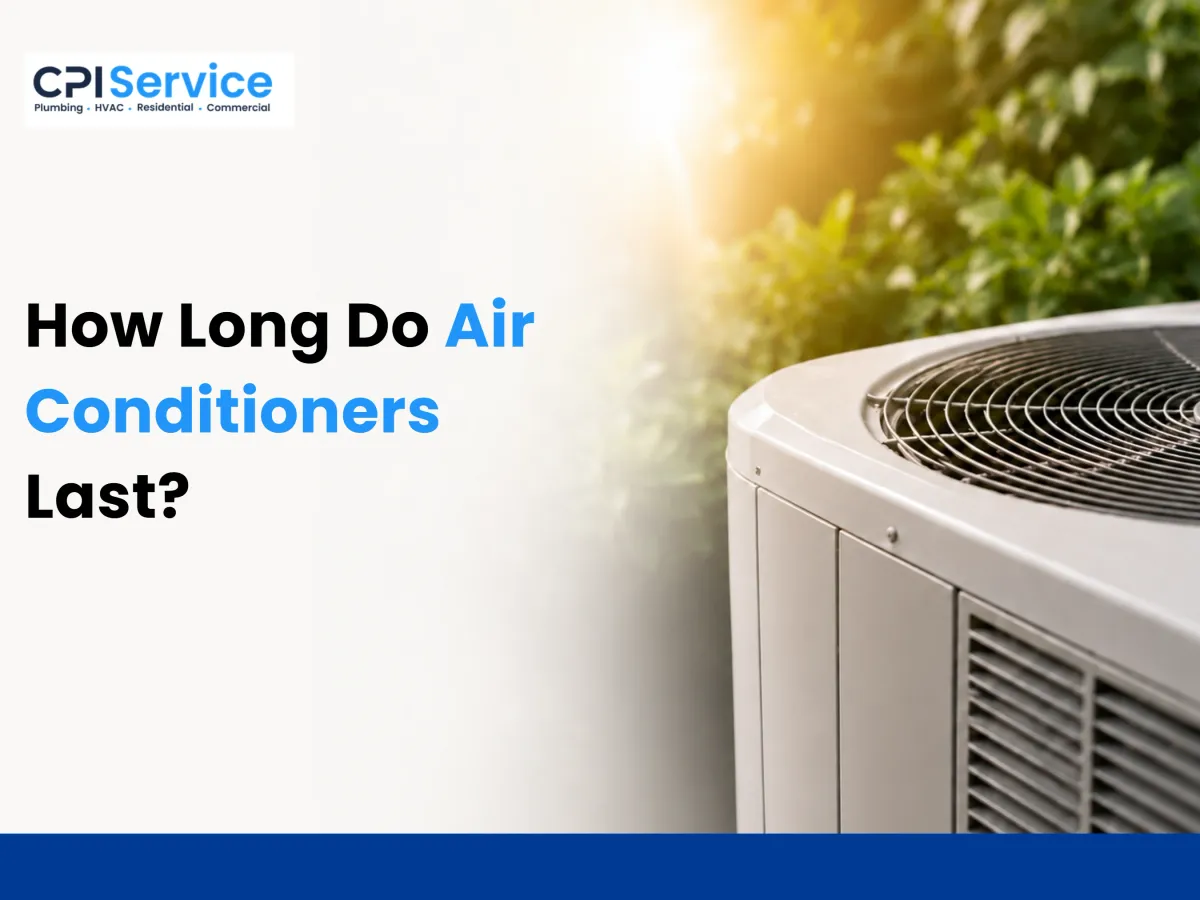
Table of Contents
- What Is the Average Lifespan of an Air Conditioner?
- How Long Does Each Type of Air Conditioner Last?
- How Many Years Does a Central Air Conditioner Last?
- How Many Years Does a Ductless Mini-Split Last?
- How Many Years Does a Window Air Conditioner Last?
- How Many Years Does a Portable Air Conditioner Last?
- How Many Years Does a Wall-Mounted Air Conditioner Last?
- How Many Years Does a Heat Pump Air Conditioner Last?
- How Many Years Does a Commercial Air Conditioner Last?
- How Long Does Each AC Component Last?
- What Affects How Long Your AC Lasts?
- Air Conditioner Lifespan in San Jose
- Signs Your AC Is Nearing the End of Its Life
- Should You Repair or Replace Your AC?
- How to Extend Your Air Conditioner’s Life
- When to Call a Professional
- Frequently Asked Questions
Most air conditioners last 10 to 20 years, depending on type, run hours, sizing, installation and maintenance. A central air conditioner with regular maintenance typically lasts 15 to 20 years, and in San Jose’s mild climate it has a good chance of reaching the upper end; portable and window units wear out much sooner.
Individual parts wear out on their own schedules too. Air handlers and outdoor condensers typically last 15 to 20 years; compressors, coils and thermostats 10 to 15; and capacitors only 5 to 10. Regular maintenance, good installation and replacing small parts before they fail help a system reach its expected life. As it ages, warning signs such as frequent repairs, uneven cooling, rising bills, new noises, refrigerant leaks or a failed compressor tell you when replacement makes more sense than another repair.
What Is the Average Lifespan of an Air Conditioner?
Across all types, an air conditioner lasts about 10 to 20 years. Short-lived window and portable units pull the average down toward 10 to 15 years; a well-sized, well-maintained central system or heat pump often runs 15 years or more. That range assumes normal use and basic care: filters changed on schedule, an annual inspection, and repairs made promptly. Installation quality, climate, run hours and maintenance decide whether a particular system reaches the low or high end.
How Long Does Each Type of Air Conditioner Last?
| Type of air conditioner | Typical lifespan |
|---|---|
| Central air conditioner | 15–20 years |
| Heat pump | 12–15 years |
| Ductless mini-split | 12–15 years (often longer with care) |
| Through-the-wall unit | 10–15 years |
| Window unit | 8–10 years |
| Portable air conditioner | 5–10 years |
| Commercial rooftop and packaged units | 15–20 years |
These are typical ranges, not guarantees. A system that was oversized, installed with the wrong refrigerant charge, or never serviced can fail years early; a well-sized, well-maintained one can outlast them.
How Many Years Does a Central Air Conditioner Last?
A central air conditioner lasts 15 to 20 years when it’s sized correctly and serviced. Climate, run hours, installation quality and maintenance all move that number. The South Bay’s mild Mediterranean climate, without long humid summers or freezing winters, is easy on equipment, so a central AC here has a good chance of reaching the upper end.
Replacing the filter every 1 to 3 months, scheduling annual maintenance and making sure the system is the right size for the home all reduce compressor wear. Oversizing is a common cause of early failure: the unit cools the house too quickly, shuts off and restarts over and over (short cycling), which wears out the compressor. See what size AC unit you need.
How Many Years Does a Ductless Mini-Split Last?
A ductless mini-split typically lasts 12 to 15 years, and well-maintained premium systems often last longer. Much of that comes from the inverter compressor, which speeds up and slows down to match the load instead of repeatedly starting and stopping, so its motor and electrical parts see less stress.
Mini-splits also deliver air straight into each room, with no ducts to leak. In a typical house, about 20 to 30 percent of the air moving through the duct system is lost through leaks, holes and poor connections, according to ENERGY STAR. And because only occupied zones are cooled, the outdoor unit runs fewer hours. See mini-splits.
How Many Years Does a Window Air Conditioner Last?
A window air conditioner lasts 8 to 10 years; a good model that’s cared for can last longer. Installation matters: the unit should tilt slightly toward the outside so condensate drains out instead of pooling inside, where it causes rust, mold and damage to internal parts.
Cleaning the filter regularly keeps air moving across the coil and keeps the compressor from overheating. If you take the unit out for the off-season, store it indoors rather than leaving it exposed to rain and weather.
How Many Years Does a Portable Air Conditioner Last?
A portable air conditioner lasts 5 to 10 years, the shortest of any type. The compressor, condenser and exhaust are all packed into one indoor cabinet, so the unit makes heat inside the same room it’s cooling, and the compressor runs hotter than in a split system.
To reduce that strain, drain the condensate reservoir regularly (especially in humid weather) to prevent mold, rust and sensor faults, and keep the exhaust hose short, straight and free of kinks so hot air leaves easily.
How Many Years Does a Wall-Mounted Air Conditioner Last?
A through-the-wall air conditioner lasts 10 to 15 years. It sits in a metal wall sleeve that protects it from weather, moisture, pests and debris better than a window unit’s mounting does. Keep the sleeve sealed so water can’t reach the internal parts and cause rust.
Clean the front filter about monthly during the cooling season to keep airflow up and the coil from icing or overheating. Units on south- or west-facing walls tend to wear a little faster, because afternoon sun means longer run times and higher operating temperatures.
How Many Years Does a Heat Pump Air Conditioner Last?
A heat pump typically lasts 12 to 15 years, and modern high-end inverter models can last longer with good maintenance. The shorter average comes from how it works: a heat pump cools in summer and heats in winter, so its compressor and fans log far more hours each year than an AC that only cools.
Routine maintenance, timely filter changes and an annual professional inspection reduce that wear. Many San Jose homes now use a heat pump for both heating and cooling; see heat pump installation.
How Many Years Does a Commercial Air Conditioner Last?
A commercial air conditioner usually lasts 15 to 20 years, depending on the type of system, the building and the maintenance schedule. Heavy-duty equipment such as water-cooled chillers can run considerably longer, while rooftop packaged units, which sit in full sun, wind and rain, tend to be at the shorter end.
Commercial systems often run 12 to 24 hours a day, and rooftop units face constant weather and standing water. Quarterly preventive maintenance reduces strain, catches problems early and extends the equipment’s life.
How Long Does Each AC Component Last?
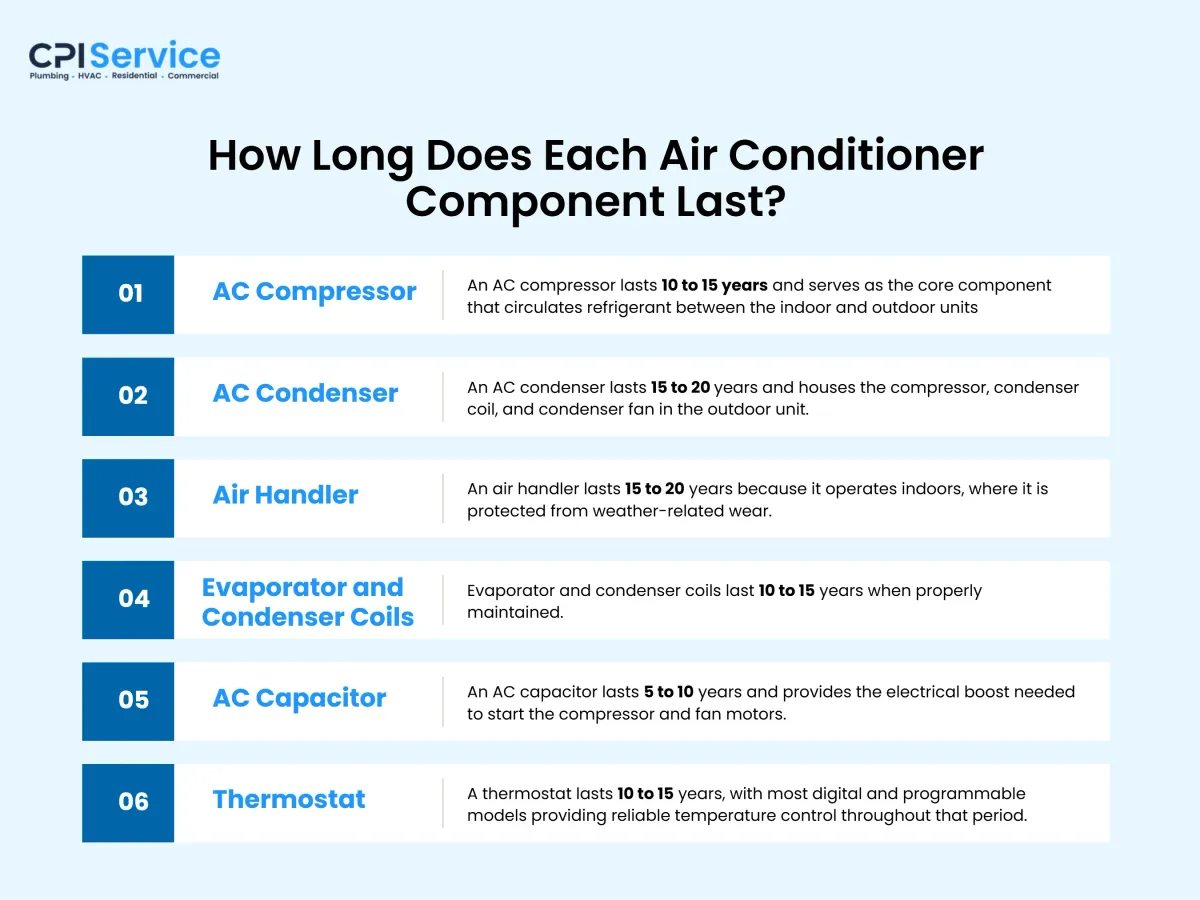
| Component | Typical lifespan | What shortens it |
|---|---|---|
| Compressor | 10–15 years | Poor airflow, wrong refrigerant charge, a failing capacitor |
| Outdoor condenser unit | 15–20 years | Dirt, blocked airflow, damaged fan motor |
| Air handler / furnace blower | 15–20 years | Dirty filters and high static pressure |
| Evaporator and condenser coils | 10–15 years | Corrosion, dirt, refrigerant leaks |
| Capacitor | 5–10 years | Heat; most systems need one or two replacements |
| Thermostat | 10–15 years | Usually replaced earlier for a smart upgrade |
Replacing aging parts on time keeps the whole system more reliable and efficient, and reduces the chance of a breakdown on the hottest day of the year.
How Long Does an AC Compressor Last?
A compressor lasts 10 to 15 years. It’s the heart of the system, pumping refrigerant between the indoor and outdoor units under constant mechanical stress, so its life depends on the health of everything around it. Compressors usually fail from restricted airflow, liquid refrigerant flooding back to the compressor, or a failing capacitor, rather than from simple old age.
It’s also the most expensive part to replace. When a compressor fails out of warranty on an older system, replacing the outdoor unit, or the whole system, is often the better value.
How Long Does an AC Condenser Last?
The outdoor condenser unit, which houses the compressor, condenser coil and fan, lasts 15 to 20 years. Dirt on the coil, blocked airflow and a damaged fan motor all make it work harder. Keep at least 2 to 3 feet of clearance around the unit and have it serviced each year.
How Long Does an Air Handler Last?
An air handler lasts 15 to 20 years because it’s indoors, out of the weather. Its main moving part is the blower motor, which pushes air through the ducts. A clogged filter raises static pressure and can overheat the motor, so changing filters on schedule is the best protection; it also keeps dust off the coil and blower wheel.
How Long Do Evaporator and Condenser Coils Last?
Coils last 10 to 15 years when they’re kept clean. The indoor evaporator coil absorbs heat from the house and can develop tiny refrigerant leaks from formicary corrosion, a chemical reaction that eats pinholes into copper tubing. The outdoor condenser coil releases heat and is exposed to rain, dirt and yard debris. Regular cleaning keeps both efficient. See why evaporator coils leak.
How Long Does an AC Capacitor Last?
A capacitor lasts 5 to 10 years. It gives the compressor and fan motors the electrical boost they need to start, and summer heat gradually weakens it, which makes it one of the most commonly replaced AC parts. Most central systems need one or two over their lifetime. Capacitors are inexpensive, so replacing a weak one during maintenance can prevent a breakdown and protect the compressor. Capacitors hold a charge even with the power off, so testing and replacing them is a job for a technician; see signs of a bad AC capacitor.
How Long Does a Thermostat Last?
A thermostat lasts 10 to 15 years, and outright failures are uncommon. Many homeowners replace a working thermostat after 5 to 10 years to upgrade to a smart model with Wi-Fi, remote control, scheduling and energy reports, which can improve comfort and trim cooling and heating costs.
What Affects How Long Your AC Lasts?
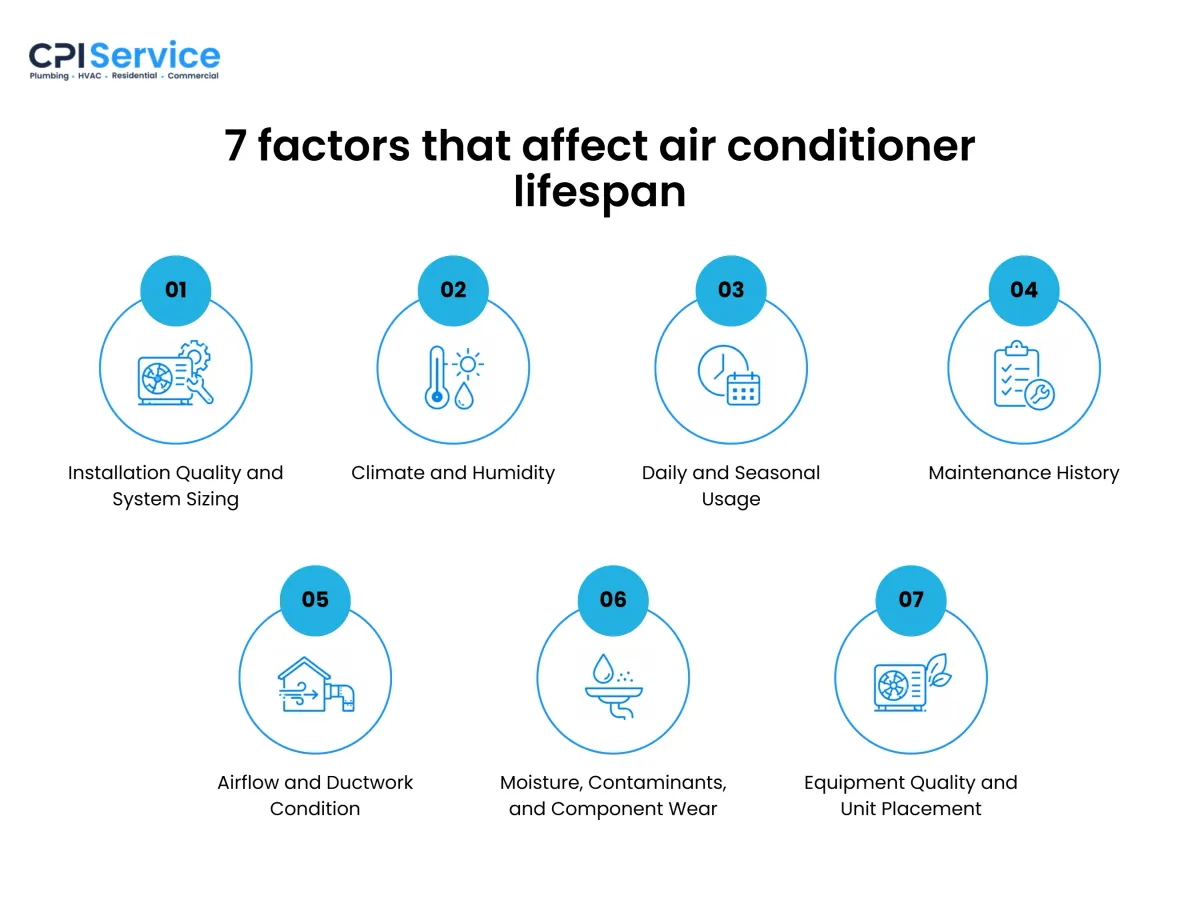
Seven factors decide most of an air conditioner’s life:
- Installation quality and sizing. An oversized unit short cycles; an undersized one runs constantly. Both stress the compressor. A professional installation also gets the refrigerant charge, airflow and duct connections right, which prevents early wear.
- Climate and humidity. In hot, humid climates an AC runs longer cycles and wears faster. In milder climates, like the South Bay’s, lower cooling demand means fewer hours and a longer life.
- Daily and seasonal use. Every hour of operation wears components. A system running most of the day through a long desert summer racks up wear far faster than one used a few months a year in a cool coastal city. A programmable thermostat and sensible settings cut unnecessary run time.
- Maintenance history. Systems that get regular filter changes, coil cleaning, refrigerant checks and an annual inspection are far more likely to reach, or beat, their expected life, because small problems are fixed before they become big ones.
- Airflow and duct condition. Dirty filters, blocked supply and return vents, and leaky ducts force the blower and compressor to work harder to hold the temperature. Good airflow and sealed ducts reduce that strain.
- Moisture and contaminants. Over time, moisture and dirt lead to clogged condensate drains, AC water leaks, corrosion, refrigerant leaks and electrical failures. Routine cleaning and keeping the drain clear limit the damage.
- Equipment quality and placement. Better-built equipment lasts longer, and a unit placed with enough clearance and ventilation, away from debris and constant afternoon sun, runs cooler and with less strain.
Air Conditioner Lifespan in San Jose
- Mild summers help. South Bay homes need far fewer cooling hours than inland California or desert climates, so a well-maintained central AC here has a good chance of reaching the upper end of its range.
- Heat pumps work year-round. Many local homes now use a heat pump for both heating and cooling, so it runs more hours than an AC alone. Annual maintenance matters more.
- Attic equipment and ducts. Air handlers and ducts in hot attics work harder. Sealing and insulating attic ducts reduces the strain.
- Rebates make replacement easier. If your system is near the end of its life, Silicon Valley HVAC rebates can lower the cost of a high-efficiency replacement.
Signs Your AC Is Nearing the End of Its Life
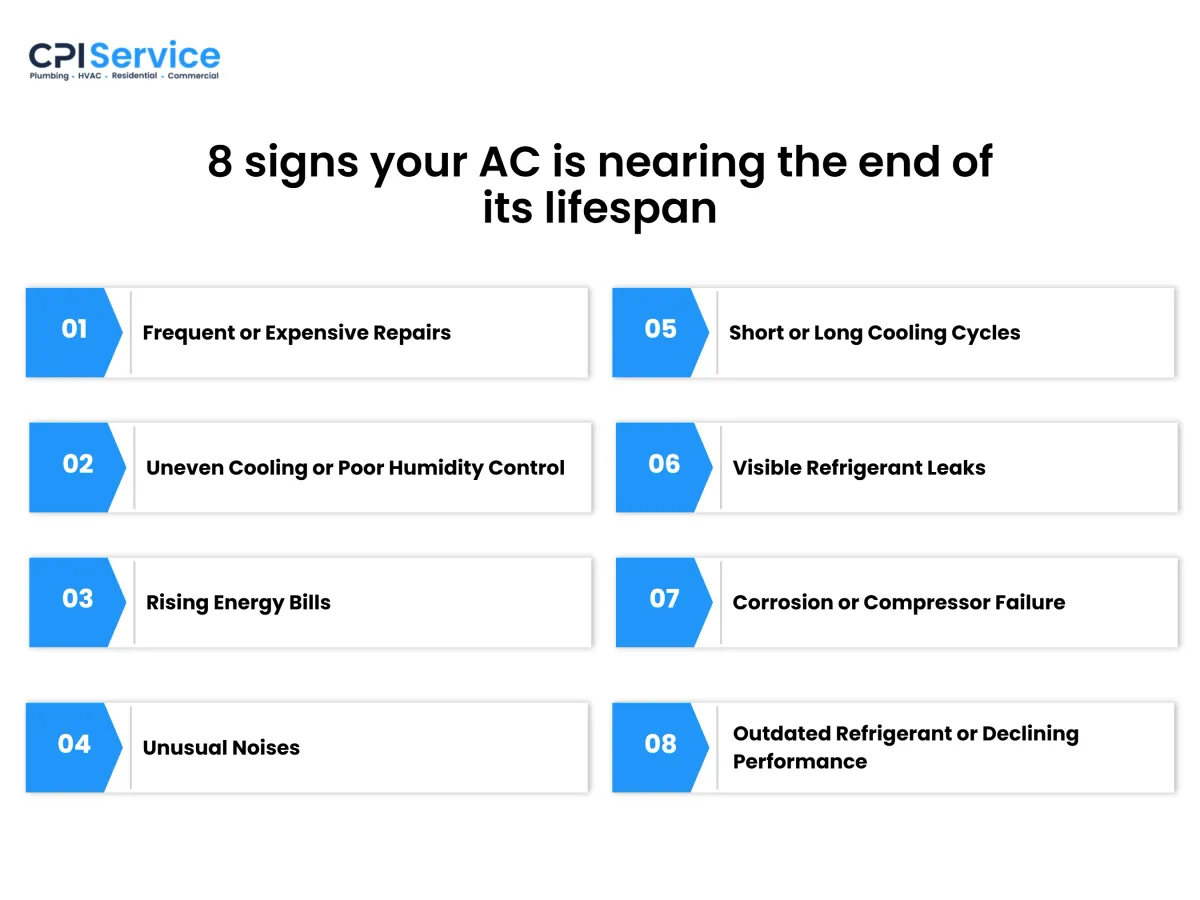
Spotting these signs early helps you decide whether one more repair is worth it, or whether it’s time to plan a replacement.
- Frequent or expensive repairs. Repeated breakdowns often mean major parts like the compressor or evaporator coil are wearing out. When AC repair costs become a large share of the price of a new system, replacement is usually cheaper over time.
- Uneven cooling or poor humidity control. Some rooms stay warm, or the house feels sticky even though the AC runs. Aging parts, refrigerant problems or a weakening compressor are common causes.
- Rising energy bills. Worn components use more electricity to deliver the same cooling, so bills climb without any change in how you use the AC.
- Unusual noises. Grinding, banging, squealing or rattling usually means wear or damage in the blower motor, fan, bearings or compressor, and needs a professional look.
- Short or long cooling cycles. Turning on and off every few minutes, or running nonstop without reaching the set temperature, both add wear and waste energy.
- Visible refrigerant leaks. Ice on the refrigerant lines or oily residue around fittings point to a leak, often from a leaking evaporator coil. Low refrigerant makes the compressor work harder.
- Corrosion or compressor failure. Rusted lines, deteriorating parts or a failed compressor usually lead to repairs that make replacement the better choice.
- Outdated refrigerant. Systems that use R-22 are expensive to repair: under EPA rules, R-22 (HCFC-22) has not been produced or imported in the U.S. since 2020, so only recovered or stockpiled supply remains.
Should You Repair or Replace Your AC?
The decision comes down to the system’s age, how often it breaks, what the repair costs and the condition of the major parts.
| Repair it when… | Replace it when… |
|---|---|
| It’s under about 10 to 12 years old and well maintained | It’s 15 to 20 years old or past its expected life |
| The problem is a minor part: capacitor, contactor, fan motor, thermostat | The compressor or a coil has failed |
| The repair costs a small fraction of a new system | Repairs keep coming back every season |
| It cools well again after the repair | Energy bills and comfort keep getting worse |
| It uses R-410A or a current refrigerant, with parts readily available | It uses R-22 |
A common rule of thumb: multiply the system’s age by the repair cost. If the result is more than about $5,000, replacement is usually the better value. New systems use newer refrigerants such as R-454B or R-32; existing R-410A systems can still be serviced.
How to Extend Your Air Conditioner’s Life
- Replace the filter every 1 to 3 months to keep air moving and protect the blower and compressor.
- Schedule an annual tune-up. A technician cleans the coils, checks the charge and electrical parts, and catches small problems early, which also helps efficiency and your energy bill. See the cost of an AC tune-up, or join one of our membership plans, which include annual maintenance.
- Keep 2 to 3 feet of clearance around the outdoor unit for airflow and heat transfer.
- Keep the coils clean. Rinse leaves and dirt off the outdoor coil gently with a garden hose (power off at the disconnect first); leave the indoor coil to a technician.
- Fix refrigerant leaks promptly. Running low on refrigerant hurts cooling and overheats the compressor.
- Keep vents and returns clear of furniture, curtains and debris for balanced airflow.
- Seal leaky ducts, especially in the attic, so cooled air isn’t lost and the AC doesn’t have to run longer.
- Use moderate thermostat settings. Set it as high as is comfortable when you’re home (around 78°F works for many people) and higher when you’re away; see how to save money on AC.
- Avoid constant thermostat changes, which add start-up cycles and wear.
- Fix small faults early, such as a weak capacitor or a worn contactor, before they damage the compressor or a motor.
When to Call a Professional
Get professional help for major repairs, refrigerant leaks, electrical problems, poor cooling, persistent noises, frequent breakdowns, frozen coils, and the annual maintenance visit. Call when:
- The AC stops cooling properly even after you’ve changed the filter and checked the thermostat settings.
- You see signs of a refrigerant leak, or the system is low on refrigerant.
- An electrical part fails: a capacitor, contactor, wiring, or a breaker that keeps tripping. Don’t open the unit’s electrical panel yourself.
- Grinding, banging, squealing or rattling continues while it runs.
- The evaporator coil or refrigerant lines freeze. Turn the cooling off and let it thaw; ice usually points to an airflow or refrigerant problem.
- The compressor, condenser fan motor or blower motor stops working or needs replacement.
CPI Service repairs, maintains and replaces air conditioners and heat pumps throughout San Jose and the South Bay. Schedule AC service, request a free estimate or call (408) 978-3093.
Frequently Asked Questions
How long does a central air conditioner last?
Typically 15 to 20 years with regular maintenance and correct sizing. Systems that were oversized, poorly installed or rarely serviced often fail sooner.
Do air conditioners last longer in San Jose?
Often, yes. The South Bay's mild summers mean fewer cooling hours than hot inland or desert climates, so a well-maintained central AC here has a good chance of reaching the upper end of its range. Heat pumps, which also heat in winter, run more hours a year.
Should I replace a 15-year-old air conditioner?
Not automatically. If it still cools well, has had few repairs and uses a current refrigerant, maintaining it can make sense. Consider replacing it if it needs a major repair (compressor or coil), uses R-22 refrigerant, or keeps breaking down.
What part of an AC fails most often?
The capacitor, which helps the compressor and fan motors start. It typically lasts 5 to 10 years and is an inexpensive repair compared with the compressor it protects.
Our new heat pump system has just been installed and we are very pleased with CPI and the new equipment. We are especially grateful for the knowledgeable and hard-working technician Bunhak, who worked throughout our recent heatwave to finish the job. We would highly recommend CPI for any HVAC installation or maintenance.
Linda G., Google review
Read more reviews →Serving San Jose and the South Bay
CPI Service is based at 2880 Aiello Dr in San Jose and serves homes and businesses across the South Bay and the Peninsula. See all the areas we serve.