AC Short Cycling: Causes & Fixes
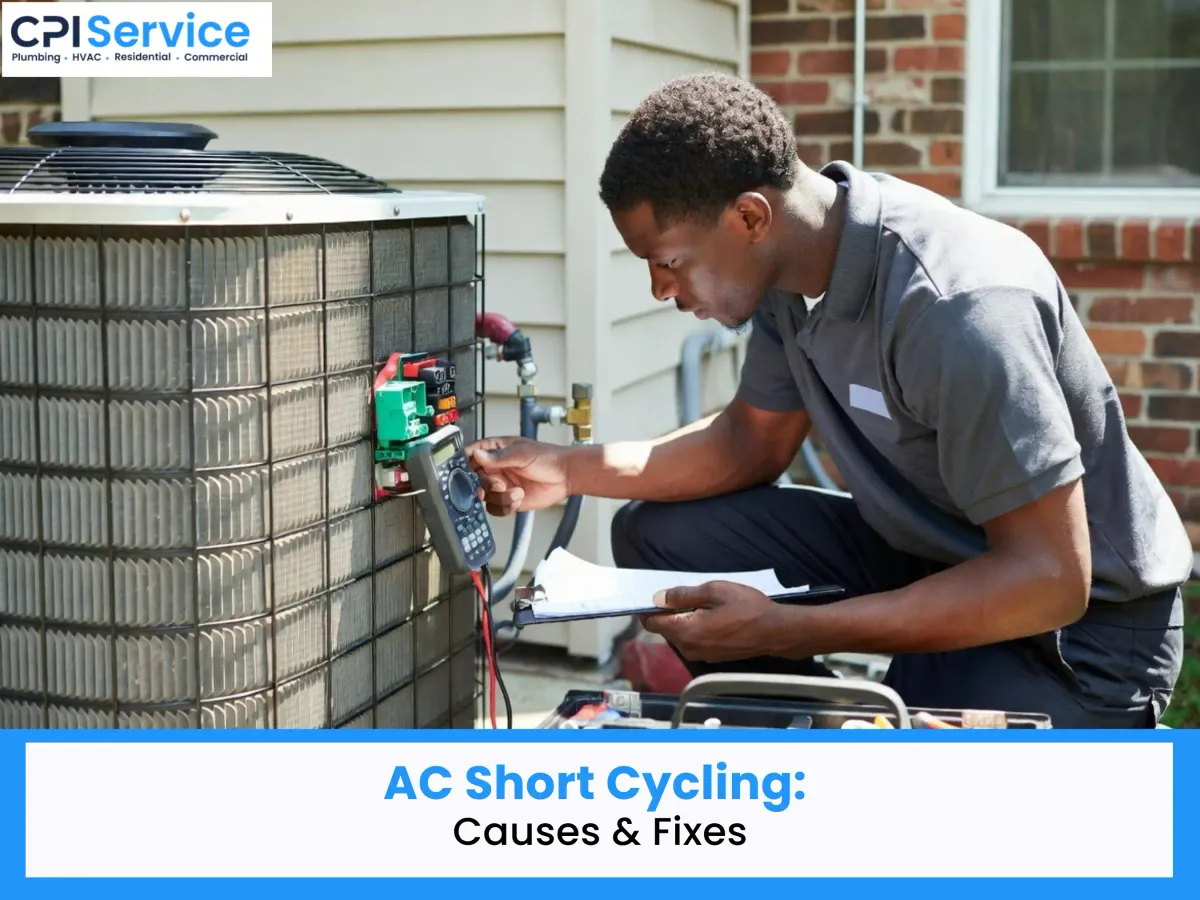
Table of Contents
- What Is AC Short Cycling?
- How Can You Tell if Your AC Is Short Cycling?
- What Causes AC Short Cycling?
- How Do You Fix AC Short Cycling?
- Is AC Short Cycling Bad for Your System?
- Short Cycling in South Bay Homes
- When Should You Call a Professional Technician for AC Short Cycling?
- How Can You Prevent AC Short Cycling?
- Frequently Asked Questions
AC short cycling means your air conditioner turns on and off every few minutes instead of running a full cycle. Each start is hard on the compressor, the house never gets properly dehumidified, and the system wastes electricity. In the South Bay, an oversized system is a common cause, since our mild summer days rarely need full capacity.
The other usual causes are a dirty filter, low refrigerant, dirty coils, a frozen coil, a badly placed or failing thermostat, an electrical fault or blocked ducts.
Start with the simple checks below (filter, thermostat, outdoor unit, vents). If the cycling continues, or you suspect a refrigerant leak or an electrical problem, have a technician diagnose it before it damages the compressor. Left alone, short cycling raises energy bills, wears out parts early and shortens the life of the whole system.
What Is AC Short Cycling?
Short cycling is a malfunction in which the AC starts and stops too often, running only a few minutes at a time instead of completing a normal cooling cycle. Those short runs don’t cool or dehumidify the house properly, they use more electricity, and every extra start adds strain to the compressor and its starting parts. Catching it early helps prevent more serious damage.
How Long Should an AC Cycle Last?
A conventional single-stage central AC usually runs for roughly 10 to 20 minutes at a time on a warm day, shuts off once the thermostat is satisfied, and starts again a while later. On hot or humid afternoons it runs longer, sometimes almost continuously, and that’s normal. If your AC shuts off after just a few minutes, then starts again soon after, over and over, it’s short cycling.
How long and how often it runs depends on the weather and how much heat the house is gaining:
| Conditions | What’s normal |
|---|---|
| Warm, moderate day | Regular cycles of roughly 10 to 20 minutes, with a rest between them |
| Hot afternoon | Much longer cycles, sometimes running almost nonstop to keep up with the heat |
| Mild evening | Fewer starts and longer rests between cycles as the house needs less cooling |
How Often Should an AC Turn On and Off?
A single-stage AC typically cycles on two or three times an hour in average conditions, with a rest period between runs that lets pressures settle before the next start. Many more starts than that, each lasting only a few minutes, is short cycling.
Two things look like short cycling but aren’t:
- Variable-speed and inverter systems are designed to run long, low-speed cycles and adjust their output instead of switching fully on and off.
- Heat pumps in winter periodically run a short defrost cycle to clear frost from the outdoor coil.
How Can You Tell if Your AC Is Short Cycling?
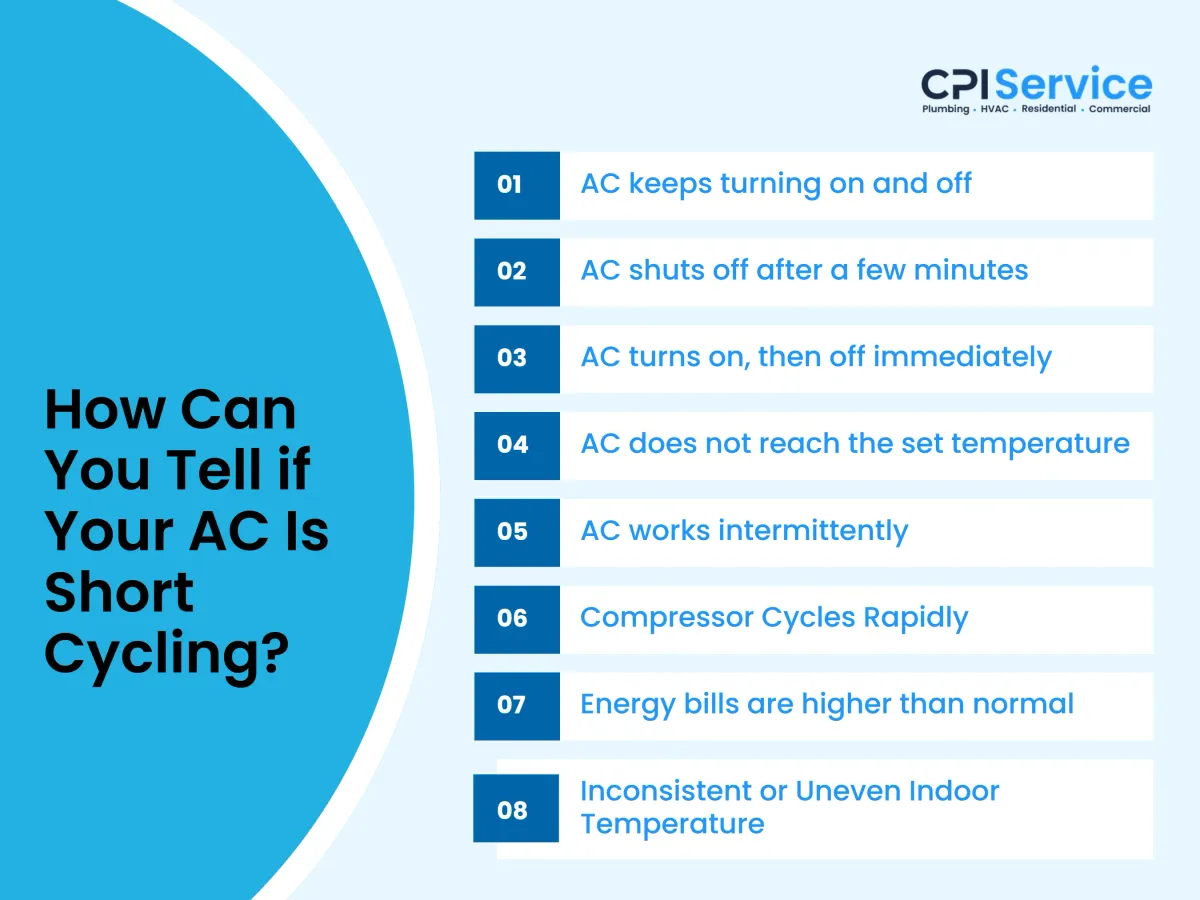
The signs are an AC that turns on and off every few minutes, shuts off before reaching the set temperature, cools unevenly, runs at random times, cycles the compressor rapidly or runs up your electric bill. This table matches what you notice to the usual cause:
| What you notice | What it often means |
|---|---|
| Shuts off after a few minutes, then restarts | Oversized system, dirty filter, or a coil freezing and tripping a safety control |
| Starts, then stops within seconds | Electrical problem (capacitor, contactor) or a safety switch such as a full drain pan |
| Never reaches the set temperature | Short cycles cool only near the thermostat; or low refrigerant |
| Runs at random, unpredictable times | Thermostat, wiring or control board fault |
| Clicking, a hot or buzzing outdoor unit | The compressor straining with every restart |
| A humid, clammy house | Cycles too short to remove moisture |
| Higher electric bills | Frequent starts and poor efficiency |
- The AC keeps turning on and off. Each run ends before the system can pull much moisture out of the air passing over the cold coil, so the house feels clammy. Turning the thermostat down to compensate only makes it cycle more.
- It shuts off after a few minutes. A unit that stops within a few minutes is often reacting to stress or a false signal that cooling is done. An oversized system cools the air around the thermostat too fast and stops before the rest of the house is comfortable; a dirty filter can freeze the coil and trip a safety control that protects the compressor.
- It turns on, then off almost immediately. Shutting down within seconds usually points to an electrical fault or a safety device. The compressor needs a surge of power to start, and a failing capacitor or relay can’t supply it. A float switch in a flooded drain pan also cuts power right away to prevent water damage.
- It never reaches the set temperature. Even cooling depends on long runs that move air through the whole house. Short cycles cool the rooms near the supply vents while distant rooms stay warm, so the thermostat keeps calling for cooling and the loop repeats.
- It runs at random times. Irregular on-off patterns usually come from the controls: damaged thermostat wiring, a corroded control board, or a sensor in a draft sending inconsistent signals.
- The compressor cycles rapidly. The compressor relies on oil carried by the refrigerant to lubricate its moving parts. Frequent restarts don’t give the oil time to circulate or the pressures time to equalize, which raises wear and heat and can lead to blown fuses, tripped breakers or early failure.
- Your energy bills are higher than normal. An AC draws much more power for the first moments of each start than it does while running steadily. A system that restarts constantly spends much of its time in that high-draw startup, so you pay for more electricity and get less cooling.
- Temperatures are uneven. Rooms nearest the vents cool quickly while farther rooms stay warm, creating hot and cold spots. That’s a sign the system isn’t running long enough to circulate air through the house.
What Causes AC Short Cycling?
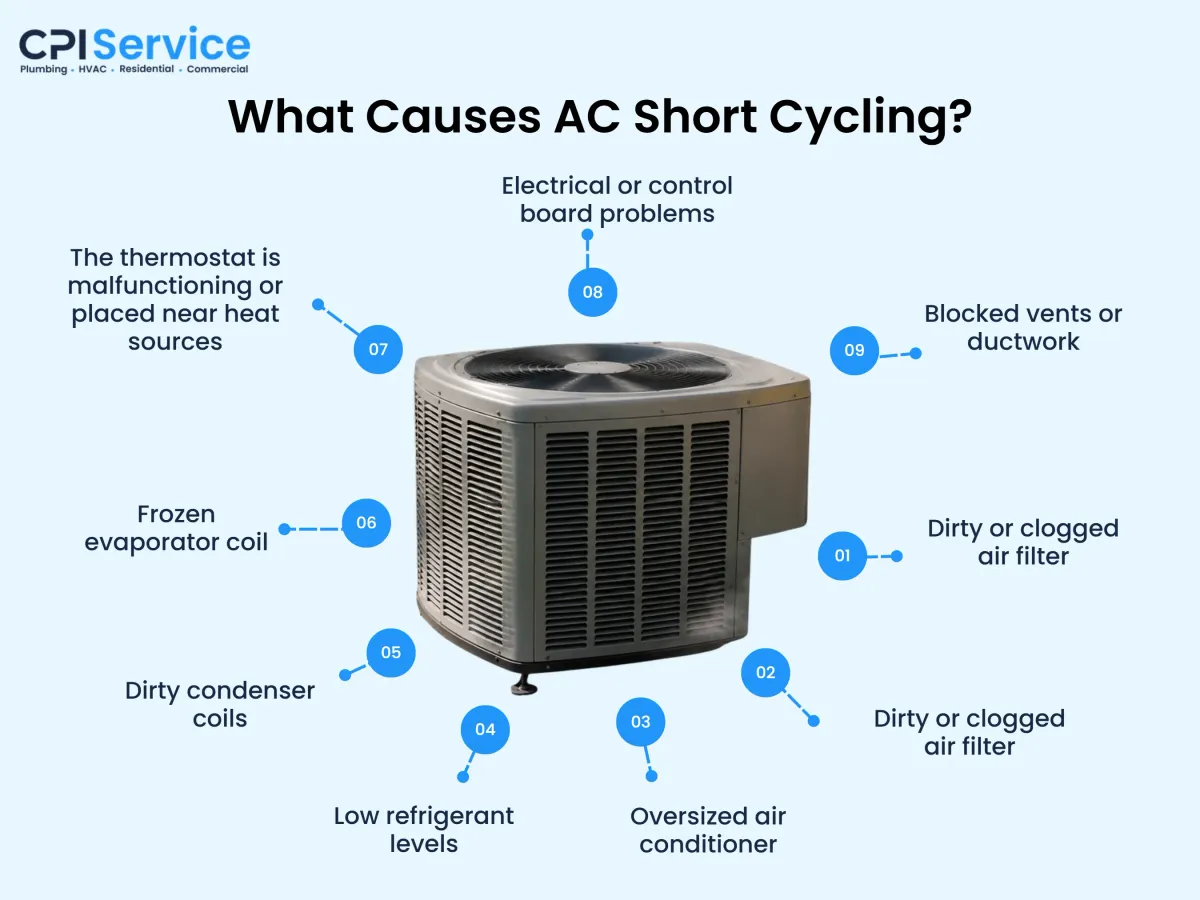
Most causes either restrict airflow, throw off temperature control, or force a protective shutdown before the cycle finishes. Finding the real cause is what stops it.
Dirty or Clogged Air Filter
A filter packed with dust blocks air moving through the system. The indoor coil can freeze or the system can overheat before a cycle finishes, and the safety controls shut it down. Replacing filters on schedule keeps airflow and cooling steady. ENERGY STAR warns that a dirty filter can increase energy costs and damage your equipment, leading to early failure.
Oversized Air Conditioner
A system that’s too big cools the air near the thermostat quickly and shuts off before the rest of the house cools or the humidity drops. The constant starts wear the compressor and leave the house damp. A professional load calculation shows the right size; see what size AC unit you need.
Low Refrigerant
A leak or an incorrect charge means the system can’t absorb and move heat properly, and protective controls stop the compressor early. Repeated interruptions cut cooling and strain the compressor. Adding refrigerant without fixing the leak doesn’t solve it.
Dirty Condenser Coil
When the outdoor coil is covered in dirt or debris, heat can’t escape. Operating temperatures and pressures rise, the compressor works harder, and the unit can overheat and shut itself down, wasting energy and wearing parts early.
Frozen Evaporator Coil
Restricted airflow or low refrigerant can ice over the indoor coil. Ice stops the coil from absorbing heat, and the system shuts down and restarts erratically. Thawing it helps only for a while unless the airflow or refrigerant problem is fixed too.
Thermostat Problems or Poor Placement
A thermostat in direct sun, beside a supply vent or near heat-producing appliances reads the wrong temperature and shuts the compressor off too soon. Low batteries, loose wiring, poor calibration or a failing unit cause the same. See thermostat repair and installation.
Electrical or Control Board Problems
Faulty wiring, relays, contactors, a weak capacitor or a failing control board interrupt the signals between components and stop the system right after it starts. These involve electrical hazards, so diagnosis and repair belong to a licensed technician; see the signs of a bad AC capacitor.
Blocked Vents or Ductwork
Closed vents, furniture over returns, debris and crushed or disconnected ducts restrict circulation, which can overheat the system or freeze the coil before a cycle finishes.
How Do You Fix AC Short Cycling?
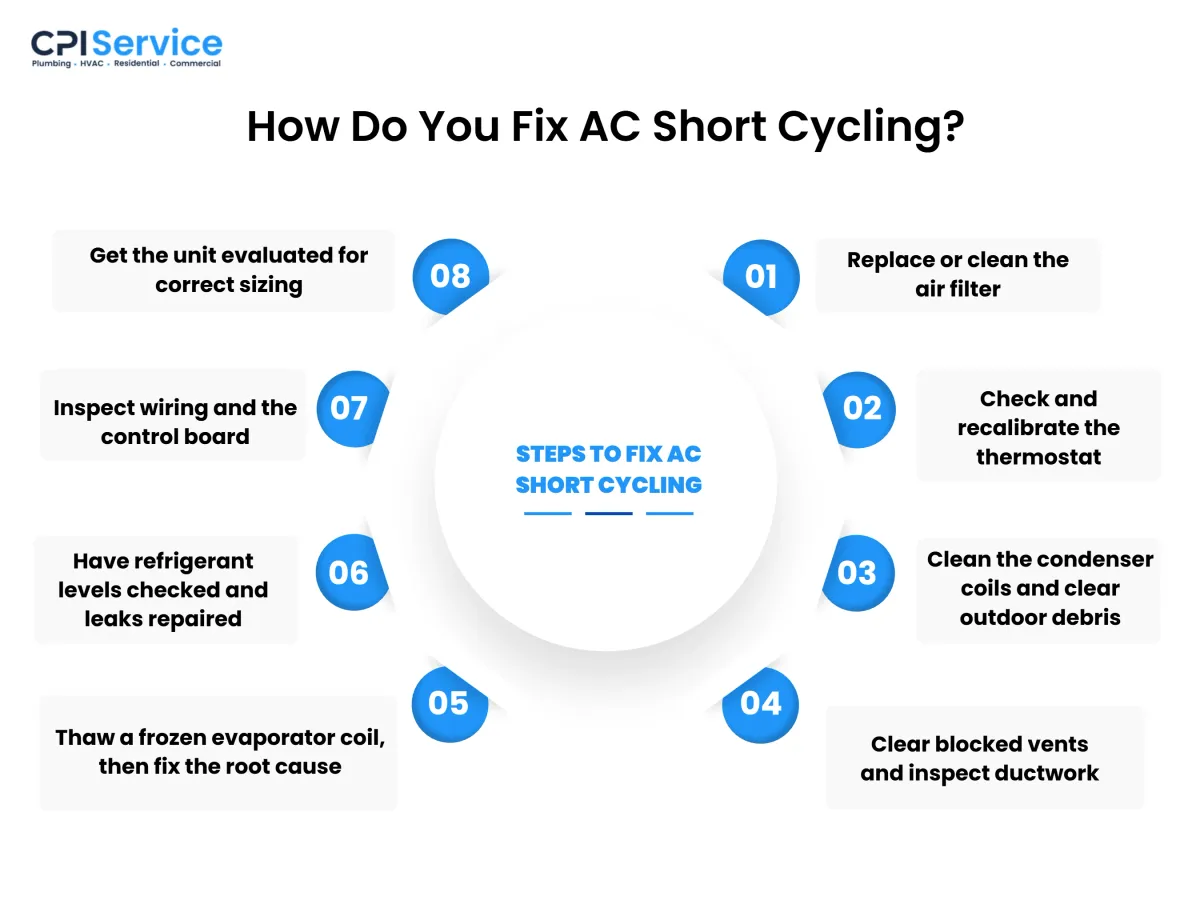
Begin with the simple maintenance steps, which clear up the common airflow and thermostat causes. If short cycling continues, or the cause involves refrigerant, electrical parts or system size, call a licensed technician.
Things You Can Do
1. Replace or Clean the Air Filter
Replace a disposable filter, or clean a reusable one, when it’s dirty. Check it monthly in summer and replace it every 1 to 3 months. If short cycling continues with a clean filter, schedule an inspection.
2. Check the Thermostat
Replace the batteries, confirm the settings and recalibrate it if the manufacturer’s instructions allow. Note whether it’s in direct sun, near an appliance or beside a supply vent; if so, it may need to be moved. If the problem continues after these checks, call for service.
3. Clean Around the Outdoor Unit
With the power off at the outdoor disconnect, remove leaves, grass and debris and keep about 2 feet of clearance. Gently rinse the coil from the inside out with a garden hose at low pressure (never a pressure washer), or brush off loose dirt with a soft brush. A clean coil sheds heat and takes strain off the compressor.
4. Open Vents and Check the Ducts You Can See
Open every supply and return vent and move furniture, rugs and curtains that block them. Where ductwork is easy to see, look for disconnected sections, crushed runs or obvious leaks, and have a technician repair them.
5. Thaw a Frozen Coil, Then Fix the Cause
If you see ice on the indoor coil or the refrigerant lines, turn cooling off and run the fan only until it thaws, which can take a few hours. Don’t chip at the ice or use heat to speed it up. Then find out why it froze (usually airflow or refrigerant) before running the AC again, or it will freeze again.
Things a Technician Should Do
6. Find and Repair Refrigerant Leaks
If cooling is fading or you suspect a leak, a technician locates and repairs it, then charges the system correctly. Just adding refrigerant won’t stop the short cycling.
7. Test the Electrical Parts
Wiring, relays, contactors, capacitors and the control board carry a shock risk, and capacitors hold a charge even with the power off. Leave inspection and testing to a technician, who can find loose connections, overheated wiring and failing parts and restore reliable operation.
8. Check the System’s Size
A technician can evaluate whether the AC fits the home. An oversized system cools too quickly; an undersized one struggles to keep up; both can cycle badly. A load calculation shows what the home actually needs, and a two-stage or variable-speed replacement can also help.
Is AC Short Cycling Bad for Your System?
Yes. Every start is the hardest moment in a compressor’s life: it draws a surge of current and starts before oil and pressures have settled. Frequent starts and stops mean:
- Compressor damage. The repeated electrical and mechanical stress, reduced lubrication and higher temperatures wear the compressor fastest, and compressor failure is the most expensive repair an AC can have, sometimes the reason to replace the system.
- Higher energy bills. Each start uses more electricity than steady running, so constant cycling costs more while delivering less cooling.
- Poor cooling. Short runs leave rooms uneven and humidity high, so the house feels uncomfortable even with the thermostat set correctly.
- More wear on parts. Relays, contactors, capacitors and electrical contacts wear out faster, which means more breakdowns and repairs.
- Overheating. Without enough rest between cycles, heat builds up in the compressor and electrical parts, triggering safety shutdowns and damaging capacitors and control boards.
- A shorter system life. The compressor, motors and electrical parts all age faster; see how long air conditioners last.
Can AC Short Cycling Damage Your Compressor?
Yes, permanently. Each rapid restart forces the compressor to start against high refrigerant pressure with limited lubrication, which leads to overheating, electrical burnout and internal wear. Left unresolved, it can end in early compressor failure. If the outdoor unit is clicking, buzzing or very hot, turn the AC off and call for service rather than letting it keep restarting; see AC compressor replacement cost.
Short Cycling in South Bay Homes
- Oversizing shows up on mild days. San Jose’s moderate summers mean many systems are bigger than the home needs most of the time. An oversized AC short cycles most on mild days, exactly the weather we have most of the summer.
- Hallway thermostats in the sun. In many local homes the thermostat sits in a hallway that gets afternoon sun through a nearby window or skylight, which shortens cycles.
- Attic ducts. Crushed or disconnected ducts in hot attics restrict airflow and can freeze the coil. See duct repair.
- Heat pump defrost. Heat pumps, increasingly common here, cycle through defrost on cold, damp winter mornings. That’s normal.
When Should You Call a Professional Technician for AC Short Cycling?
Call a technician if short cycling continues after basic troubleshooting, or if you notice any of these:
- It keeps short cycling after the DIY fixes. If a new filter, a thermostat check and a clean outdoor unit didn’t stop it, the cause is likely refrigerant, electrical, airflow or sizing, which needs an inspection.
- You suspect a refrigerant leak. Ice on the coil, hissing or fading cooling point to low refrigerant. Handling refrigerant takes certification and special equipment.
- The coil refreezes after thawing. The airflow or refrigerant problem behind it hasn’t been fixed, and running it strains the compressor.
- The compressor clicks, buzzes, overheats or keeps shutting off. These are signs of serious stress; prompt diagnosis can prevent a compressor failure.
- The breaker keeps tripping or you smell burning. Turn the AC off first: continuing to run it may be a safety hazard.
- The AC runs but doesn’t cool. The cause may be low refrigerant, dirty coils, airflow or a failing part; see AC not blowing cold air, or check whether an evaporator coil is leaking.
- The system is 10 to 15 years old and short cycling keeps coming back. Several parts may be wearing out at once; a technician can tell you whether repair or replacement makes more sense.
How Can You Prevent AC Short Cycling?
Routine homeowner care plus a yearly professional inspection keeps most systems cycling normally:
- Replace filters every 1 to 3 months, or clean reusable filters as the manufacturer recommends, so the coil doesn’t freeze and the system doesn’t overheat.
- Schedule an annual tune-up to catch worn parts, refrigerant problems and electrical faults early; our membership plans include one.
- Keep the condenser coil clean so heat escapes and pressures stay normal.
- Keep airflow open: vents and returns unblocked and ducts in good repair.
- Watch for refrigerant warning signs such as ice, hissing or fading cooling, and have them checked promptly.
- Keep the thermostat accurate and away from sun, vents and heat sources.
- Size replacement equipment with a load calculation, not by matching the old unit; see also how to save money on AC.
- Keep 2 feet of clearance around the outdoor unit, free of leaves, grass and branches.
CPI Service diagnoses and repairs air conditioners and heat pumps throughout San Jose and the South Bay. Schedule AC repair, request a free estimate or call (408) 978-3093.
Frequently Asked Questions
How long should an AC cycle last?
On a typical warm day, a single-stage central AC usually runs for roughly 10 to 20 minutes per cycle, two or three times an hour, and longer on hot afternoons. If it keeps shutting off after just a few minutes, it's likely short cycling. Variable-speed systems are different: they're designed to run long, low-speed cycles.
Is AC short cycling dangerous?
It isn't usually a safety hazard, but it's hard on the equipment. Frequent starts wear the compressor, capacitor and contactor, waste electricity and leave the house humid. A burning smell or a breaker that keeps tripping is different: turn the AC off and call for service.
Can a thermostat cause short cycling?
Yes. A thermostat in direct sun, next to a supply vent or near a heat source reads the wrong temperature and stops the AC early. Low batteries, loose wiring and a failing thermostat can do the same.
Why does my heat pump turn on and off in winter?
In winter a heat pump periodically runs a defrost cycle to clear frost from the outdoor coil, which can look like short cycling. Defrost every so often on cold, damp mornings is normal; constant on-off cycling is not.
CPI Service is a great company to use for HVAC too! Our A/C stopped working during the recent heatwave & another company wanted to replace our whole unit. Then we called CPI & they found it didn’t need to be replaced, they fixed it that day! I really appreciate a company that responds quickly, is very professional & reasonably priced!!! I’ll be using them for sure in the future.
Jaycee V., Google review
Read more reviews →Serving San Jose and the South Bay
CPI Service is based at 2880 Aiello Dr in San Jose and serves homes and businesses across the South Bay and the Peninsula. See all the areas we serve.