What Size AC Unit Do I Need?
Table of Contents
- How Is AC Unit Size Measured?
- What Size AC Unit Do You Need Based on Square Footage?
- What Size AC for a Single Room?
- How Do You Estimate the Right AC Unit Size?
- Which Factors Change the AC Size You Need?
- AC Sizing in San Jose and the South Bay
- What Happens If Your AC Is the Wrong Size?
- Should You Have an HVAC Technician Confirm Your AC Unit Size?
- Why Is Professional AC Installation Important After Sizing Your Home?
- Frequently Asked Questions
For most homes, the right AC size is between 1.5 and 5 tons (18,000 to 60,000 BTUs per hour); your home’s cooling load, not its floor area alone, decides where it falls. In San Jose and the South Bay, the mild climate often puts it toward the lower end, one more reason to measure instead of guessing.
As a rough starting point, homes under 1,000 square feet often start around 1.5 tons, homes of 1,000 to 2,000 square feet around 2 to 2.5 tons, and larger homes around 3 to 5 tons. Those are estimates, not answers: climate, insulation, ceiling height, windows, sun, occupancy and humidity decide your home’s actual cooling load, which is why two homes with the same floor area can need different systems.
Getting the size right matters. An undersized system runs constantly and still can’t keep up; an oversized one short cycles, leaves the air humid and wears out sooner. Before you buy, have the cooling load confirmed with a Manual J load calculation by a qualified HVAC technician. Try the estimator below for a first idea.
Quick AC Size Estimator
A starting point for whole-home central AC or heat pump sizing. Your answers adjust the chart below; they don't replace a load calculation.
This is a rough estimate, not a sizing recommendation. Duct condition, room-by-room loads and equipment ratings can change the right size, which is why a Manual J load calculation is needed before you buy. Ask for a free estimate or call(408) 978-3093.
How Is AC Unit Size Measured?
Air conditioner size means cooling capacity, not physical dimensions. It’s measured in BTUs per hour or in tons:
- BTU (British Thermal Unit): the heat needed to raise one pound of water by one degree Fahrenheit (about 1,055 joules). For an air conditioner, the BTU/hr rating is how much heat it can remove from your home in an hour. Room units start around 5,000 BTU/hr; residential central systems run up to about 60,000 BTU/hr.
- Tons: 1 ton of cooling equals 12,000 BTUs per hour (about 3.5 kW), the cooling effect of melting one ton of ice over 24 hours. Residential central systems usually range from 1.5 to 5 tons.
How Do You Convert BTUs Into Tons?
Divide the BTU/hr rating by 12,000:
Tons = BTU/hr ÷ 12,000 · BTU/hr = Tons × 12,000
For example, a 24,000 BTU/hr unit is 24,000 ÷ 12,000 = 2 tons.
| Cooling capacity | Tons |
|---|---|
| 9,000 BTU/hr | 0.75 |
| 12,000 BTU/hr | 1 |
| 18,000 BTU/hr | 1.5 |
| 24,000 BTU/hr | 2 |
| 30,000 BTU/hr | 2.5 |
| 36,000 BTU/hr | 3 |
| 48,000 BTU/hr | 4 |
| 60,000 BTU/hr | 5 |
What Size AC Unit Do You Need Based on Square Footage?
By square footage alone, a common starting point is about 1.5 tons for 600 to 1,000 square feet, rising to about 5 tons for homes over 3,500 square feet. Count only conditioned floor area: leave out garages, unfinished attics, crawl spaces and unconditioned basements.
AC Unit Size Chart by Square Footage
| Conditioned floor area | Typical starting size | Cooling capacity |
|---|---|---|
| 600–1,000 sq ft | 1.5 tons | 18,000 BTU/hr |
| 1,000–1,500 sq ft | 2 tons | 24,000 BTU/hr |
| 1,500–2,000 sq ft | 2.5 tons | 30,000 BTU/hr |
| 2,000–2,500 sq ft | 3 tons | 36,000 BTU/hr |
| 2,500–3,000 sq ft | 3.5 tons | 42,000 BTU/hr |
| 3,000–3,500 sq ft | 4 tons | 48,000 BTU/hr |
| 3,500+ sq ft | 5 tons | 60,000 BTU/hr |
Use this chart as an illustration, not a recommendation. It shows typical starting sizes for whole-home systems in a moderate climate. Your home’s real cooling load can be higher or lower, and only a Manual J load calculation can tell you which.
What Size AC Unit for Homes Under 1,000 sq ft?
A home of 600 to 1,000 square feet typically starts around 1.5 tons (18,000 BTU/hr). Small homes, ADUs and additions are also good candidates for a ductless system; see single rooms and small spaces below.
What Size AC Unit for 1,000–2,000 sq ft Homes?
Homes of 1,000 to 1,500 square feet typically start around 2 tons (24,000 BTU/hr), and homes of 1,500 to 2,000 square feet around 2.5 tons (30,000 BTU/hr).
What Size AC Unit for Homes Larger Than 2,000 sq ft?
Larger homes typically start around 3 tons (36,000 BTU/hr) for 2,000 to 2,500 square feet, 3.5 tons for 2,500 to 3,000, 4 tons for 3,000 to 3,500, and 5 tons above that. The bigger the home, the more its layout, ceiling heights and window area matter, and the more likely it is to benefit from two systems or zoning instead of one large unit.
Why Two Homes the Same Size Can Need Different AC Sizes
Picture two 1,800-square-foot homes. One is a single-story 1960s ranch home with its original single-pane windows, little wall insulation and a big west-facing living room. The other is a newer two-story home built to California’s Title 24 energy code, with insulated walls and attic, dual-pane windows and mature shade trees. The chart gives both the same 2.5-ton starting point, but the first home gains heat much faster and may need more capacity, while the second may need less. A load calculation measures those differences instead of guessing.
What Size AC for a Single Room?
Sizing a window, portable or single-zone unit for one room is a different job from sizing a whole-home system. For room air conditioners, ENERGY STAR publishes a square-footage sizing chart that’s a sensible guide. For an ADU, a converted garage or an addition, a ductless mini-split sized to that space is often the most efficient choice.
For central air conditioners and heat pumps, the U.S. Department of Energy advises against rules of thumb and recommends a proper load calculation (DOE Energy Saver guide).
How Do You Estimate the Right AC Unit Size?
You can make a preliminary estimate in three steps, then confirm it with a professional:
- Measure the conditioned area. Multiply the length and width of each air-conditioned room and add them up. Leave out garages, unfinished attics and crawl spaces.
- Find your starting size in the chart. Look up your floor area in the chart above (or use the estimator).
- Adjust for your home. Expect more capacity for high or vaulted ceilings, poor insulation, single-pane windows or lots of afternoon sun, and less for a well-insulated, shaded home.
Then convert to BTUs if you need to (tons × 12,000) and have the result checked with a Manual J load calculation before choosing equipment.
Which Factors Change the AC Size You Need?
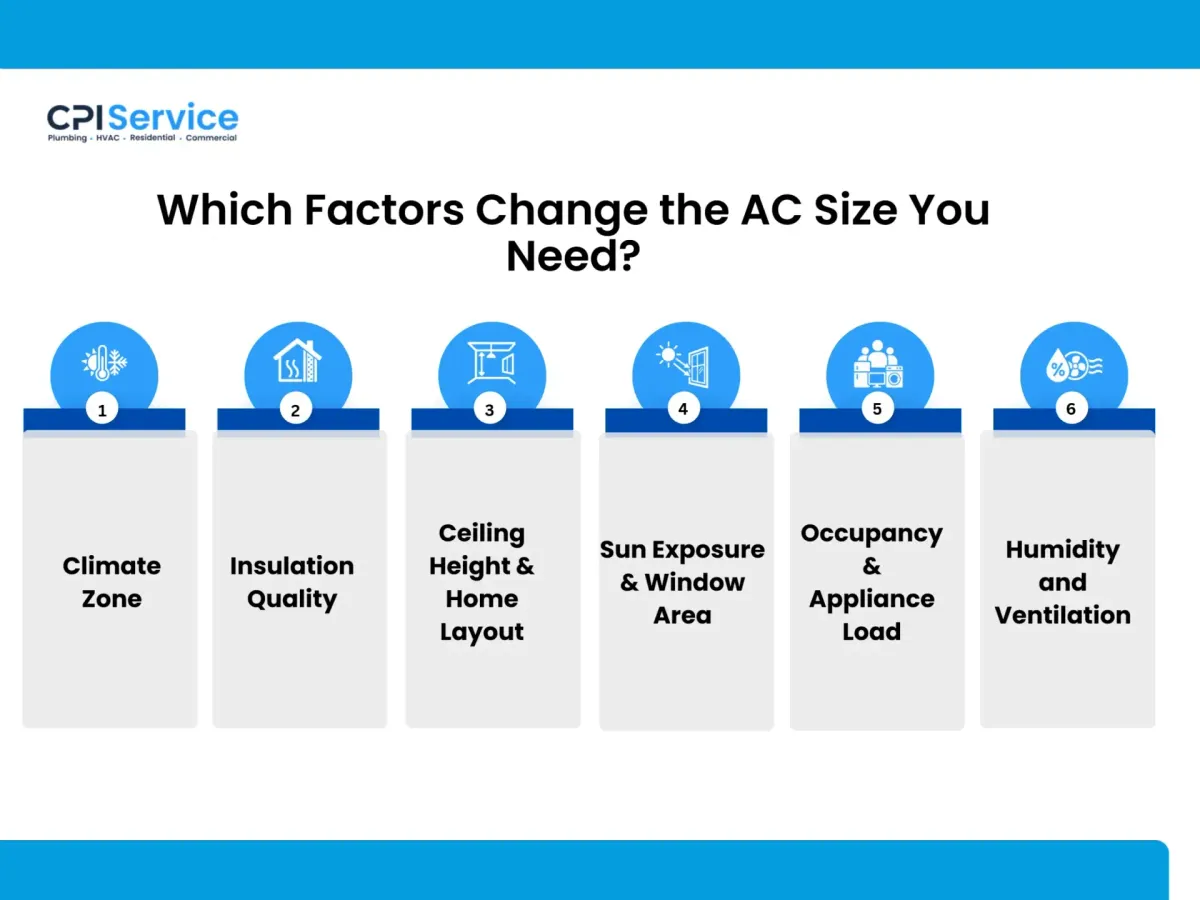
Your home’s cooling load is how much heat the system has to remove to keep you comfortable. These six factors change it:
- Climate. Hotter places need more cooling for the same floor area. San Jose’s summers are milder than desert climates, so homes here usually need less capacity than the same home in a place like Phoenix, and conditions vary within the South Bay too (see below).
- Insulation quality. Insulated walls, attics and floors slow heat gain; poorly insulated homes let heat in faster and need more capacity.
- Ceiling height and layout. Vaulted ceilings and open plans mean more air to cool than standard 8-foot ceilings and closed rooms.
- Sun exposure and window area. Large south- and west-facing windows add a lot of afternoon heat; shade and fewer windows reduce it.
- Occupancy and appliances. People, cooking, computers and lighting all add heat inside the home.
- Humidity and ventilation. The system also removes moisture, and fresh outdoor air brought in by ventilation adds to the load.
AC Sizing in San Jose and the South Bay
Local conditions matter when you size an air conditioner here:
- Older homes. Many San Jose neighborhoods were built in the 1950s to 1970s. Unless they’ve been upgraded, these homes often have little wall insulation, single-pane windows and ducts running through hot attics or crawl spaces, all of which raise the cooling load.
- Newer and remodeled homes. Homes built or remodeled to California’s Title 24 energy code are much better sealed and insulated. Replacing an old system in an upgraded home with the same size it had before can mean an oversized system.
- Near the bay vs inland. Neighborhoods closer to the bay often get cooler afternoon breezes, while areas farther inland and in the foothills, such as Morgan Hill and the east foothills, tend to see hotter summer afternoons. The same floor plan can need different capacity in each.
- Two-story homes. Upstairs rooms collect heat. Zoning or a separate upstairs system often solves comfort problems better than a bigger single unit.
- Heat pumps and rebates. Many South Bay homeowners replacing an AC choose a heat pump that heats and cools. It needs the same careful sizing, and local HVAC rebates can help with the cost.
We install and service systems throughout San Jose and the South Bay, so our technicians size equipment for local homes every day.
What Happens If Your AC Is the Wrong Size?
The wrong size costs you comfort, energy and equipment life.
Undersized AC Unit
- Runs constantly. It can’t remove heat as fast as it comes in, so it rarely shuts off on hot days.
- Can’t keep up. The house may never reach the thermostat setting, and the farthest rooms stay warm.
- Higher energy use. Long run times use more electricity while still falling short.
- More wear. Constant running strains the compressor, blower motor and fan and shortens the system’s life.
Oversized AC Unit
- Short cycling. It cools the air so quickly that it switches off and on repeatedly. Frequent AC short cycling strains the compressor and other parts.
- Poor humidity control. Short cycles don’t run long enough to pull moisture out, so the home can feel clammy even at the set temperature.
- Uneven cooling. The thermostat is satisfied before cooled air reaches every room.
- Wasted energy. Each start draws a surge of power, so frequent starts waste electricity.
- More wear. Repeated starts stress the compressor, blower motor and capacitor; watch for the signs of a bad AC capacitor, such as hard starts and humming.
Should You Have an HVAC Technician Confirm Your AC Unit Size?
Yes. A square-footage estimate can’t account for your insulation, windows, orientation, ducts and how your family uses the home. A technician performs a Manual J load calculation to measure those factors and then selects equipment that matches the result. CPI Service runs a Manual J calculation as part of its AC and heat pump estimates.
Example: Square-Footage Guess vs. a Manual J Result
This is an illustrative example, not a specific customer’s home. Take a 1,900-square-foot, single-story 1960s ranch home in San Jose with a 20-year-old 3.5-ton air conditioner that short cycles and leaves the house clammy.
| Size | How it was reached | |
|---|---|---|
| Existing system | 3.5 tons | Installed decades ago, likely oversized from the start |
| Square-footage rule (chart above) | 2.5 tons | 1,500 to 2,000 sq ft |
| Manual J load calculation | About 23,000 BTU/hr, so a 2-ton system | Measured insulation, windows, orientation, ducts and occupancy |
Why the Manual J result came in lower: the attic had been reinsulated, the original single-pane windows had been replaced with dual-pane, mature trees shade the west wall, and the attic ducts were sealed during the visit. A correctly sized 2-ton system runs longer, steadier cycles, removes more humidity and costs less to buy and run than another 3.5-ton unit. In another home of the same size, with west-facing glass, little insulation and a vaulted ceiling, the same calculation could just as easily call for 3 tons, which is why measuring beats guessing.
When Should You Get a Manual J Load Calculation?
- Before buying or replacing a system. Your old unit may never have been sized correctly, or your home may have changed since it was installed.
- For new construction, additions and remodels. New rooms, finished spaces, enclosed patios or layout changes change the load.
- After insulation or window upgrades. Better insulation and windows can lower the capacity you need.
- When you have comfort problems. Hot or cold rooms, uneven temperatures or high humidity can mean the system no longer matches the home. A technician should diagnose the cause first, since airflow or duct problems can look like a sizing problem.
Why Is Professional AC Installation Important After Sizing Your Home?
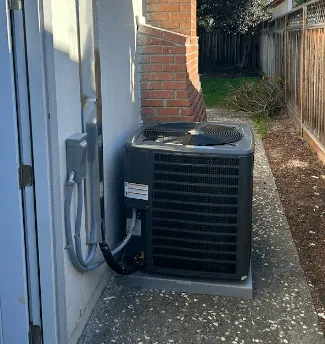
A correctly sized system only delivers its rated capacity if it’s installed correctly. A professional AC installation verifies the refrigerant charge, airflow, duct connections and electrical work against the load calculation and the manufacturer’s specifications, so the system cools evenly, controls humidity, runs efficiently and lasts.
Not sure what size you need? Request a free estimate and a CPI technician will look at your home and recommend the right system, or call us at (408) 978-3093.
Frequently Asked Questions
How many square feet does a 3-ton AC unit cool?
As a rule of thumb, a 3-ton (36,000 BTU/hr) system is a common starting point for about 2,000 to 2,500 square feet of conditioned space. Insulation, windows, ceiling height and how hot your part of the South Bay gets can move that up or down, so confirm it with a Manual J load calculation.
Is a bigger AC unit better?
No. An oversized AC cools the air quickly, then shuts off before it has removed much humidity. The short on-and-off cycles leave rooms uneven and wear the compressor faster. The right size is the one that matches your home's calculated cooling load.
Do homes in San Jose need a smaller AC than homes in hotter places?
Often, yes. San Jose's summers are milder than desert climates, so the same floor area usually needs less cooling capacity. Within the South Bay, homes near the bay tend to need less than homes inland or in the foothills.
What size AC do I need for one room?
For a single room, size a window, portable or ductless mini-split unit to that room. ENERGY STAR publishes a square-footage chart for room air conditioners. Whole-home central systems need a load calculation instead.
Our new heat pump system has just been installed and we are very pleased with CPI and the new equipment. We are especially grateful for the knowledgeable and hard-working technician Bunhak, who worked throughout our recent heatwave to finish the job. We would highly recommend CPI for any HVAC installation or maintenance.
Linda G., Google review
Read more reviews →Serving San Jose and the South Bay
CPI Service is based at 2880 Aiello Dr in San Jose and serves homes and businesses across the South Bay and the Peninsula. See all the areas we serve.