10 Most Effective Ways to Save Money on AC This Summer
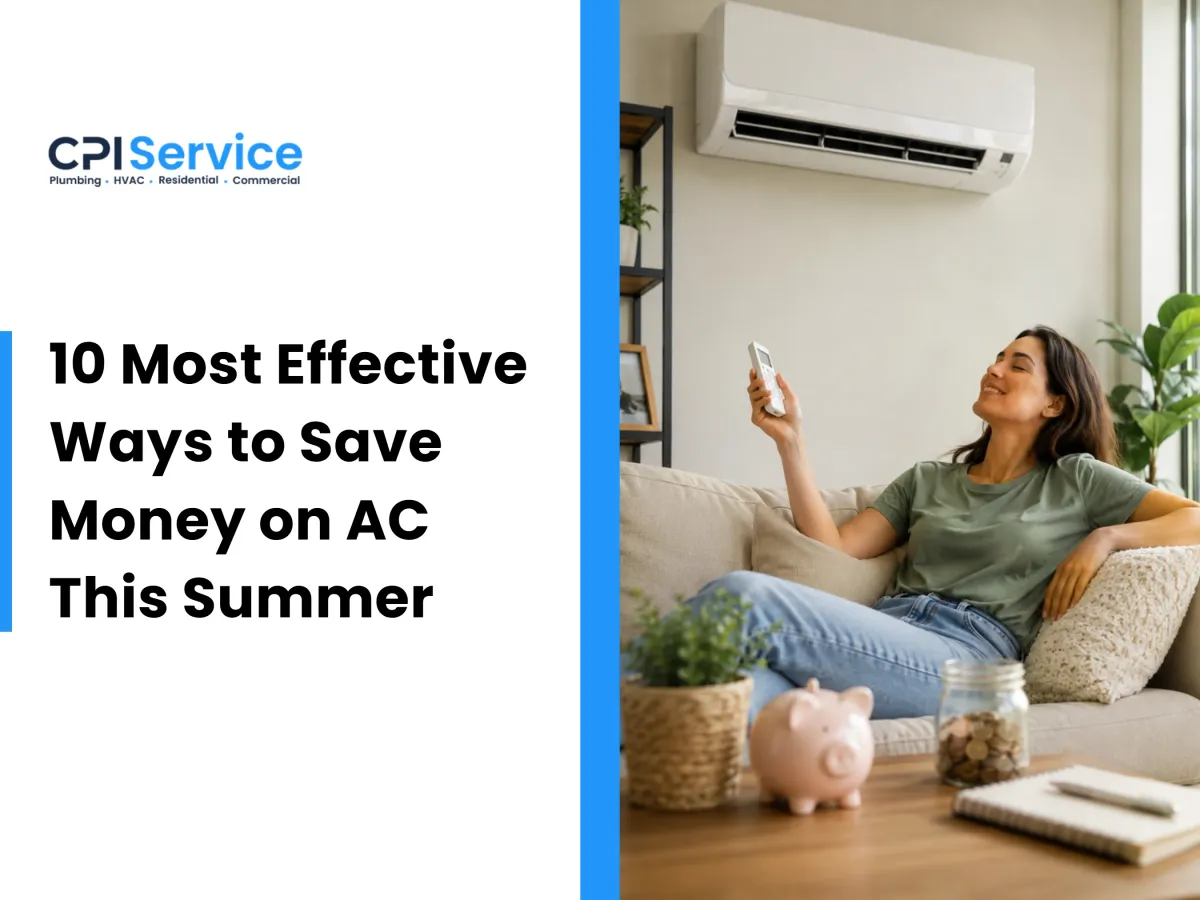
Table of Contents
- 10 Ways to Save Money on AC This Summer
- 1. Set the Thermostat a Little Higher
- 2. Automate It With a Smart or Programmable Thermostat
- 3. Check the Air Filter Every Month
- 4. Schedule a Spring Tune-Up
- 5. Seal Air Leaks Around Windows and Doors
- 6. Improve Attic Insulation
- 7. Use Ceiling Fans So You Can Raise the Thermostat
- 8. Block the Afternoon Sun
- 9. Cut Indoor Heat on Hot Afternoons
- 10. Upgrade an Old, Inefficient System
- How Does Regular Maintenance Improve AC Efficiency and Save Money?
- What Is the Best AC Temperature to Save Money?
- What Home Preparation Steps Can Help Reduce AC Costs?
- How Do Different AC Types Affect Savings?
- Which AC Upgrades Save the Most?
- What Affects How Much You Spend on AC?
- Saving on AC in San Jose
- When to Call an HVAC Professional
- Frequently Asked Questions
The biggest savings come from running the AC less and helping it work efficiently: set the thermostat higher, automate it, keep the filter and coils clean, keep heat out of the house, and stop cooled air from leaking away. In San Jose, timing matters too, because PG&E electricity costs the most from 4 to 9 p.m.
Using the AC well and preparing the house before summer does most of the work. Choosing the right system and upgrades, and understanding what drives the bill (insulation, ducts, humidity, electricity rates and thermostat settings), does the rest. If your AC runs constantly, cools unevenly, needs frequent repairs or hasn’t been serviced in a year, a technician can usually restore its efficiency before the bills climb.
10 Ways to Save Money on AC This Summer
1. Set the Thermostat a Little Higher
Set the thermostat as high as is comfortable when you’re home (around 78°F works for many people) and higher when you’re away. Every degree higher means less run time. The Department of Energy estimates you can save about 10% a year by setting the thermostat 7 to 10 degrees warmer for 8 hours a day (DOE Energy Saver guide). Setting it very low doesn’t cool the house faster; the AC just runs longer. Light, breathable clothing indoors makes a higher setting easier to live with.
2. Automate It With a Smart or Programmable Thermostat
A programmable or smart thermostat raises the temperature when you leave or go to sleep and brings it back before you return, so you never cool an empty house by accident. Smart models can also use geofencing (your phone’s location) to notice when everyone has left, follow the weather forecast, and let you check and change settings from an app. ENERGY STAR reports that certified smart thermostats save about 8% of heating and cooling bills on average (ENERGY STAR). Keep the fan on Auto, not On: on Auto it runs only while the AC is cooling, while On keeps it running all day. If you have a heat pump, the DOE advises using a thermostat designed for heat pumps before setting it back.
3. Check the Air Filter Every Month
A clean filter lets air flow freely across the cooling coil, so the blower and compressor work less and the system cools faster. A clogged one strains the system, raises energy use and shortens the life of its parts. Check it monthly in summer and replace it (or wash a reusable filter) when it’s dirty, at least every three months (ENERGY STAR maintenance checklist). Pets, dust and nearby construction mean more frequent changes.
4. Schedule a Spring Tune-Up
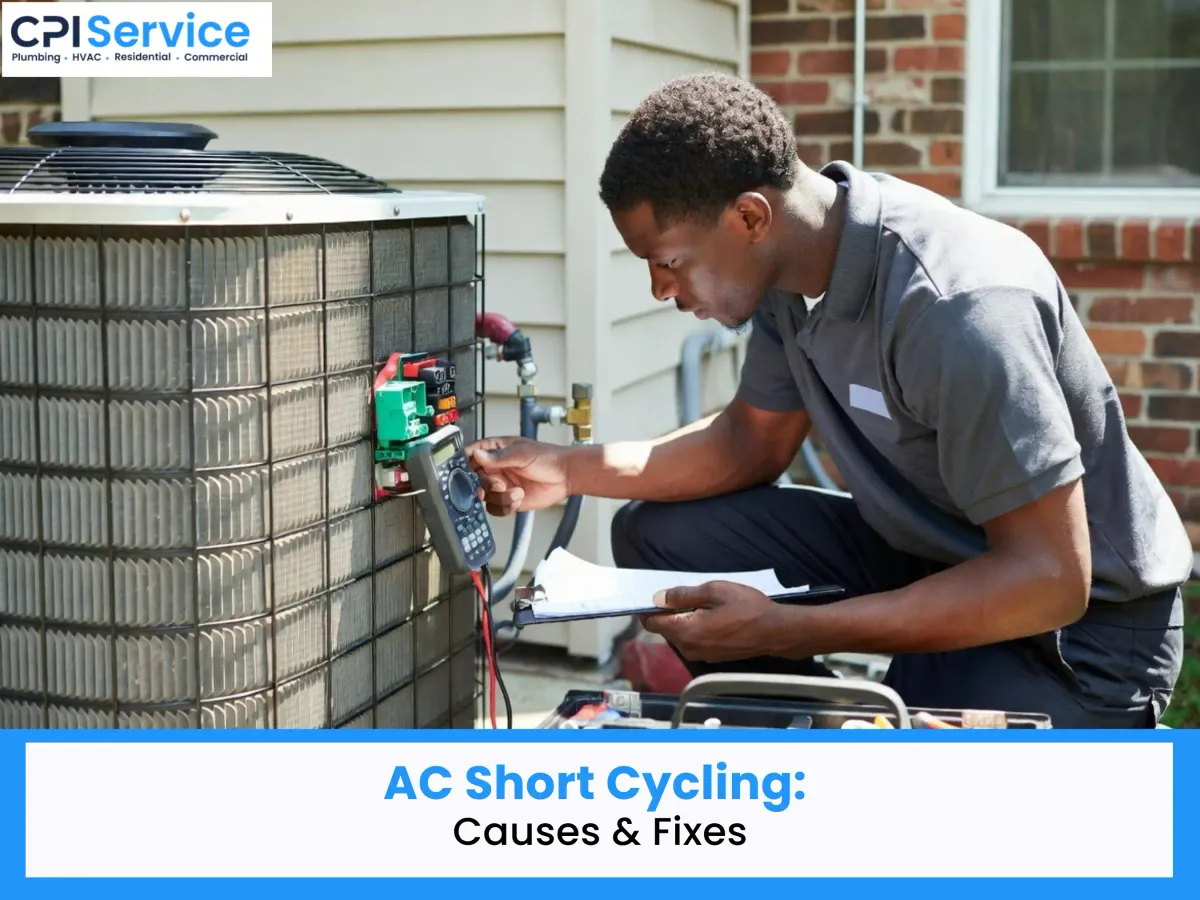
Before the hot weather, have a technician clean the evaporator and condenser coils, check the refrigerant charge, test the electrical connections and the capacitor, check moving parts, and clear the condensate drain. Dust, a low charge and worn parts all make the AC run longer for the same cooling. A tune-up also catches small problems before they turn into a breakdown in a heat wave. In San Jose an AC tune-up typically costs $150 to $300, and our membership plans include annual HVAC maintenance; see AC tune-up cost.
5. Seal Air Leaks Around Windows and Doors
Gaps and worn seals let cooled air out and hot air in, so the AC runs longer. Weatherstrip doors, caulk gaps around window frames with silicone caulk, and seal the openings where pipes, wires and utility lines enter the house, which are common hidden leaks. The DOE estimates that sealing air leaks can save 10% to 20% on heating and cooling bills.
6. Improve Attic Insulation
Most summer heat comes in through the roof and attic. Insulation in the attic, walls and floors slows that heat, so the house stays cooler and the AC keeps up on the hottest afternoons. Check your attic against ENERGY STAR’s recommended R-values: in climate zone 3, which includes the South Bay, that’s R49 for an uninsulated attic, or adding R38 where there’s already 3 to 4 inches.
7. Use Ceiling Fans So You Can Raise the Thermostat
In summer, run ceiling fans counterclockwise so they blow air down. The breeze makes you feel cooler, and the DOE says a ceiling fan lets you raise the thermostat about 4°F with no loss in comfort. Fans cool people, not rooms, so turn them off when you leave.
8. Block the Afternoon Sun
Sun through windows heats rooms fast. Close blinds, curtains or shades on south- and west-facing windows in the afternoon; blackout curtains and reflective coverings block the most. Exterior solar screens, awnings and shade trees stop the heat before it reaches the glass.
9. Cut Indoor Heat on Hot Afternoons
Ovens, stovetops, dryers and dishwashers add heat and humidity the AC then has to remove. On hot days, cook with the microwave, a slow cooker or the grill, and run laundry and the dishwasher in the morning or late evening, which in San Jose also avoids peak electricity prices.
10. Upgrade an Old, Inefficient System
If your AC is 10 to 15 years old, a modern high-efficiency system or a variable-speed heat pump uses noticeably less electricity and controls humidity better. Older units have single-speed compressors that run at full power every time they start; newer ones adjust their output to the load. Efficiency is rated in SEER2 (SEER on older units): higher means less electricity for the same cooling. The DOE estimates that new efficient equipment alone can cut heating and cooling energy use by 20% or more, and about 30% combined with insulation, air sealing and good thermostat settings. Make sure it’s sized correctly (see what size AC unit you need), and check Silicon Valley HVAC rebates before you buy.
How Does Regular Maintenance Improve AC Efficiency and Save Money?
A clean, correctly charged and calibrated system moves more heat per kilowatt-hour, keeps airflow up, wears its parts more slowly, and gives a technician the chance to fix small issues before they become expensive repairs. Professional maintenance before summer (tip 4) plus a few daily habits get the most from it:
- Use Auto, not On. The fan runs only during cooling cycles.
- Let the AC cycle normally. Running it nonstop doesn’t save energy; letting it turn on and off to hold a sensible setting does.
- Program it for your routine. Raise the temperature automatically when you’re away or asleep and restore it before you return.
- Don’t keep cranking it down. A much lower setting doesn’t cool faster; it just runs the system longer.
- Fix small problems early. Refrigerant leaks, loose electrical connections, odd noises and weak airflow all waste energy and lead to breakdowns.
What Is the Best AC Temperature to Save Money?
For most people, around 78°F while you’re home and awake balances comfort and cost. When you’re away for more than a couple of hours, set it 7 to 10 degrees higher (around 85°F) or let a thermostat do it; that’s the setback behind the DOE’s estimate of about 10% a year. At night, many people prefer it cooler for sleep, around 72°F to 74°F; staying closer to 78°F saves more, and a ceiling fan makes that easier. A programmable or smart thermostat handles all of these changes automatically.
Two habits undo these savings. Dropping the setting to 68°F on a hot afternoon doesn’t cool the house any faster; the system runs at the same speed until it reaches the lower number, then keeps running to hold it. And changing the setting by hand several times a day usually ends with the AC running longer than a steady schedule would. Pick a schedule once, program it, and leave it alone.
What Home Preparation Steps Can Help Reduce AC Costs?
Before summer, work through the tips that keep heat out and let the AC run efficiently:
- Weatherstrip and caulk around windows and doors (tip 5)
- Check attic and wall insulation (tip 6)
- Hang thermal or blackout curtains on south- and west-facing windows (tip 8)
- Replace or clean the air filter (tip 3)
- Book a spring tune-up (tip 4)
- Set ceiling fans to counterclockwise (tip 7)
- Program the thermostat around PG&E’s 4 to 9 p.m. peak (tip 2)
How Do Different AC Types Affect Savings?
Different AC types cost different amounts to run because they differ in efficiency, technology and how much of the house they cool.
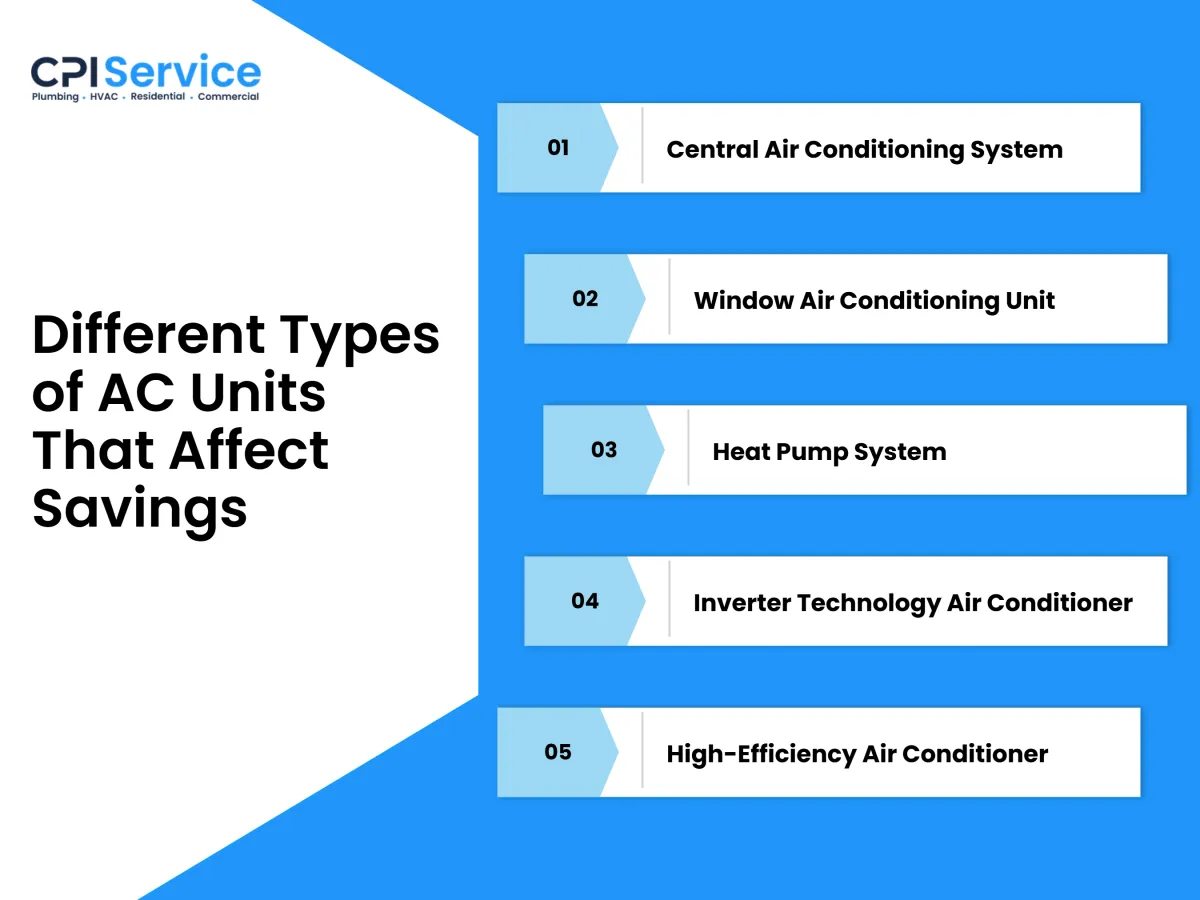
- Central AC is the most convenient way to cool a whole house with several bedrooms, but its running cost depends on its efficiency rating and the ducts. An old low-SEER unit with leaky ducts wastes a lot of cooling; a modern system with sealed ducts, and zoning to cool only occupied rooms, costs much less to run.
- Window or portable units are a cheap way to cool one bedroom or office, so you can keep the central thermostat higher or leave it off. They’re impractical for several rooms at once, and they need to be sized for the room: too big or too small wastes energy.
- Heat pumps heat and cool with one system by moving heat instead of burning fuel. The DOE notes that heat pumps can deliver up to three times as much heat as the electricity they use, which lowers year-round costs.
- Inverter (variable-speed) systems adjust compressor speed to match the load instead of switching between full power and off. That avoids startup surges, holds a steadier temperature, removes more humidity and runs quietly, which pays off most in homes that need cooling for long stretches.
- High-efficiency systems use multi-stage or variable-speed compressors and higher SEER2 ratings to produce more cooling per kilowatt-hour. They cost more upfront but less to run, and local utility rebates can offset some of the price of a heat pump (rebates by city); the federal 25C tax credit ended for systems installed after 2025.
Which AC Upgrades Save the Most?
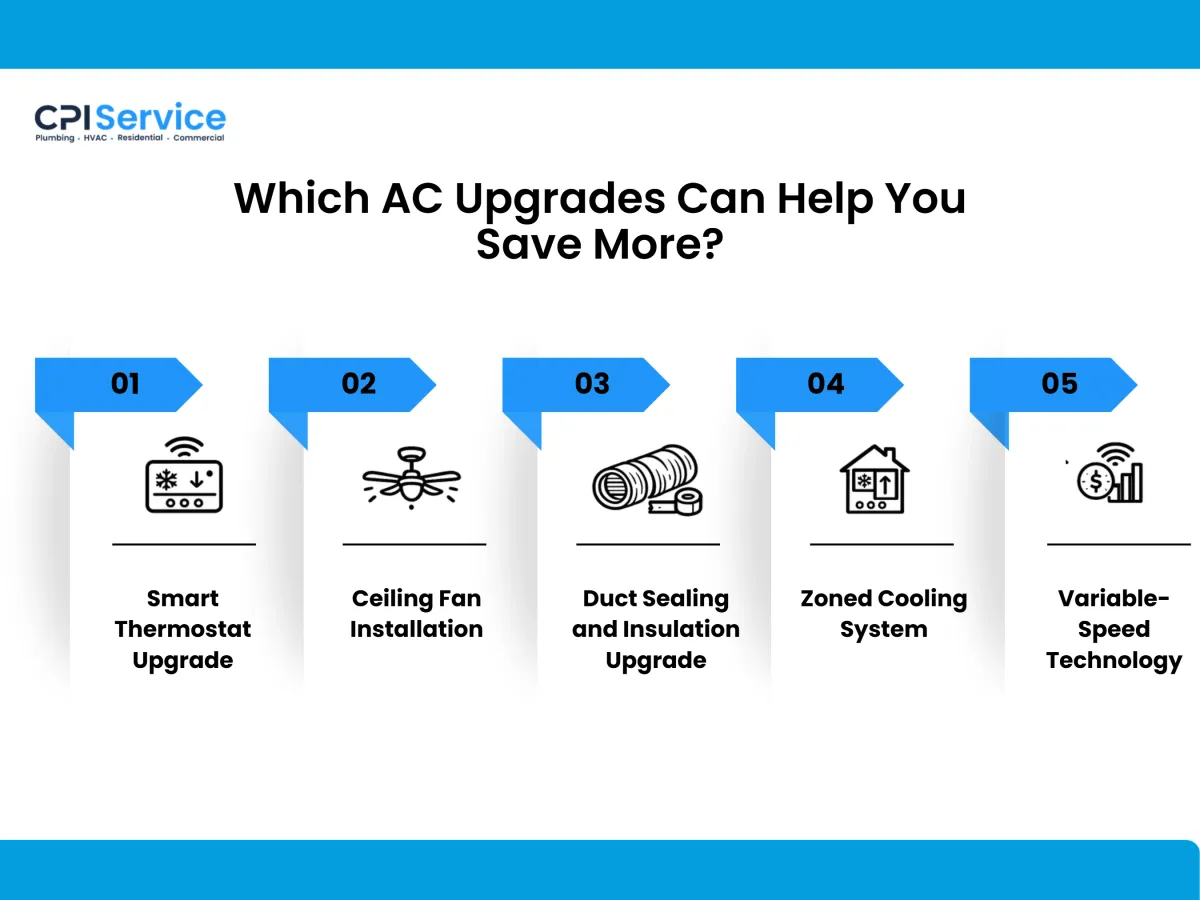
These five upgrades work together to cut wasted energy:
- Smart thermostat: automates setbacks and pre-cooling based on your schedule, your phone’s location and the weather, the easiest upgrade.
- Ceiling fans: don’t lower the temperature but make rooms feel about 4°F cooler, so you can raise the thermostat.
- Duct sealing and insulation: ENERGY STAR says a typical house loses about 20 to 30 percent of the air moving through its ducts to leaks, holes and poor connections. Sealing and insulating them delivers the cooling you pay for to your rooms instead of the attic and balances the airflow.
- Zoning: motorized dampers and separate thermostats cool only the rooms in use, especially useful in two-story homes, where upstairs and downstairs need different settings.
- Variable-speed equipment: the compressor runs slower and steadier instead of starting at full power, using less energy and removing more humidity, so a higher setting still feels comfortable.
A ductless mini-split is another option for an addition, a converted garage or an ADU: it cools that space without cooling the whole house. See mini-splits.
What Affects How Much You Spend on AC?
Eight factors decide how hard your AC works and how much electricity it uses.
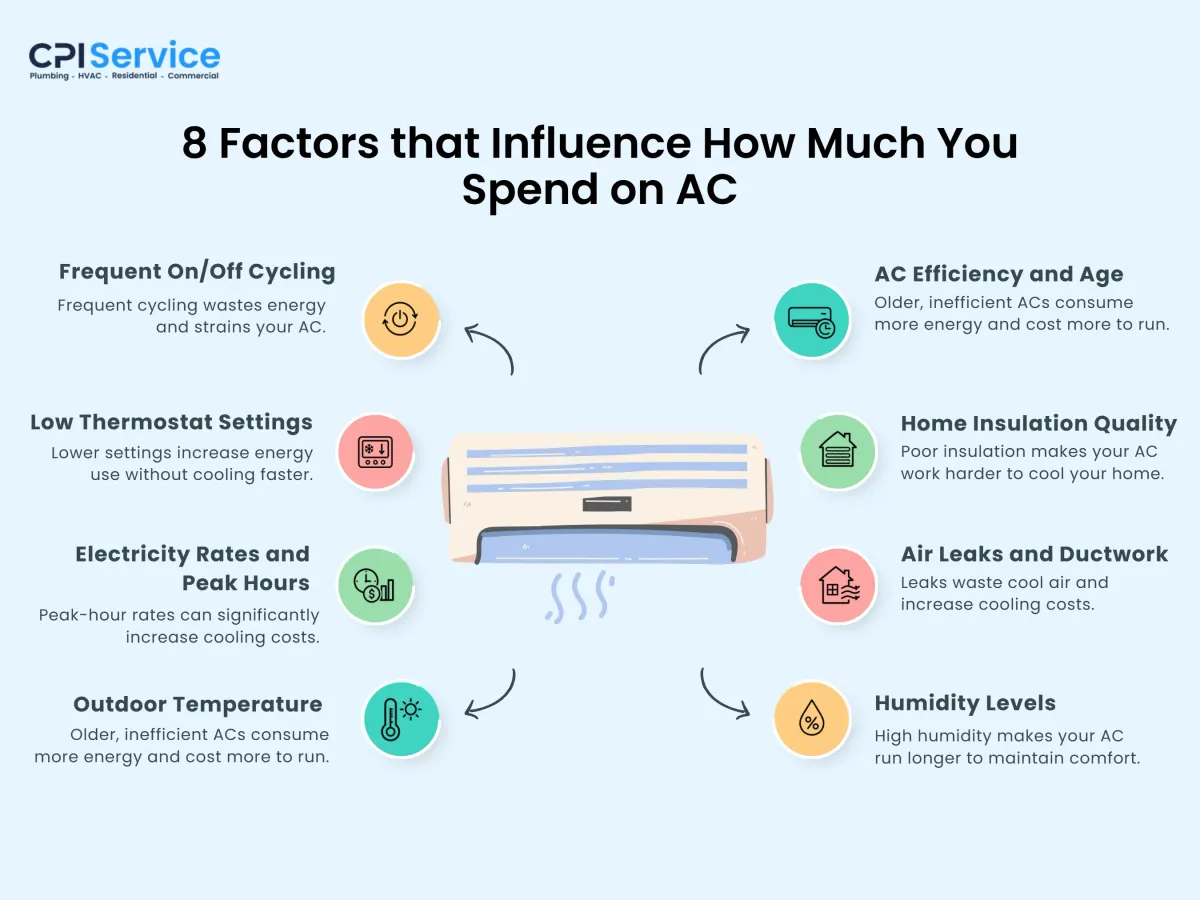
| Factor | Why it raises the bill | What helps |
|---|---|---|
| AC efficiency and age | Older, lower-SEER units use more electricity for the same cooling; wear and problems like a leaking evaporator coil make them run longer. SEER is cooling per watt-hour, so a 20-SEER unit uses about half the electricity of a 10-SEER unit for the same cooling at rating conditions. | Maintenance; replacement when it’s 10 to 15 years old |
| Insulation | Heat gets in through the attic and walls and has to be pumped back out. | Bring the attic up to the recommended R-value |
| Air leaks and ducts | Cooled air escapes through gaps and leaky ducts before it reaches your rooms. | Weatherstripping, caulk, duct sealing |
| Humidity | The AC removes moisture as well as heat, which takes extra run time; humid air also feels warmer. | Variable-speed equipment, a clean coil and correct airflow |
| Outdoor temperature | Heat waves mean longer compressor run times. | Shade, pre-cooling, a higher setting during the peak |
| Electricity rates and peak hours | With time-of-use rates, the same cooling costs more from 4 to 9 p.m. | Pre-cool before 4 p.m. with a smart thermostat |
| Low thermostat settings | Each degree lower adds run time without cooling the house faster. | Around 78°F at home, higher when away |
| Frequent on/off cycling | Turning the AC on and off constantly, or short cycling from an oversized system or a badly placed thermostat, wastes energy and wears parts. | Correct sizing, thermostat placement, a technician’s diagnosis |
Saving on AC in San Jose
- Pre-cool before 4 p.m. Most PG&E residential customers are on time-of-use rates, with the highest prices from 4 to 9 p.m. Cool the house a little more in the early afternoon, then raise the thermostat during the peak. A smart thermostat can do this automatically.
- Use the cool evenings. South Bay evenings usually cool off, even after hot days. Once it’s cooler outside than inside, turn the AC off and open windows (or run a whole-house fan) to flush out the heat.
- Check the ducts. Many local homes have ducts in hot attics or crawl spaces. Leaky or poorly insulated ducts there waste cooling before it reaches your rooms; duct repair fixes that.
- Take the rebates. Heat pump rebates in Silicon Valley can cut the cost of an upgrade significantly.
When to Call an HVAC Professional
Call for service if your AC:
- Runs constantly without reaching the set temperature. Low refrigerant, restricted airflow, dirty coils or an undersized system are the usual causes, and each wastes energy until it’s fixed.
- Costs more to run every month without more use. Rising bills often mean worn parts, a refrigerant problem or poor airflow.
- Cools unevenly or isn’t blowing cold air. Leaky ducts, blocked vents, poor insulation, low refrigerant or unbalanced airflow can leave some rooms warm.
- Is 10 to 15 years old and losing efficiency. A technician can tell you whether repairs still make sense or replacement will pay for itself; see how long air conditioners last.
- Needs frequent repairs, such as the signs of a bad AC capacitor (hard starts, shutdowns, humming), which usually point to aging parts.
- Hasn’t been serviced in over a year. Annual maintenance cleans the critical parts, checks the refrigerant and catches small problems early.
CPI Service maintains, repairs and replaces air conditioners and heat pumps throughout San Jose and the South Bay. Schedule AC service, request a free estimate or call (408) 978-3093.
Frequently Asked Questions
What temperature should I set my AC to save money?
Set it as high as is comfortable when you're home, around 78°F for many people, and higher when you're away. Every degree higher shortens how long the AC runs. The Department of Energy estimates you can save about 10% a year by setting the thermostat 7 to 10 degrees warmer for 8 hours a day in summer.
Is it cheaper to leave the AC on all day?
Usually not. A home that's warmer while you're out gains heat more slowly, so the AC uses less energy overall. Raise the setting when you leave and let a programmable or smart thermostat bring it back down before you return. In San Jose, try to do that cooling before PG&E's 4 to 9 p.m. peak.
Do ceiling fans save money with the AC on?
Yes, if you use them to raise the thermostat. A fan doesn't cool the room; it makes you feel cooler, so you can set the AC about 4°F higher with no loss in comfort, according to the Department of Energy. Turn fans off when you leave the room.
When does it make sense to replace an old AC?
When it's 10 to 15 years old, needs frequent repairs, or can't keep up. A modern high-efficiency system or heat pump uses noticeably less electricity, and Silicon Valley heat pump rebates can lower the upfront cost.
How often should I change my AC filter?
Check it every month during the cooling season and replace it when it's dirty, at least every three months, as ENERGY STAR recommends. Homes with pets, dust or construction nearby may need monthly changes.
Is duct sealing worth it?
Often, yes. ENERGY STAR says a typical house loses about 20 to 30 percent of the air moving through its ducts to leaks, holes and poor connections. Ducts in a hot attic or crawl space waste the most, which is common in South Bay homes.
CPI Service is a great company to use for HVAC too! Our A/C stopped working during the recent heatwave & another company wanted to replace our whole unit. Then we called CPI & they found it didn’t need to be replaced, they fixed it that day! I really appreciate a company that responds quickly, is very professional & reasonably priced!!! I’ll be using them for sure in the future.
Jaycee V., Google review
Read more reviews →Serving San Jose and the South Bay
CPI Service is based at 2880 Aiello Dr in San Jose and serves homes and businesses across the South Bay and the Peninsula. See all the areas we serve.