
15 Common Causes of HVAC Airflow Issues
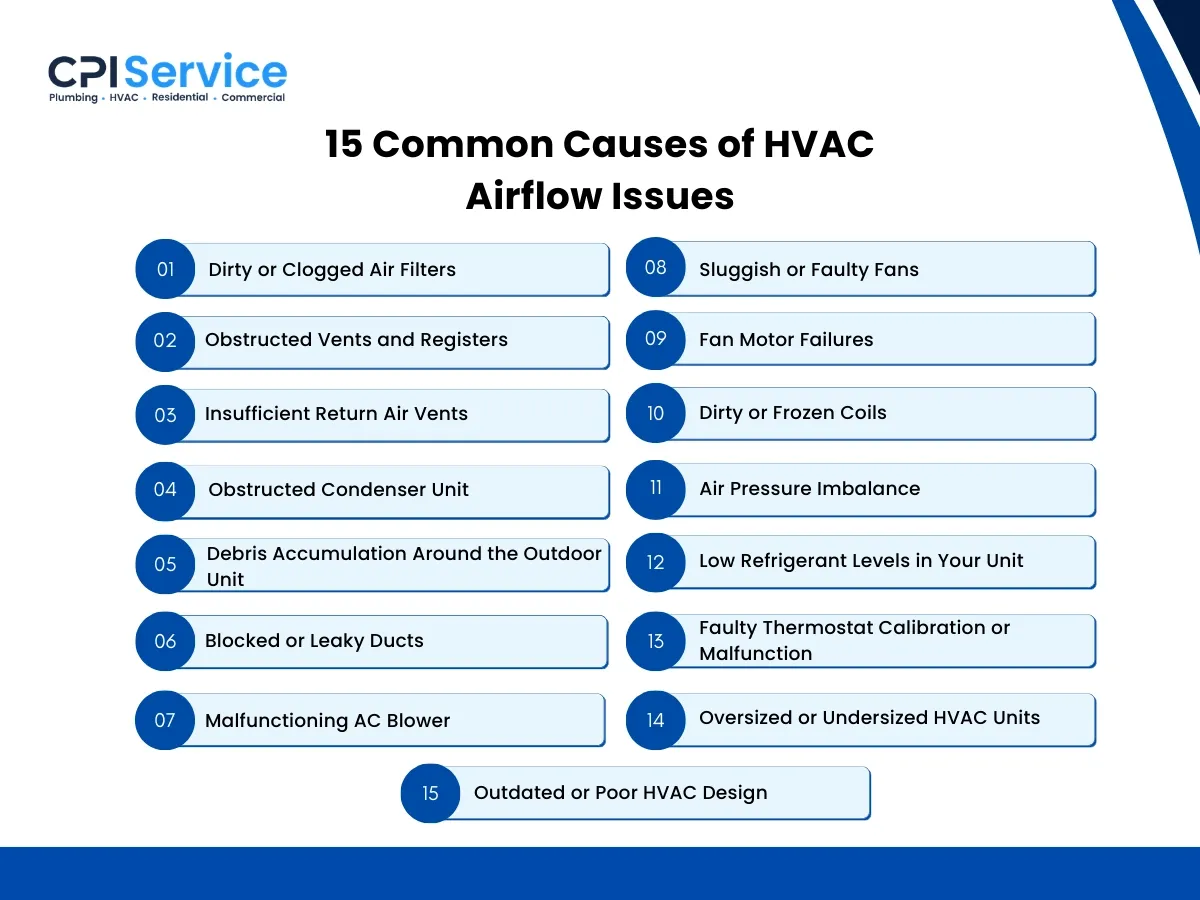
Table of Contents
- Quick Diagnosis
- 15 Common Causes of HVAC Airflow Problems
- 1. Dirty or Clogged Air Filters
- 2. Obstructed Vents and Registers
- 3. Insufficient Return Air Vents
- 4. Obstructed Condenser Unit
- 5. Debris Accumulation Around the Outdoor Unit
- 6. Blocked or Leaky Ducts
- 7. Malfunctioning AC Blower
- 8. Sluggish or Faulty Fans
- 9. Fan Motor Failures
- 10. Dirty or Frozen Coils
- 11. Air Pressure Imbalance
- 12. Low Refrigerant Levels in Your Unit
- 13. Faulty Thermostat Calibration or Malfunction
- 14. Oversized or Undersized HVAC Units
- 15. Outdated or Poor HVAC Design
- How to Prevent HVAC Airflow Problems
- Fix Your Airflow Problem Today
- Airflow Problems in South Bay Homes
- Frequently Asked Questions
Airflow problems happen when air can’t move freely from the returns through the filter, blower, coil and ducts to the vents. The usual symptoms are weak airflow, rooms that never get comfortable, a system that runs and runs, and higher bills. In San Jose and South Bay homes, leaky and crushed ducts are among the most common causes.
That’s because many ducts here run through hot attics and crawl spaces.
Left alone, airflow problems raise energy bills, lengthen run times and wear out parts. ENERGY STAR notes that airflow problems can reduce a system’s efficiency by up to 15 percent.
Quick Diagnosis
| What you notice | Likely causes |
|---|---|
| Weak airflow from every vent | Dirty filter, frozen coil, weak blower, too little return air |
| Weak airflow from some vents | Closed vents, crushed or disconnected ducts, long duct runs |
| Doors slam or whistle, rooms feel stuffy | Not enough return air; pressure imbalance |
| Ice on the refrigerant lines | Airflow too low across the coil, or low refrigerant |
| Air is weak and not cold (or not warm) | Outdoor unit blocked, low refrigerant, coil problems |
| Short, frequent cycles and uneven rooms | Oversized system |
15 Common Causes of HVAC Airflow Problems
1. Dirty or Clogged Air Filters
The most common cause. A filter clogged with dust, pet hair and debris is a barrier the blower has to push through, so the system moves less air than designed. You’ll notice weak or uneven airflow, more dust and rising bills; a badly clogged filter can even freeze the AC coil.
Check the filter monthly. Standard 1-inch filters usually need changing every 1 to 3 months, and thicker 4- to 5-inch media filters every 6 to 12 months, sooner with pets or heavy use. Follow the filter and system maker’s directions. A technician also checks the filter at each AC tune-up.
2. Obstructed Vents and Registers
Furniture, rugs, curtains and dust over supply vents and return grilles block the air entering and leaving a room, causing weak vents and temperature differences between rooms. Walk through every room, make sure nothing sits on or directly in front of a register or return, and vacuum the grilles. Clearing them also reduces the back pressure that strains the blower.
3. Insufficient Return Air Vents
The system can only push out as much air as it can pull back in. With too few or undersized returns, or returns that are blocked, air barely comes out of the vents, rooms feel stuffy, doors slam or whistle from the pressure difference, and temperatures are uneven. Keep returns clean and unblocked, and make sure each floor has adequate return air. A technician can add a return, enlarge an existing one or install a transfer grille or jumper duct so a closed room has a path back to the system.
4. Obstructed Condenser Unit
The outdoor unit has to release the heat it carried out of the house. Boxed in by a fence, shrubs or stored items, it recirculates its own hot air: warm air from the vents, longer cycles and higher bills. Keep the condenser clear on all sides, with the clearance its manufacturer recommends (about 2 feet is a common rule), and don’t let vines or plantings grow into it.
5. Debris Accumulation Around the Outdoor Unit
Leaves, grass clippings and dirt collect on and around the condenser coil and block the air the unit pulls through it, so the AC runs continuously without reaching the set temperature. With the power off at the outdoor disconnect, clear leaves and debris from around the unit and rinse the outside of the coil gently with a garden hose (no pressure washer, which bends the fins). A deep coil cleaning is part of a professional tune-up.
6. Blocked or Leaky Ducts
Leaky ducts let conditioned air escape into the attic, crawl space or walls before it reaches the rooms. ENERGY STAR estimates that in a typical house about 20 to 30 percent of the air moving through the ducts is lost to leaks, holes and poorly connected ducts. Aging or poorly installed ductwork, crushed flex duct and rodents chewing through flexible ducting in the attic or crawl space are common causes; symptoms include weak airflow, uneven temperatures, excess dust and higher bills.
Visible leaks at accessible joints can be sealed with mastic or metal foil tape; ENERGY STAR advises never using cloth duct tape, which doesn’t last. Hidden leaks and damaged sections need a professional inspection and duct repair.
7. Malfunctioning AC Blower
The indoor blower moves all the air in the system. A failing motor, worn bearings or an electrical fault drops airflow to a trickle. Clogged filters, frozen coils and restrictive ducts overload it and wear it out faster. Start with a clean filter and open vents. If airflow doesn’t improve, have a technician test the blower motor and its controls; see blower motor replacement cost.
8. Sluggish or Faulty Fans
A fan can turn but move far less air than it should. Dirt caked on the blower wheel, a weak capacitor, worn bearings or, on older belt-drive equipment, a worn or loose belt slows it down. Airflow feels like a light breeze, the farthest rooms are warmest and the coil can freeze. Replace the filter first. Cleaning a blower wheel, checking capacitors and replacing belts are technician jobs, since they mean working inside the equipment near live wiring.
9. Fan Motor Failures
Motors fail from overheating, a failed capacitor, worn bearings or years of straining against dirty filters, blocked vents and leaky ducts. Symptoms include no air, airflow that comes and goes, a burning smell, or a system that turns on without moving air; outdoors, a failed condenser fan motor stops the unit from shedding heat. A technician tests the motor, capacitor and wiring to confirm the failure. A failed motor is usually replaced, and the cause of the overheating fixed with it.
10. Dirty or Frozen Coils
A dirty indoor (evaporator) coil blocks airflow and absorbs less heat, which can make it ice over; a dirty outdoor (condenser) coil traps heat and makes the system run hot. Restricted airflow from dirty filters or blocked vents, and low refrigerant, are the usual reasons coils freeze. Replace the filter and open the vents. If the coil is frozen, turn the AC off (leaving the fan on helps) and let it thaw completely before restarting. If it keeps freezing, have the refrigerant charge and airflow checked; see why an AC freezes up.
11. Air Pressure Imbalance
When more air is pushed into some rooms than can get back to the system, airflow becomes uneven and strained. Blocked supply or return vents, dirty filters, leaky or poorly designed ductwork, closing too many vents or interior doors, and mismatched equipment all cause it.
Keep vents open and seal visible duct leaks. If the imbalance continues, a technician can balance the duct system, add return paths or install a bypass damper; see AC repair cost for typical prices.
12. Low Refrigerant Levels in Your Unit
Refrigerant doesn’t get used up; if it’s low, there’s a leak or the system was charged incorrectly. Low refrigerant limits how much heat the coil can absorb, causing warm air, ice on the coil and long run times. Only a certified technician can find and repair the leak, then charge the system to the manufacturer’s specification. Adding refrigerant without fixing the leak only delays the problem.
13. Faulty Thermostat Calibration or Malfunction
A thermostat that misreads the room makes the system short cycle or leaves rooms warmer or cooler than the setting. Dead batteries, loose wiring, an outdated thermostat, or one mounted in direct sun, near a heat source or in a draft are common causes.
Replace the batteries and confirm the settings (cool or heat, fan on Auto, the right schedule). If the readings are still off, recalibrate it if the model allows or replace it; see thermostat repair.
14. Oversized or Undersized HVAC Units
An oversized system cools the air near the thermostat quickly and shuts off before air is mixed through the house, so it short cycles and leaves humidity and uneven temperatures. An undersized one runs constantly and still can’t reach the setting. Both wear the equipment faster. A proper load calculation shows whether the equipment fits the house. Duct and airflow adjustments can ease the symptoms, but the lasting fix for a badly mismatched system is a correctly sized unit at replacement time. See what size AC unit you need.
15. Outdated or Poor HVAC Design
Some airflow problems are built in. Undersized ducts, long runs and sharp 90-degree turns create so much friction that some rooms never stay comfortable no matter how long the system runs. It’s common with builder-grade duct designs and with additions that were tied into the original ducts.
A technician can retrofit the restrictive sections with properly sized ductwork and smoother turns. Where redesign is limited, a booster fan or a separate system for the problem area, such as a ductless mini-split, can help.
How to Prevent HVAC Airflow Problems
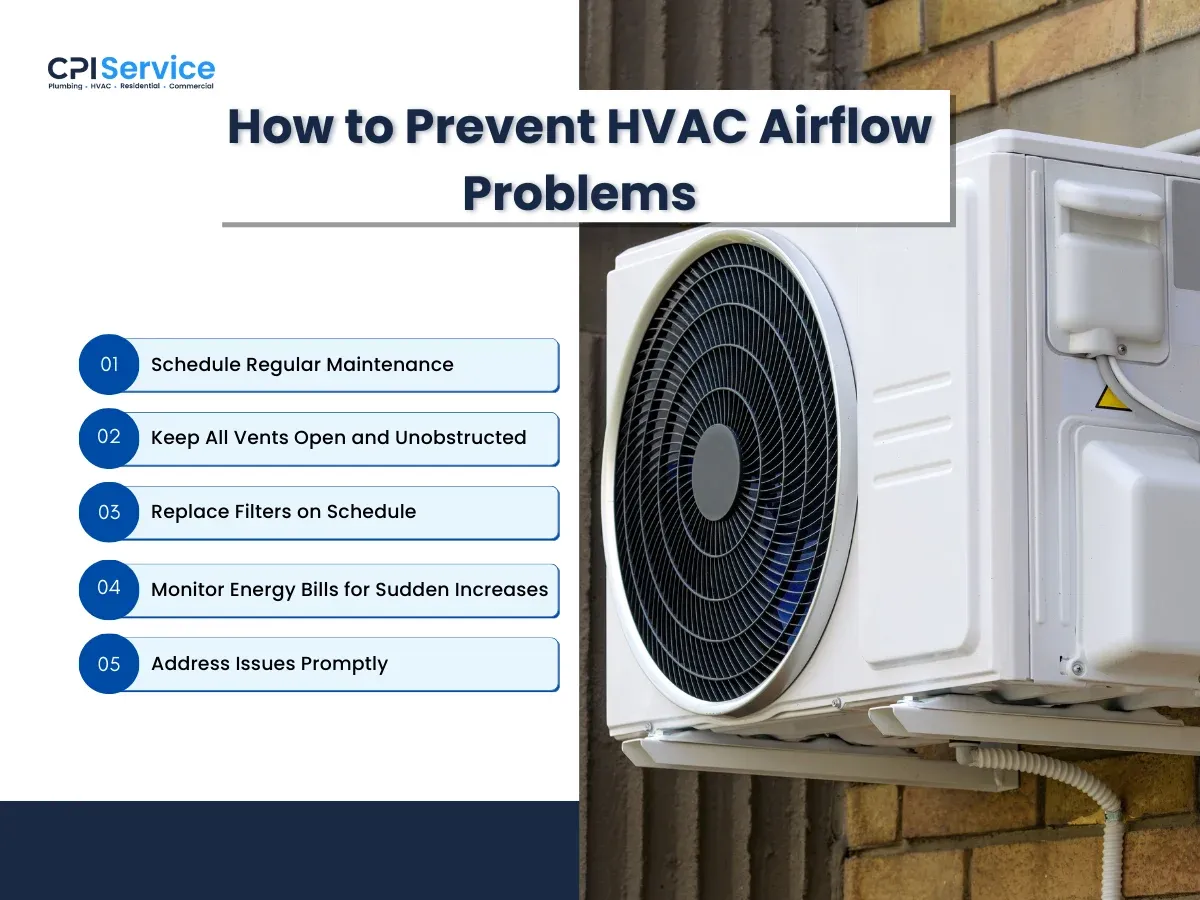
Schedule Regular Maintenance
An annual tune-up (or one before cooling season and one before heating season) catches restrictions before they affect comfort. ENERGY STAR’s maintenance checklist includes cleaning the evaporator and condenser coils, cleaning and adjusting blower components for proper airflow, and checking the refrigerant level. See AC tune-up cost; our membership plans include it.
Keep All Vents Open and Unobstructed
Closing vents raises static pressure in the ducts, which strains the blower and can overheat a furnace. Keep supply and return vents open and leave space between them and furniture or drapes.
Replace Filters on Schedule
A clean filter protects the blower and coil and helps indoor air quality. Check it monthly and change it on the schedule for its size.
Monitor Energy Bills for Sudden Increases
An unexplained jump in your bill, compared with the same month last year, often means the system is working harder to move air: a dirty filter, a blocked duct or a developing refrigerant leak.
Address Issues Promptly
Call for service as soon as you notice weak airflow, unusual noises or uneven temperatures. Small airflow problems set off a chain reaction (a clogged filter freezes the coil; a struggling blower overheats its motor), and early repairs cost less than emergency ones.
Fix Your Airflow Problem Today
Start with the quick checks a homeowner can safely do:
- Replace a dirty filter
- Open all supply and return vents and move furniture or drapes away from them
- Look at the outdoor unit for debris, plants or anything boxing it in
- Confirm the thermostat is set to cool or heat, with the fan on Auto
- If you see ice on the lines or coil, turn the AC off and let it thaw
- Listen for grinding, squealing or humming from the blower or outdoor fan
Call a technician if airflow stays weak after a new filter and clear vents, the ice comes back, the blower is noisy, or some rooms never get comfortable. See AC repair costs for typical prices.
Airflow Problems in South Bay Homes
- Attic and crawl-space ducts. Many local homes have flex ducts in attics and crawl spaces, where they get crushed, disconnected or chewed by rodents. A quick look in the attic often explains a room that never cools.
- Older homes and additions. Ducts sized for the original house rarely serve a later addition well. A ductless mini-split is often the better fix for an addition or converted garage.
- Duct testing. California’s energy code requires duct leakage testing on many HVAC replacements, a good time to fix leaky ducts.
CPI Service diagnoses and fixes airflow problems throughout San Jose and the South Bay. See our HVAC services, request a free estimate or call (408) 978-3093.
Frequently Asked Questions
Why is airflow weak from only some vents?
Usually a closed or blocked vent, a disconnected or crushed duct, or a long duct run to a far room. If every vent is weak, look at the whole system: filter, blower, coil or return air.
Can closing vents in unused rooms save money?
Closing a few is fine, but closing many raises pressure in the ducts, reduces airflow across the coil and can freeze an AC or overheat a furnace. Zoning is the proper way to condition only some rooms.
How do I know if my ducts are leaking?
Signs include rooms that never get comfortable, dusty air, high bills and visible gaps or disconnected sections in the attic or crawl space. A technician can measure duct leakage; in California, many HVAC replacements require a duct leakage test.
How often should I change my HVAC filter?
Check it monthly. Standard 1-inch filters usually need changing every 1 to 3 months, and thicker 4- to 5-inch media filters every 6 to 12 months, sooner with pets, dust or heavy use. Follow the filter and system maker's directions, and change it any time it looks gray and clogged.
CPI Service is a great company to use for HVAC too! Our A/C stopped working during the recent heatwave & another company wanted to replace our whole unit. Then we called CPI & they found it didn’t need to be replaced, they fixed it that day! I really appreciate a company that responds quickly, is very professional & reasonably priced!!! I’ll be using them for sure in the future.
Jaycee V., Google review
Read more reviews →Serving San Jose and the South Bay
CPI Service is based at 2880 Aiello Dr in San Jose and serves homes and businesses across the South Bay and the Peninsula. See all the areas we serve.