

 Emergency Plumbing
 Plumbing Repairs
 Water Heaters
 Drain Cleaning
 Sewer Service
 Faucets & Fixtures
 Repiping
 Toilet Plumbing
 Trenchless
 Plumbing Leaks
 Air Conditioning
 Heating
 Minisplit Systems
 Heat Pumps
 HVAC Components
 HVAC Rebates
Homes under 1,000 square feet require about 1.5 tons (18,000 BTUs/hr), homes between 1,000 and 2,000 square feet require 2 to 2.5 tons (24,000 to 30,000 BTUs/hr), and homes larger than 2,000 square feet require about 3 to 5 tons (36,000 to 60,000 BTUs/hr). Selecting the correct AC unit size starts with understanding how cooling capacity is measured using BTUs per hour and AC tonnage and how to convert BTUs into tons. These estimates provide a preliminary reference for AC sizing, while factors such as climate, insulation, ceiling height, home layout, window area, occupancy, humidity, and ventilation determine the home’s actual cooling load.
Selecting an AC unit that matches the cooling requirements is important because incorrect sizing can affect system performance. An improperly sized AC unit can lead to continuous operation, insufficient cooling, higher energy bills, short cycling, poor humidity control, uneven temperatures, increased energy use, and premature system wear. To improve sizing accuracy, the home’s cooling load should be confirmed through a Manual J load calculation and verified by a qualified HVAC technician before the final AC equipment capacity is selected.
How Is AC Unit Size Measured?
Air conditioner size is measured by its cooling capacity in BTUs (British Thermal Units) per hour or in tons rather than physical dimensions. One ton of cooling capacity equals 12,000 BTUs per hour, which represents the amount of heat the AC unit can remove from an indoor space in one hour. The correct AC size depends on more than square footage because climate, insulation, ceiling height, window orientation, occupancy, and appliance heat can affect the home’s cooling load.
Here is how the AC unit size is measured:
- BTU (British Thermal Unit): Measures the amount of heat an air conditioner can remove in one hour, with residential units generally ranging from 5,000 BTUs for small rooms to over 60,000 BTUs for large central systems.
- Tons: Represents the cooling equivalent of melting 1 ton (2,000 pounds) of ice over a 24-hour period, where 1 ton equals 12,000 BTUs per hour, and typical residential setups range from 1.5 to 5 tons.
- Square Footage Baselines: General guidelines scale capacity relative to space size, starting at 12,000 to 18,000 BTUs (1.0 to 1.5 tons) for spaces up to 500 square feet, up to 48,000 to 60,000 BTUs (4.0 to 5.0 tons) for 2,000 to 2,500 square feet.
- Manual J load calculation: A professional HVAC technician can calculate the home’s cooling load by assessing square footage, local climate, insulation quality, ceiling height, window direction, appliances, and occupancy. This assessment helps determine the appropriate AC unit capacity before equipment selection.
What Are BTUs?
A BTU (British Thermal Unit) is a traditional unit of heat energy that measures the amount of thermal energy required to raise the temperature of one pound of water by one degree Fahrenheit. In the metric system, 1 BTU is equivalent to approximately 1,055 joules (or about 0.293 watt-hours).
In the HVAC industry, BTUs measure the power and capacity of heating and cooling systems. For air conditioners, it quantifies how much heat the unit can remove from a space in one hour. Because a single BTU is a small amount of energy, roughly equal to the heat of a single burning match, appliances operate in the thousands, spanning from small 5,000 BTU window units to large 60,000 BTU furnaces.
What Is AC Tonnage?
AC tonnage measures the cooling capacity of an air conditioner rather than its physical weight, with 1 ton equaling 12,000 BTUs per hour (or approximately 3.5 kilowatts of cooling power). This term originates from the historical cooling power of melting one ton of ice over 24 hours. Standard residential central air systems range from 1.5 to 5 tons, depending on the home’s size. Selecting the correct AC tonnage is essential because an undersized unit runs constantly without effectively cooling, while an oversized unit cools too quickly and shuts off before dehumidifying the space, leaving the home feeling damp and humid.
How Do You Convert BTUs Into Tons?
To convert BTUs (British Thermal Units) into tons of cooling capacity, you simply divide the total BTU rating by 12,000, because 1 ton of cooling equals 12,000 BTUs per hour (or approximately 3.5 kilowatts).
Conversion Formula:
Tons = BTU/hr ÷ 12,000
BTU/hr = Tons × 12,000
Example:
A 24,000 BTU/hr AC unit can be converted into tons by dividing 24,000 by 12,000:
24,000 ÷ 12,000 = 2 tons
This means a 24,000 BTU/hr air conditioner provides approximately 2 tons of cooling capacity.
Common Conversions
- 9,000 BTU: 0.75 tons
- 12,000 BTU: 1 ton
- 18,000 BTU: 1.5 tons
- 24,000 BTU: 2 tons
- 30,000 BTU: 2.5 tons
- 36,000 BTU: 3 tons
What Size AC Unit Do You Need Based on Square Footage?
The size of the AC unit you need, based on square footage, ranges from approximately 1.5 tons (18,000 BTUs per hour) for 600 to 1,000 square feet to about 5 tons (60,000 BTUs per hour) for homes larger than 3,500 square feet. These capacity estimates apply only to conditioned floor area and should not include garages, unfinished attics, unconditioned basements, or other spaces outside the home’s conditioned envelope. They serve as a preliminary sizing reference because square footage alone cannot determine the final AC capacity your home requires.
AC Unit Size Chart by Square Footage
| Conditioned Floor Area (Approximate) | Estimated AC Unit Size (Tons) | Estimated Cooling Capacity (BTUs per Hour) |
| 600–1,000 sq ft | 1.5 Ton | 18,000 BTUs/hr |
| 1,000–1,500 sq ft | 2 Ton | 24,000 BTUs/hr |
| 1,500–2,000 sq ft | 2.5 Ton | 30,000 BTUs/hr |
| 2,000–2,500 sq ft | 3 Ton | 36,000 BTUs/hr |
| 2,500–3,000 sq ft | 3.5 Ton | 42,000 BTUs/hr |
| 3,000–3,500 sq ft | 4 Ton | 48,000 BTUs/hr |
| 3,500+ sq ft | 5 Ton | 60,000 BTUs/hr |
Note: These AC unit sizes are approximate estimates based on conditioned floor area only. Actual cooling requirements vary depending on climate, insulation quality, ceiling height, window area, occupancy, humidity, and other home-specific factors. A Manual J load calculation should be performed to determine the appropriate AC unit size for your home.
What Size AC Unit Do You Need for Homes Under 1,000 sq ft?
For homes with 600 to 1,000 square feet of conditioned floor area, the estimated AC unit size is approximately 1.5 tons, which provides about 18,000 BTUs per hour of cooling capacity. This estimate serves as a starting point for selecting residential air-conditioning capacity and applies only to conditioned living spaces.
Homes within this size range require 1.5 tons of cooling capacity because the conditioned floor area produces a cooling load that an 18,000-BTU-per-hour air conditioner can handle under typical residential conditions. The final AC unit size can still vary depending on local climate, insulation quality, ceiling height, window area, sun exposure, occupancy, and indoor humidity.
What Size AC Unit Do You Need for 1,000–2,000 sq ft Homes?
You need an approximately 2 to 2.5-ton AC unit, or 24,000 to 30,000 BTUs per hour of cooling capacity, for a home with 1,000 to 2,000 square feet of conditioned floor area. As a preliminary estimate, homes between 1,000 and 1,500 square feet require a 2-ton (24,000 BTUs/hr) AC unit, while homes between 1,500 and 2,000 square feet generally require a 2.5-ton (30,000 BTUs/hr) system.
These estimated AC unit sizes are based on conditioned floor area and may vary depending on climate, insulation quality, ceiling height, window area, sun exposure, occupancy, and indoor humidity. A Manual J load calculation performed by an HVAC technician is recommended to verify the appropriate AC unit size before selecting or installing new equipment.
What Size AC Unit Do You Need for Homes Larger Than 2,000 sq ft?
You need an approximately 3- to 5-ton AC unit, or 36,000 to 60,000 BTUs per hour of cooling capacity, for homes larger than 2,000 square feet of conditioned floor area. The recommended AC unit size is 3 tons (36,000 BTUs/hr) for 2,000–2,500 square feet, 3.5 tons (42,000 BTUs/hr) for 2,500–3,000 square feet, 4 tons (48,000 BTUs/hr) for 3,000–3,500 square feet, and 5 tons (60,000 BTUs/hr) for homes with more than 3,500 square feet.
As home size increases, cooling requirements become more dependent on the home’s overall heat load than square footage alone. Ceiling height, home layout, insulation quality, window orientation, occupancy, appliances, and local climate all influence the amount of heat the air conditioning system must remove, which can affect the final AC unit capacity.
How Do You Calculate the Right AC Unit Size?
You can calculate the right AC unit size by measuring the conditioned cooling area, estimating the required BTUs per hour, and converting the cooling capacity into AC tonnage as a preliminary sizing reference. This preliminary process provides a general estimate based on conditioned floor area, while a Manual J load calculation is required to verify the final cooling capacity for your home.
You can calculate the right AC unit size in the following ways:
- Measure the Cooling Area
Begin by calculating the total square footage of the living spaces that require active air conditioning. Measure the length and width of each conditioned room interior, multiply the dimensions to find the individual square footage, and sum the results. Exclude unconditioned areas such as garages, uninsulated attics, and crawl spaces. This accurate floor area measurement serves as the foundational baseline required for all subsequent thermal calculations and sizing estimations.
- Estimate the Required BTUs
Next, determine the thermal cooling capacity your space requires by applying standard multiplier rules to your measured square footage. You need approximately 20 BTUs of cooling power for every square foot of living space. Multiply your total square footage by 20 to find your baseline BTU requirement, then increase that figure if your home has high ceilings, poor insulation, or intense direct sunlight.
- Convert BTUs Into AC Tonnage
Finally, translate your calculated BTU requirement into standard HVAC tonnage by dividing the total BTU figure by 12,000, since one ton of cooling capacity equals 12,000 BTUs per hour. For example, a 24,000 BTU requirement equals a 2-ton system. Use this final tonnage figure to match your home with standard residential equipment sizes, keeping in mind that professional verification through a Manual J load calculation remains essential.
Which Factors Change the AC Size You Need?
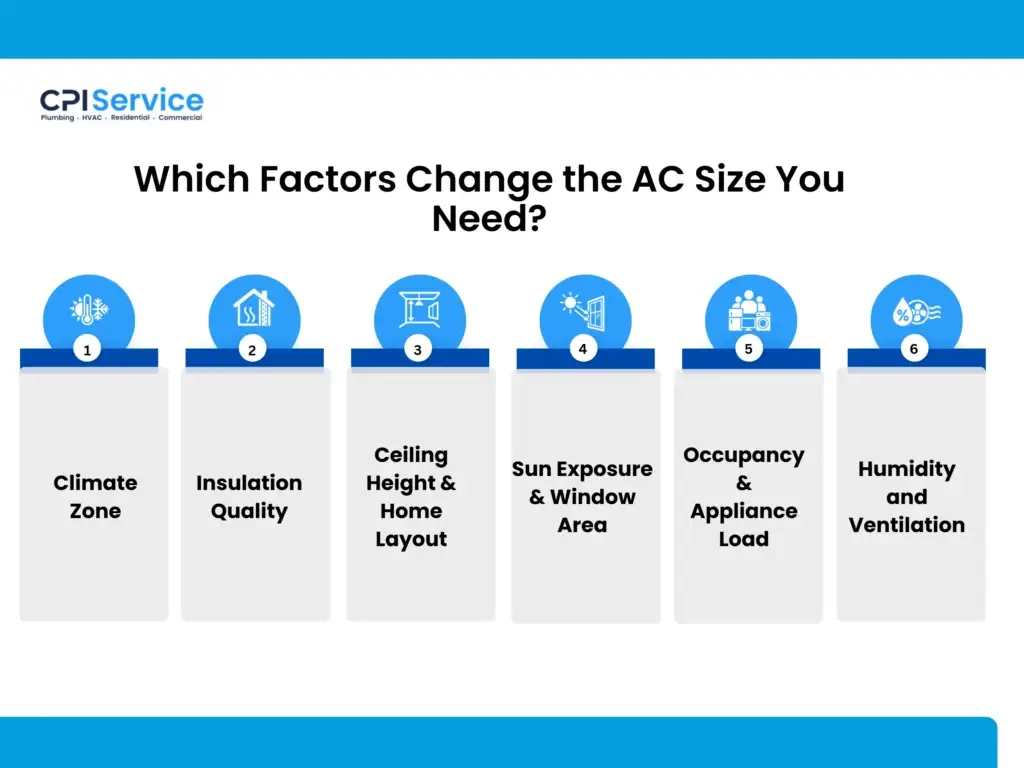
Factors that can change the AC unit your home requires include climate, insulation, ceiling height, home layout, window area, sun exposure, occupancy, appliances, humidity, and ventilation. Each component affects the home’s cooling load, which determines how much heat the air conditioning system must remove to maintain a comfortable indoor temperature.
6 factors that change the AC unit size you need are:
- Climate Zone
Local climate affects the cooling load of a home by determining how much heat the AC system must remove during the cooling season. A home in San Jose may require a different-sized AC unit than a home of the same square footage in Phoenix because the local climate determines how much heat the air conditioner must remove during the cooling season. Homes in hotter climates experience higher outdoor temperatures and longer periods of cooling demand, while San Jose’s milder climate places a lower cooling load on residential AC systems.
- Insulation Quality
Insulation quality directly affects the size of the AC unit your home requires by controlling how much heat enters the conditioned living space. Well-insulated walls, ceilings, floors, and attics slow heat transfer, helping conditioned air stay indoors and reducing the cooling load. Poor insulation allows outdoor heat to enter more quickly, increasing the amount of heat the air conditioner must remove.
- Ceiling Height & Home Layout
Ceiling height and home layout affect the size of the AC unit your home requires because they influence the volume of air that must be cooled and how efficiently cooled air circulates throughout the living space. For example, a 2,000-square-foot home with vaulted ceilings and an open floor plan requires a different cooling capacity than a 2,000-square-foot home with standard 8-foot ceilings.
- Sun Exposure & Window Area
A home with large south- or west-facing windows requires a different AC unit size than a similar-sized home with fewer windows or more natural shade because window area and sun exposure directly affect indoor heat gain. Sunlight entering through windows increases the amount of heat the air conditioner must remove, especially during the hottest parts of the day.
- Occupancy & Appliance Load
Higher occupancy and frequent appliance use can require a larger AC unit by increasing the amount of heat generated inside the home. For example, cooking appliances, computers, televisions, lighting, and additional occupants all contribute to the cooling load. Considering these internal heat gains helps HVAC professionals select the appropriate AC unit capacity for efficient and consistent indoor comfort.
- Humidity and Ventilation
Higher indoor humidity and increased ventilation can require a larger AC unit because the system must remove both heat and excess moisture from the conditioned space. For example, a home in a humid coastal climate requires a different cooling capacity than a similar-sized home in a dry inland region. Outdoor air introduced through ventilation can also increase the cooling load.
What Happens If Your AC Is the Wrong Size?
If your AC unit is the wrong size, it can reduce indoor comfort, increase energy consumption, shorten equipment lifespan, and affect overall system performance. Understanding the problems caused by an undersized or oversized AC unit helps explain why selecting the correct cooling capacity is essential for efficient operation, effective humidity control, and long-term reliability.
Undersized AC Unit
An undersized AC unit can cause continuous operation, insufficient cooling, higher energy bills, and increased system wear because it cannot meet the home’s cooling load. Each issue reduces overall system performance and highlights the importance of selecting an AC unit with the appropriate cooling capacity.
- Continuous Operation: An undersized AC unit often runs continuously because it cannot remove heat as quickly as it enters the home. Longer operating cycles increase energy use and place additional strain on system components over time.
- Insufficient Cooling: Maintaining a comfortable indoor temperature becomes challenging when the AC unit lacks sufficient cooling capacity. The system may fail to reach the thermostat setting, leaving some areas of the home warmer than others.
- Higher Energy Bills: Energy costs can increase by 15% to 30% when an undersized AC unit runs continuously to compensate for insufficient cooling capacity. The extended runtime consumes more electricity while still struggling to maintain the desired indoor temperature
- Increased System Wear: An undersized AC unit experiences greater wear because it runs longer to meet the home’s cooling demand. The extended runtime places additional strain on components such as the compressor, blower motor, and fan, increasing the likelihood of repairs and reducing the system’s overall lifespan.
Oversized AC Unit
An oversized AC unit can cause short cycling, poor humidity control, uneven cooling, higher energy use, and increased system wear because it provides more cooling capacity than the home’s cooling load requires. These problems reduce system efficiency, affect indoor comfort, and highlight the importance of selecting an AC unit that matches the home’s cooling requirements.
- Short Cycling: An oversized AC unit can cause short cycling by cooling the home faster than the thermostat calls for. Repeated AC short cycling increases the number of start-up cycles, placing additional strain on the compressor and other critical components.
- Poor Humidity Control: Removing moisture from indoor air becomes difficult when an oversized AC unit completes cooling cycles too quickly. The shorter runtime leaves excess humidity indoors, making the home feel damp or clammy even after the thermostat setting is reached.
- Uneven cooling: An oversized AC unit can create uneven cooling because it reaches the thermostat setting before conditioned air circulates throughout the home. The short cooling cycles leave some rooms cooler than others, resulting in inconsistent indoor temperatures and reduced comfort.
- Higher Energy Use: Frequent startup and shutdown cycles make an oversized AC unit consume more electricity than a properly sized system during normal operation. Each restart requires a power surge, increasing energy consumption and raising monthly utility costs even though the home reaches the desired temperature quickly.
- Increased System Wear: Repeated on-and-off operation causes an oversized AC unit to place greater stress on its mechanical and electrical components over time. The constant cycling accelerates wear on the compressor, blower motor, and capacitor, increasing the risk of signs of a bad AC capacitor, including hard starts, humming sounds, and inconsistent system operation.
Should You Have an HVAC Technician Confirm Your AC Unit Size?
Yes, you should have an HVAC technician confirm your AC unit size because a preliminary estimate based on square footage alone cannot accurately determine your home’s cooling load. Factors such as climate, insulation quality, ceiling height, window area, sun exposure, occupancy, humidity, and ventilation all affect the required cooling capacity. An HVAC technician performs a Manual J load calculation to evaluate these variables and recommend the appropriate AC unit size for efficient performance, effective humidity control, and long-term system reliability.
When Should You Get a Manual J Load Calculation?
You should get a Manual J load calculation whenever you need to determine your home’s actual heating and cooling loads before selecting HVAC equipment. Unlike a square-footage estimate or an existing system size, a Manual J calculation evaluates the home’s specific characteristics to determine the required heating and cooling capacity.
Below are the most common situations where a Manual J load calculation is recommended:
- Replacing an old HVAC system is a good time to perform a Manual J load calculation because the existing equipment may have been incorrectly sized or your home’s heating and cooling load may have changed over time.
- New home construction requires a Manual J load calculation to determine the whole-home heating and cooling load based on the home’s design, insulation, windows, orientation, and other construction features.
- Remodeling or expanding living space changes the home’s heating and cooling requirements, making a new Manual J load calculation necessary after additions, finished basements, enclosed patios, or major layout changes.
- Upgrading windows or insulation changes the home’s thermal performance by reducing or increasing heat transfer. A Manual J load calculation measures the updated heating and cooling load before equipment sizing.
- Persistent comfort issues, such as hot or cold rooms, uneven temperatures, or excess humidity, often indicate that the installed HVAC system no longer matches the home’s actual load. A Manual J load calculation identifies these load differences before equipment sizing.
When Should You Get Your AC Unit Sized by a Professional?
You should have your AC unit sized by an HVAC professional before purchasing or installing new equipment to confirm that the selected system meets your home’s actual cooling needs. A professional load calculation helps match the AC capacity to the home’s specific cooling requirements and supports efficient system operation.
You should get your AC unit sized by professionals in the following situations:
- Before purchasing a new AC unit, verify that the selected equipment matches the home’s calculated cooling load.
- When replacing an existing HVAC system, confirm the previous equipment was correctly sized before selecting a replacement.
- After major home renovations or energy-efficiency upgrades, changes to the home can increase or reduce the required cooling capacity.
- When experiencing persistent comfort or performance issues, so an HVAC technician can diagnose the cause before attributing the problem to incorrect AC sizing.
- Before installing a new HVAC system, review the calculated load, system design, and equipment compatibility.
Why Is Professional AC Installation Important After Sizing Your Home?
Professional AC installation is important after sizing your home because proper installation ensures the correctly sized system delivers its intended cooling capacity, balanced airflow, humidity control, and energy efficiency. A professional AC installation service verifies the refrigerant charge, airflow, ductwork connections, electrical components, and system operation against the calculated load and manufacturer specifications, helping maximize performance, reliability, and equipment lifespan.

