PEX vs. Copper for Repiping a San Jose Home
Table of Contents
- PEX vs. Copper at a Glance (October 2026)
- Which Costs Less?
- How Long Does Each Last?
- What About San Jose’s Hard Water?
- Which Handles Freezing Better?
- Which Is Better in an Earthquake?
- Fittings and Joints
- How Long Does the Installation Take?
- When Copper Is Still the Right Call
- Get Both Prices for Your Home
- Frequently Asked Questions
Short answer: for most San José homes, PEX is the better choice for a whole-house repipe: it costs less, goes in faster with fewer wall openings and fittings, doesn’t pit or corrode, and usually survives a freeze. A typical San José PEX repipe costs $8,000 to $18,000.
Copper costs more but suits pipe exposed to sunlight, or owners who want metal; we quote it on request. A repipe in San José and the South Bay usually replaces galvanized steel, polybutylene or copper that has started to leak. Both PEX and copper are approved for drinking water in California, and both last for decades when they’re installed well.
The differences that matter are cost, how the pipe gets into finished walls, and how it handles your water, the occasional freeze and a house that moves.
PEX vs. Copper at a Glance (October 2026)
| PEX (cross-linked polyethylene) | Copper | |
|---|---|---|
| Relative installed cost | $ (lower) | $$ (higher, in material and labor) |
| Whole-house repipe, typical San José home | $8,000–$18,000 | Quoted on request |
| Life expectancy (InterNACHI guideline) | About 40 years | About 50–70 years |
| Water chemistry | Won’t pit or stress corrode; resists mineral build-up (PPI) | Corrosion-resistant, but aggressive or soft, acidic water and poor workmanship can cause pitting (CDA) |
| Freezing | Usually expands and returns to size without damage (PPI) | Soft tube survived several freezes in testing; shouldn’t be allowed to freeze (CDA) |
| Flexibility | Bends around obstacles; copper is 180 times more rigid (PPI) | Rigid; can be bent on site (CDA) |
| Joints | Fewer: long coils, mechanical crimp, clamp, press, expansion or push fittings; no flame | More: soldered or brazed, or flame-free press and push fittings |
| Installation time | Faster; “greatly reduced” labor (PPI) | Slower; more fittings and wall access |
| Sunlight | Must be protected from UV | Not affected by UV (CDA) |
Prices are CPI Service’s typical San José range for a residential job, including permits, inspections and drywall patching, before any special offer. Other rows are from the Plastics Pipe Institute (PPI), the Copper Development Association (CDA) and InterNACHI, read October 27, 2026. Sources are listed at the end.
Which Costs Less?
PEX, in almost every house. The pipe costs less, but the bigger difference is labor: the PEX Design Guide, published by the Plastics Pipe Institute and the Plastic Pipe and Fittings Association, says PEX comes in long coils that eliminate coupling joints, bends around obstructions to reduce fittings, and joins without solder, chemicals or flame. In a finished San José house that means fewer and smaller openings in walls and ceilings, which also means less patching.
A whole-house PEX repipe in a typical San José home (about 1,500 to 2,000 square feet with two bathrooms) costs $8,000 to $18,000, including permits, inspections and drywall patching. Copper costs more in both material and labor: a copper repipe typically runs $5,000 to $50,000, depending mostly on the size of the home. Ask for both prices and we’ll quote each in writing for your house. For a ballpark by home size, stories and foundation, try the repiping cost calculator, and see how much repiping costs for everything that moves the price.
How Long Does Each Last?
InterNACHI’s life-expectancy chart, which it calls a guideline and not a guarantee, lists PEX at about 40 years and copper water lines at 50 to 70 years. Two more data points:
- PEX for drinking water must show a minimum extrapolated lifetime of 50 years in the hot, chlorinated-water test of its product standard, ASTM F876, according to the PEX Design Guide. That’s a test requirement, not a promise for your house.
- Copper has a long record: the Copper Tube Handbook calls it long-lasting, with excellent resistance to corrosion and scaling. Most early failures it describes come from aggressive water or installation faults, covered next.
Either is a long-term replacement for the galvanized steel or polybutylene a repipe often removes.
What About San Jose’s Hard Water?
San José gets water from three retailers and several sources, so hardness depends on your address. San Jose Water’s 2025 water quality report shows its groundwater averaging 288 ppm hardness (very hard), its mountain surface water 151 ppm and its treated Valley Water supply 99 ppm. See South Bay water hardness by city for San José Municipal Water and Great Oaks.
Hardness alone doesn’t decide which pipe holds up:
- Copper. The Copper Tube Handbook says copper corrosion problems are rare and usually come from aggressive, hard well water that causes pitting; soft, acidic water that keeps a protective film from forming; water moving too fast (it advises staying under 8 feet per second for cold water and 5 for hot); poor workmanship or excess flux. It describes aggressive pitting water as high in dissolved solids, with a pH of 7.2 to 7.8, more than 10 ppm of carbon dioxide and dissolved oxygen. San Jose Water’s report lists dissolved solids (397 ppm on average for its groundwater), but not pH, carbon dioxide or dissolved oxygen, so the report alone can’t tell you whether your water is aggressive to copper.
- PEX. The PEX Design Guide says PEX won’t pit or stress corrode and resists mineral build-up. San Jose Water notes that its water may contain chloramine or chlorine; PEX made for drinking water is tested for hot chlorinated water, and the Plastics Pipe Institute’s position is that chloramines are less aggressive to PEX than free chlorine.
If your current copper has pinhole leaks in several places, tell us during the estimate: that history helps decide which pipe to use for the new system.
Which Handles Freezing Better?
San José’s winters are mild, so frozen pipes are rare here, but pipes in a crawl space, an attic or an outside wall can still see a cold snap.
- PEX stays flexible below freezing. The PEX Design Guide says water-filled PEX can usually freeze and thaw without cracking, because it expands and returns to its size. That holds when the pipe has room to expand along its length, as it does in walls and ceilings; PEX frozen inside a slab or tightly packed soil may be damaged.
- Copper. The Copper Tube Handbook reports that soft (annealed) copper tube survived the expansion of freezing water several times in testing before bursting, but says that doesn’t mean copper water lines should be allowed to freeze.
Either way, insulating pipes in unheated spaces is the real protection.
Which Is Better in an Earthquake?
We haven’t found a manufacturer, trade association or official source that rates PEX or copper for earthquakes or compares the two, so we won’t claim one is safer. What is documented is flexibility: the Plastics Pipe Institute says copper is about 180 times more rigid than PEX, and that PEX’s flexibility lets it absorb pressure surges that cause water hammer. In a seismic area, how the pipe is supported, strapped and connected at the water heater and fixtures matters as much as the material, and both are installed to the California Plumbing Code with a City inspection.
Fittings and Joints
Fewer joints mean fewer places for a leak to start.
- PEX connects with mechanical fittings: copper or stainless crimp rings, stainless clamps or press sleeves over brass, copper or polymer fittings, cold-expansion fittings, or push-type fittings. None need solder or an open flame, and because PEX bends, many changes of direction need no fitting at all. A manifold can feed individual fixtures with continuous runs.
- Copper joins with soldered or brazed fittings, or with flame-free press-connect and push-connect fittings, which the Copper Tube Handbook calls fast and economical. Every change of direction needs a fitting unless the tube is bent.
How Long Does the Installation Take?
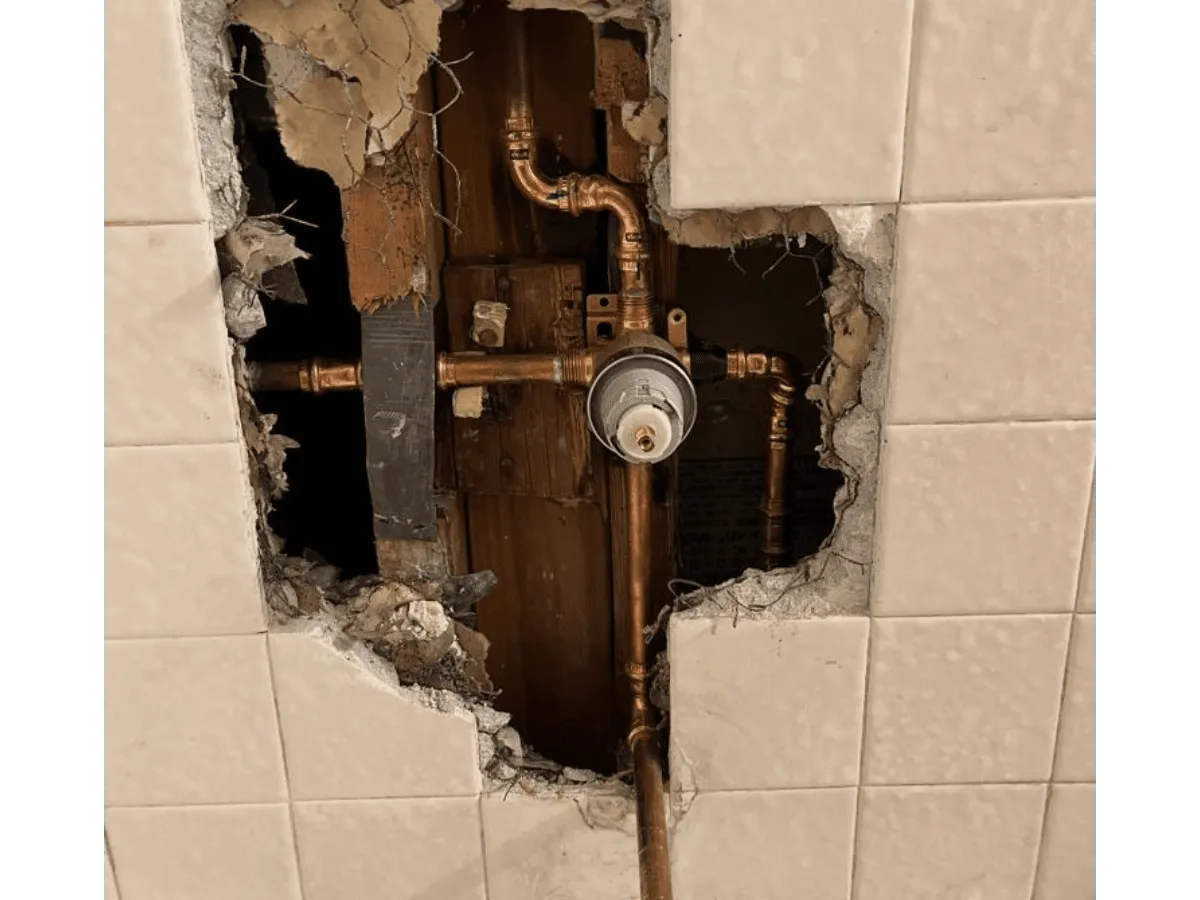
The PEX Design Guide says PEX greatly reduces installation time and labor compared with rigid metal pipe, mainly because it pulls through walls and ceilings in long runs. Most San José homes we repipe take two to five days, and water is turned back on at the end of most days, so families usually stay home. A copper repipe of the same house generally takes longer and needs more wall access.
When Copper Is Still the Right Call
- Exposed or sunny runs. PEX must not be installed outdoors unless it’s buried or protected from ultraviolet light, and it should be covered where sunlight reaches it, even indirect light. Copper isn’t affected by UV.
- You want metal pipe. Some owners simply prefer copper’s track record, and the Copper Tube Handbook notes it won’t burn or carry fire through floors and walls.
- Walls are already open. During a remodel with open walls, copper’s extra labor matters less.
The two can also be combined, with PEX inside the walls and copper where pipe is exposed; ask about it during the estimate.
Get Both Prices for Your Home
CPI Service repipes homes with PEX or copper throughout San José and the South Bay, under CSLB License #1101278 (C-36 Plumbing). We look at your current pipe, access from the attic or crawl space, and your wall finishes, then give you a written price for PEX and, if you want it, for copper. Every job is quoted as a fixed price before we start, permits, inspections and patching included, and our work carries a 1-year labor warranty. Financing is available, including 0% interest for 12 months, subject to approval.
See whole-house repiping in San José, what repiping involves and how much repiping costs, request a free estimate or call (408) 978-3093.
Sources
- Plastics Pipe Institute and Plastic Pipe and Fittings Association: PEX Design Guide, 2nd edition (2013), Ch. 1 Introduction
- PEX Design Guide, Ch. 2 Advantages
- PEX Design Guide, Ch. 3 Material Properties
- PEX Design Guide, Ch. 5 Joining Methods
- Copper Development Association: The Copper Tube Handbook (print edition, PDF)
- San Jose Water: 2025 Annual Water Quality Report (PDF)
- InterNACHI: Standard Estimated Life Expectancy Chart for Homes
Checked October 2026.
Frequently Asked Questions
Is PEX or copper better for repiping a house in San José?
For most San José repipes, PEX: it costs less, goes in faster through existing walls with fewer openings and fittings, and doesn't pit or corrode. Copper is the better fit for runs exposed to sunlight and for owners who want metal pipe. Both are approved for drinking water and both last for decades when installed well.
How much does a PEX repipe cost in San José?
A whole-house PEX repipe in a typical San José home costs $8,000 to $18,000, including permits, inspections and drywall patching. A copper repipe typically runs $5,000 to $50,000 depending on the size of the home; the repiping cost calculator gives a ballpark for yours.
Does San José's hard water hurt copper or PEX pipe?
Hardness alone doesn't decide it. San Jose Water's 2025 report shows its groundwater averaging 288 ppm hardness and its Valley Water supply 99 ppm. The Copper Development Association says copper corrosion problems usually come from aggressive water (high dissolved solids, pH 7.2 to 7.8, high carbon dioxide and dissolved oxygen) or soft, acidic water, plus installation faults. The Plastics Pipe Institute says PEX won't pit or stress corrode and resists mineral build-up.
Will PEX or copper burst if it freezes?
PEX usually won't: the PEX Design Guide says water-filled PEX can freeze and thaw without damage when the pipe has room to expand. The Copper Tube Handbook says soft copper tube survived several freezes in testing but that copper water lines shouldn't be allowed to freeze. San José rarely freezes; it matters most for pipes in crawl spaces, attics and outside walls.
How long do PEX and copper pipes last?
InterNACHI's life-expectancy chart, a guideline rather than a guarantee, lists PEX at about 40 years and copper water lines at 50 to 70. PEX pipe for drinking water must show a minimum extrapolated lifetime of 50 years in the hot chlorinated water test of its standard, ASTM F876.
How long does a whole-house repipe take?
Most San José homes take two to five days, with water restored at the end of most days. PEX usually goes faster than copper because it comes in long coils and bends around obstacles, so it needs fewer joints.
We hired CPI for a complete house repipe and an addition of a water recirculation system. They did an excellent job. The workers were friendly, they cleaned up after themselves, they didn’t hesitate to ask if they had any questions and we were assigned a project manager to ensure that the job went smoothly. They handled permits and inspections very well. Everything went smoothly. They were definitely worth the money. I wish all of our home improvement jobs had gone this well. I definitely recommend them.
Tanja F., Yelp review
Read more reviews →Serving San Jose and the South Bay
CPI Service is based at 2880 Aiello Dr in San Jose and serves homes and businesses across the South Bay and the Peninsula. See all the areas we serve.