
Trenchless vs. Traditional Sewer Repair: Which Fits Your Line?
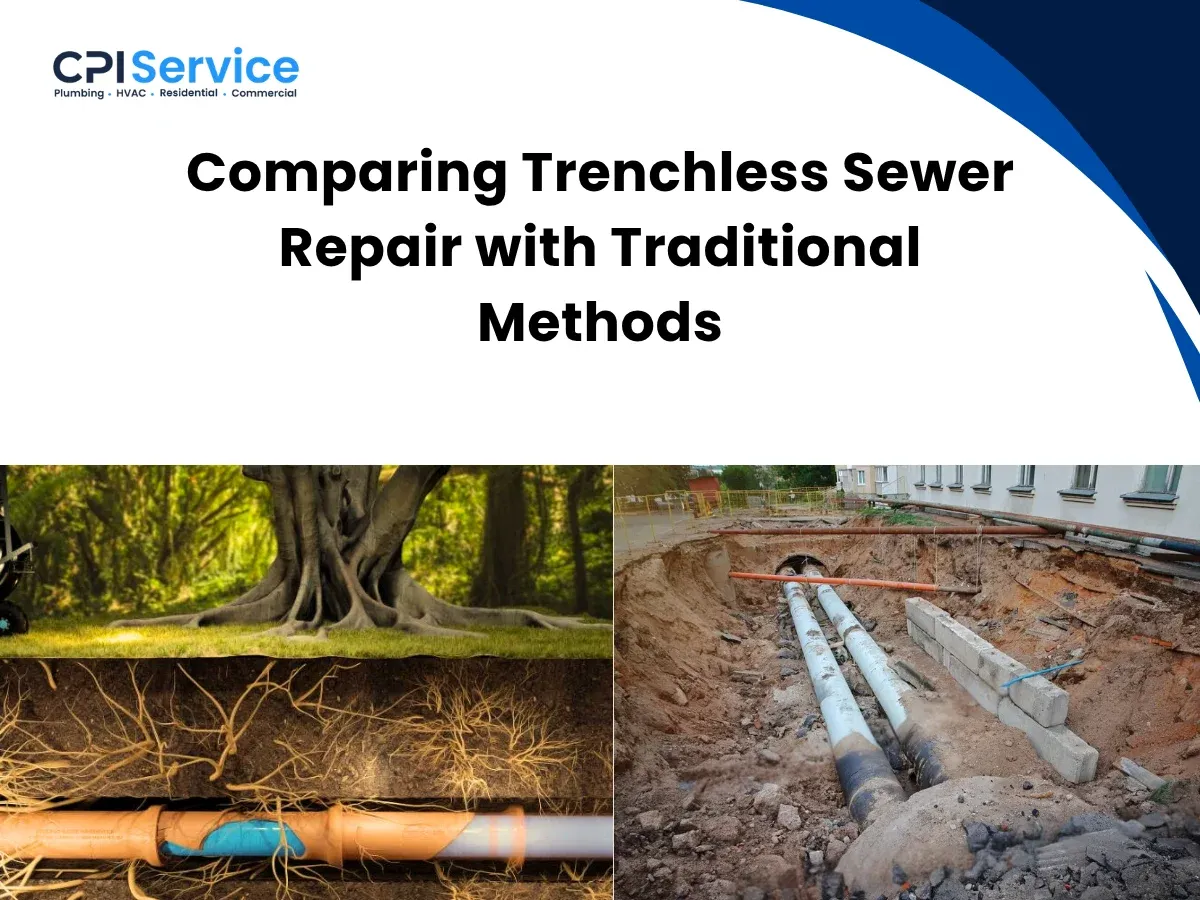
Table of Contents
- Side by Side
- What Is Trenchless Sewer Repair?
- Advantages of Trenchless Sewer Repair
- Limitations of Trenchless Technology
- When Trenchless Makes Sense
- What Is Traditional Sewer Repair?
- Advantages of Traditional Sewer Repair
- Limitations of Traditional Sewer Repair
- When a Trench Is the Better Choice
- Cost Comparison of Trenchless Repair vs. Traditional
- Choosing the Right Method for Your Property
- Sewer Repairs in San Jose
- Frequently Asked Questions
When a South Bay sewer line needs repair, the big decision is whether to dig a trench and replace the pipe, or use a trenchless method (pipe bursting or lining) through small access pits. Neither is always better: the right choice depends on the pipe’s condition, what’s above it, and how deep it runs.
Here’s how they compare for local homes, where many sewer laterals run under driveways and mature trees.
For example, a Sunnyvale home whose cracked clay lateral still holds its shape and runs under a landscaped front yard is often a good fit for trenchless repair. A property in Fremont with a fully collapsed cast-iron line may need excavation to reach and replace the failed section. Trenchless work is usually faster and far less disruptive on the surface; a trench gives full access and can fix problems trenchless methods can’t, like a collapsed pipe or a line that needs regrading.
This post compares the two approaches side by side to help you choose. For how trenchless repair works step by step, see what trenchless sewer repair is; for the advantages and drawbacks of trenchless on its own, see pros and cons of trenchless sewer repair.
Side by Side
| Trenchless | Traditional (open trench) | |
|---|---|---|
| How it works | Burst and replace, or line, the pipe from small pits | Dig along the pipe and replace it |
| Digging | One or two small pits | The whole run |
| Restoration | Minimal | Lawn, landscaping, concrete, hardscape |
| Time on site | Often a day or two | Several days plus restoration |
| Collapsed pipe or severe sag | Usually can’t fix | Can fix and regrade |
| Rerouting | No | Yes |
| Repair price | Can be higher | Can be lower in open ground |
| Total with restoration | Often lower under hardscape | Often higher under hardscape |
What Is Trenchless Sewer Repair?
Trenchless sewer repair fixes or replaces an underground sewer line without digging up its whole length. The crew works through an existing cleanout or one or two small access pits, so the lawn, driveway and landscaping above the pipe stay largely in place. It’s used on homes, businesses and city sewer mains wherever avoiding surface damage matters. See what the trenchless repair method is for a closer look at each technique.
The main methods are:
- Cured-in-place pipe (CIPP) lining: a resin-soaked liner is pulled or inverted into the old pipe and cured hard, forming a new jointless pipe inside the old one.
- Pipe bursting: a bursting head is pulled through the old pipe, breaking it outward while new HDPE pipe is pulled in behind it along the same path.
- Slip lining: a slightly smaller new pipe is pushed inside the old one.
Less common options, such as pipe reaming and robotic repairs from inside the pipe, suit some localized problems. Spiral-wound lining and UV-cured liners are mostly used on larger-diameter pipes and city sewer mains rather than home laterals.
Advantages of Trenchless Sewer Repair
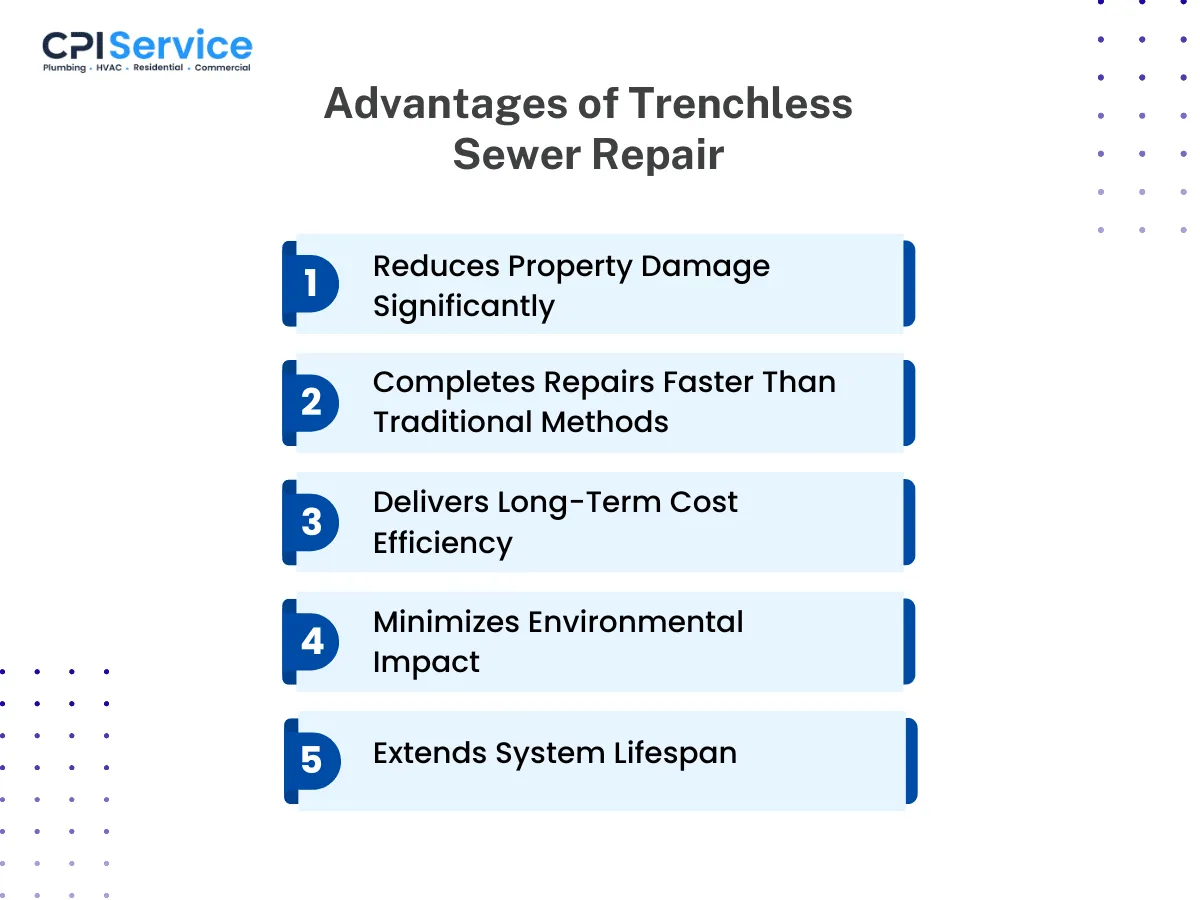
Trenchless repair avoids most of the digging, which means less damage to the property, a shorter job, lower restoration costs and less disturbance to the ground around the pipe.
Less Property Damage
CIPP lining and pipe bursting work from inside the old pipe or along its path, entering through a cleanout or small pits. Because nobody digs along the whole route, lawns, sidewalks, driveways and garden beds above the line stay mostly undisturbed. That limits both the disruption during the job and the cost of putting things back afterward.
Faster Than a Trench
Most of the time on a traditional job goes to digging, removing the old pipe, backfilling and restoring the surface. Trenchless methods skip most of that, so many home sewer laterals are finished in a day or two instead of several days plus restoration.
Lower Total Cost in the Right Conditions
Trenchless work needs specialized equipment and trained crews, but it saves on excavation labor, heavy machinery and restoration. Where the line runs under a driveway, patio or mature landscaping, those savings usually outweigh the higher equipment cost. New HDPE pipe and cured liners resist corrosion and root intrusion, which helps avoid repeat repairs.
Less Environmental Disturbance
Small entry points mean less soil moved, fewer truck trips and less heavy-equipment time. Trees, roots and planted areas above the line are less likely to be damaged, and there’s less loose soil to manage during the job.
Longer System Life
A cured liner forms a continuous pipe with no joints for roots to enter or for leaks to start. Pipe bursting replaces old clay, cast iron or Orangeburg with HDPE pipe, which resists corrosion, chemicals and ground movement and is joined by heat fusion into one continuous length. Installed correctly, both are designed to last for decades.
Limitations of Trenchless Technology
Trenchless repair isn’t possible for every line, and it can cost more up front.
Higher Equipment and Setup Costs
CIPP needs liner and curing equipment; pipe bursting needs hydraulic bursting equipment and fusion machines; both need trained crews. On a short line in open ground with little to restore, a trench can cost less.
Needs Access and a Pipe That Can Be Repaired This Way
The crew needs a usable cleanout or room for small access pits at each end. The old pipe has to be in a condition the method can handle: a liner needs a pipe that still holds its shape, and bursting needs a path the new pipe can follow. Collapsed sections, severe sags or offsets, and lines close to other utilities or foundations can rule it out for part or all of the run. Clay and cast-iron laterals, which are common in the South Bay, can usually be burst or lined if they haven’t collapsed. A camera inspection before the job shows whether trenchless will work.
Some Jobs Still Need Digging
A line that has collapsed, needs regrading, needs rerouting or needs a new connection usually needs at least some excavation. Many jobs combine both: trenchless for most of the line and a small dig at the collapsed spot or the connection.
When Trenchless Makes Sense
- The line runs under a driveway, patio, walkway or established landscaping
- The pipe is cracked, root-damaged or has leaking joints but still holds its shape
- An old clay, cast-iron or Orangeburg lateral can be burst and replaced along the same path
- You want the work done quickly with minimal disruption
What Is Traditional Sewer Repair?
Traditional (or conventional) sewer repair means digging a trench along the pipe, removing the damaged section or the whole line, laying new pipe (usually PVC) at the right slope, and backfilling. It’s disruptive, but the crew can see and reach every foot of the pipe, which makes it the right choice when the pipe has collapsed, sags, is badly misaligned or has to be rerouted.
Advantages of Traditional Sewer Repair
Fixes Collapsed or Misaligned Pipe
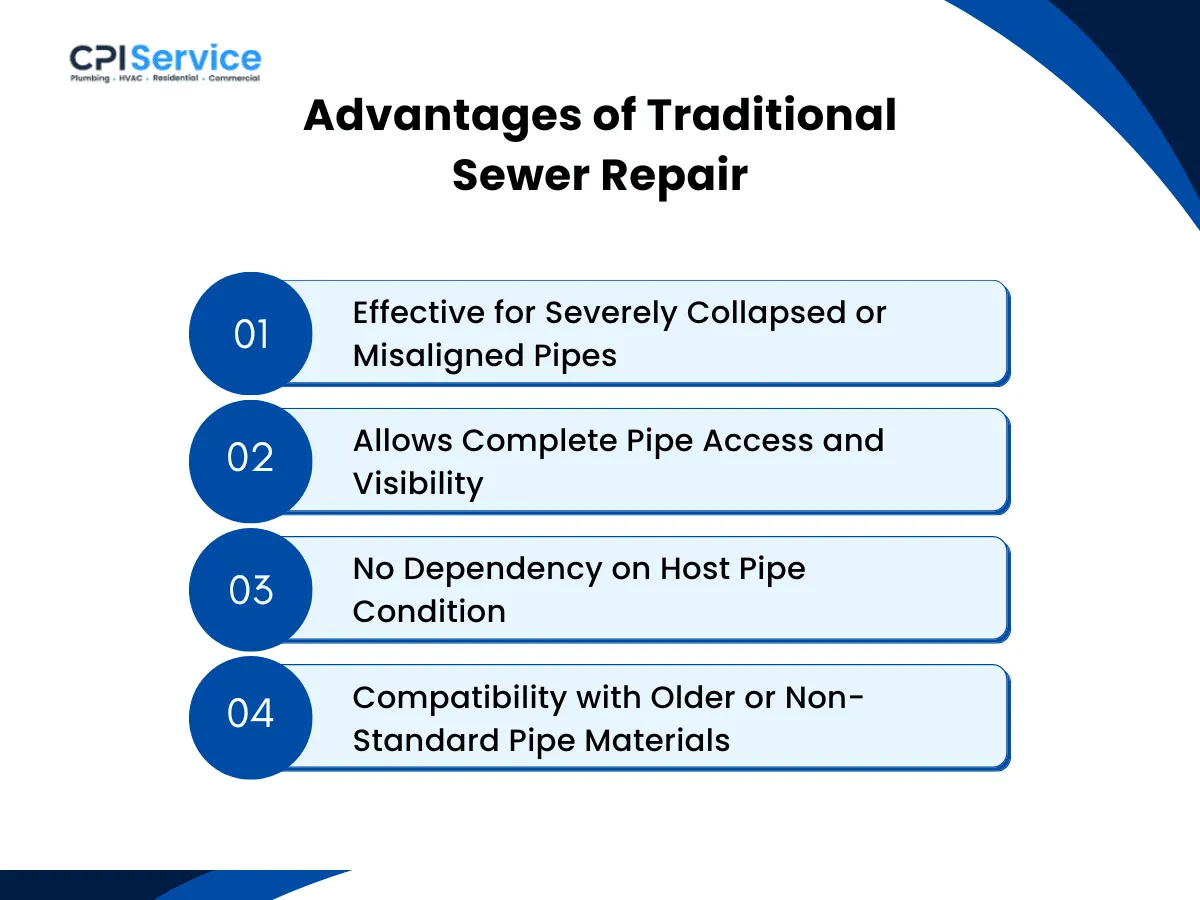
When a pipe has collapsed or its sections have shifted out of line, digging it up is often the only reliable fix. The crew removes the failed pipe and lays new pipe at the correct alignment and slope, which trenchless methods can’t do.
Full Access and Visibility
With the pipe exposed, the crew can see every crack, joint and connection directly, along with problems around the pipe such as poor bedding or root masses. Nothing is left to interpretation from a camera image.
No Dependence on the Old Pipe
Lining needs the old pipe to hold its shape, and bursting follows its path. A trench doesn’t need either: the old pipe is removed entirely, however badly it’s damaged, and the new one can go where it should.
Works With Any Pipe Material and Layout
Excavation works with any old material, including clay, cast iron, Orangeburg and concrete, and with unusual layouts, multiple connections and fittings. It also suits materials that are hard to burst, such as heavily reinforced or repaired sections.
Limitations of Traditional Sewer Repair
Longer Timelines
Digging, replacing, backfilling and restoring takes longer than trenchless work: several days for a typical lateral, and longer for deep lines, long runs or work in the street. Weather, permits and inspections can add time.
Extensive Excavation
A trench along the whole line disturbs whatever is above it: lawn, driveways, sidewalks and landscaping. That damage has to be repaired after the pipe is in.
Risk to Other Utilities
Gas, water, electric and communication lines often run near sewer laterals, and digging a long trench raises the chance of hitting one. California law requires anyone excavating to contact 811 at least two working days before digging so utilities can mark their lines (USA North 811). A licensed contractor handles that, and trenchless methods reduce the risk because there’s far less digging.
Higher Restoration Costs
Repaving, replacing concrete, replanting and rebuilding hardscape after a trench can add a large share to the total project cost. That’s why a trench that looks cheaper for the pipe work alone can end up costing more under a driveway or patio.
When a Trench Is the Better Choice
- The pipe has collapsed or has a deep sag that needs regrading
- The line needs to be rerouted or a new connection added
- The run is short and in open ground with little to restore
- Other utilities are too close to burst a pipe safely
Cost Comparison of Trenchless Repair vs. Traditional
Which method costs less depends on the whole job, not just the pipe work. Trenchless usually costs more for equipment and materials; a trench costs more in excavation labor and restoration.
| Cost factor | Trenchless repair | Traditional repair |
|---|---|---|
| Equipment and materials | Higher (specialized equipment, liners, HDPE) | Lower (standard equipment and PVC pipe) |
| Labor | Lower (less digging, shorter job) | Higher (digging, backfill, longer job) |
| Property disruption | Small access pits | A trench along the whole run |
| Restoration | Lower (little surface damage) | Higher (landscaping, concrete, driveways) |
| Long-term upkeep | Low: new jointless pipe or liner | Low: new pipe, once restored |
In San Jose, a typical sewer lateral replacement costs $6,000 to $15,000; long, deep or street sewer work runs $15,000 to $20,000 or more; and a spot repair of one damaged section costs $2,000 to $5,000. A sewer camera inspection to decide on the method costs $300 to $600, and CPI’s current free sewer line inspection special covers homes with an accessible mainline cleanout. Where your job falls depends on the length and depth of the line, what’s above it and the method it needs. See sewer line replacement cost, or CPI’s trenchless sewer repair in San Jose for how the work is done.
Choosing the Right Method for Your Property
The right method depends on your property and the condition of the pipe. Weigh these factors:
- Pipe condition: trenchless suits pipes that still hold their shape; collapsed or badly sagging pipe needs a trench for at least that section.
- Property access: trenchless needs a cleanout or room for small pits; a trench needs room to dig along the line.
- Budget: trenchless can cost more up front but usually less in total under hardscape or landscaping.
- Repair time: trenchless jobs are often done in a day or two; a trench takes longer, plus restoration.
- Environmental impact: trenchless disturbs far less soil, which matters around mature trees and planted areas.
How to Decide
- Get a camera inspection with locating, so you know the pipe material, depth and every problem spot; see sewer inspection cost.
- Ask for the method and why. A good contractor explains what the footage shows and which method fits.
- Compare total cost, including restoration. See sewer line replacement cost.
For more detail, see sewer line repair methods and pros and cons of trenchless repair.
Sewer Repairs in San Jose
- Driveways and mature landscaping sit on top of many South Bay laterals, which favors trenchless.
- Clay laterals and street trees mean root damage along the whole line, often a good candidate for pipe bursting.
- Permits are required in San Jose for both methods, with City approval for work in the street. Each sewer agency sets its own rules: Union Sanitary District, which serves Fremont, accepts pipe bursting once its staff has reviewed a video of the existing lateral.
CPI Service performs pipe bursting, CIPP lining and spot repairs, and recommends the method after a camera inspection of your line. CPI Service repairs and replaces sewer lines throughout San Jose and the South Bay. See sewer line replacement, request a free estimate or call (408) 978-3093.
Frequently Asked Questions
Which is cheaper, trenchless or traditional sewer repair?
It depends on what's above the line. In open ground, a trench can cost less. Under a driveway, patio or mature landscaping, trenchless usually costs less overall because there's far less to restore.
Can every sewer line be repaired trenchless?
No. Collapsed pipe, severe sags and lines that need rerouting usually need an open trench for at least part of the run.
Which lasts longer?
Both use modern materials designed to last for decades: new PVC in a trench, new HDPE with pipe bursting, or a cured liner inside the old pipe.
CPI has again done a top-rate job of storm season preparation for our complex, video inspections and hydrojetting all the drain lines and sewer lines too. They work hard and efficiently. Especially appreciated their extra effort to finish up before the Thanksgiving holiday with all the friends and family gatherings— Luis took a moment as he was finishing up and gathering up his equipment to say all looked good with a sewer line that had been questionable and that we should be good now for all those big holiday get-togethers.
Lucinda C., Yelp review
Read more reviews →Serving San Jose and the South Bay
CPI Service is based at 2880 Aiello Dr in San Jose and serves homes and businesses across the South Bay and the Peninsula. See all the areas we serve.