

 Emergency Plumbing
 Plumbing Repairs
 Water Heaters
 Drain Cleaning
 Sewer Service
 Faucets & Fixtures
 Repiping
 Toilet Plumbing
 Trenchless
 Plumbing Leaks
 Air Conditioning
 Heating
 Minisplit Systems
 Heat Pumps
 HVAC Components
 HVAC Rebates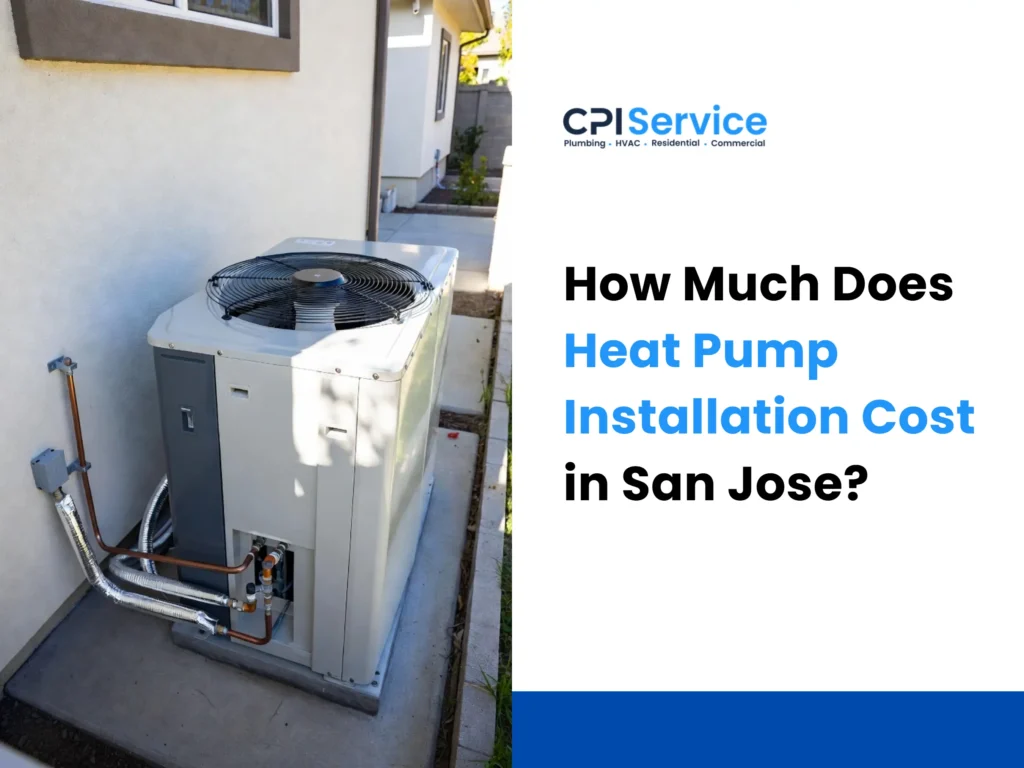
Heat Pump Installation Cost in San Jose ranges from $8,700 to $22,700 before incentives, depending on the heat pump type, system size, equipment efficiency, home size, existing ductwork, electrical upgrades, permit requirements, and labor complexity. Air source systems cost $7,000 to $15,000, ducted systems $8,000 to $25,000, ductless mini-splits $3,000 to $15,000, geothermal systems $18,000 to $45,000, and heat pump with air handler installations $12,000 to $22,700. Heat pump installation costs also vary by capacity, from $4,200 to $14,600 for 2-ton systems to $10,000 to $25,000 for 5-ton systems, making proper sizing essential.
The total project price includes heat pump equipment, indoor and outdoor units, electrical upgrades, ductwork, permits, and labor. Homeowners can reduce upfront costs through federal tax credits, California and San José Clean Energy rebates, manufacturer incentives, off-season discounts, and the reuse of existing ductwork. Comparing repair and replacement costs, evaluating long-term energy savings, and obtaining a professional HVAC assessment help identify the most cost-effective heat pump installation for each home.
What Is the Average Heat Pump Installation Cost in San Jose?
The average cost of heat pump installation in San Jose is $8,000 to $20,000, with most homeowners paying $10,000 to $14,000 for a complete system installation. Lower costs apply to straightforward replacements that reuse existing ductwork and electrical connections, while higher costs reflect larger systems, high-efficiency equipment, duct modifications, electrical upgrades, permit requirements, and increased labor. The final heat pump installation price varies based on the home’s requirements, the chosen heat pump system, and other factors specific to each installation.
How Does Heat Pump Installation Cost in San Jose Compare With California and the National Average?
Heat pump installation in San Jose costs between $8,000 and $20,000. Costs are generally lower than the California average ($10,000–$24,000) because the region’s mild Mediterranean climate often requires smaller-capacity systems. However, installation expenses remain competitive with, or can exceed, the national average ($13,450 to $15,400) due to high Bay Area labor costs, strict Title 24 energy-efficiency requirements, municipal permitting fees, mandatory HERS duct testing, and electrical panel upgrades ($2,000–$5,000) commonly needed in older homes. Homeowners can reduce upfront costs by combining the Federal 25C tax credit (up to $2,000), TECH Clean California incentives ($1,000–$4,000), and available San Jose Clean Energy rebates.
How Much Does Heat Pump Installation Cost by Heat Pump Size?
Heat pump installation costs in San Jose range from $4,200 to $25,000, with larger system capacities requiring higher equipment and installation costs. Proper heat pump sizing should be based on a Manual J load calculation instead of square footage alone to improve system performance and installation value.
The table below compares installation costs, BTU capacity, and recommended home sizes for each heat pump size:
| Heat Pump Size | Installation Cost | BTU Capacity | Recommended Home Size |
| 2 Ton | $4,200-$14,600 | 24,000 BTUs | 900-1,200 sq. ft. |
| 3 Ton | $6,000-$13,000 | 36,000 BTUs | 1,200-1,800 sq. ft. |
| 4 Ton | $7,000-$16,000 | 48,000 BTUs | 1,800-2,400 sq. ft. |
| 5 Ton | $10,000-$25,000 | 60,000 BTUs | Over 2,400 sq. ft. |
How Much Does a 2 Ton Heat Pump Installation Cost?
A 2-ton heat pump installation in San Jose costs $4,200 to $14,600 and offers a cost-effective solution for many smaller homes. It delivers about 24,000 BTUs of heating and cooling capacity and fits many homes between 900 and 1,200 square feet. Installation costs vary based on equipment efficiency, existing ductwork, electrical upgrades, permit fees, and labor requirements.
How Much Does a 3 Ton Heat Pump Installation Cost?
A 3-ton heat pump installation in San Jose costs $6,000 to $13,000 and suits many medium-sized homes requiring greater heating and cooling capacity. Delivering about 36,000 BTUs, it serves many homes ranging from 1,200 to 1,800 square feet. Installation price vary based on equipment efficiency, ductwork condition, electrical upgrades, permit fees, and labor requirements.
How Much Does a 4 Ton Heat Pump Installation Cost?
A 4-ton heat pump installation in San Jose ranges from $7,000 to $16,000, depending on the system type, efficiency rating, and installation complexity. Delivering approximately 48,000 BTUs of heating and cooling capacity, it is commonly sized for homes between 1,800 and 2,400 square feet. Costs may increase with ductwork modifications, electrical upgrades, permit fees, or higher-efficiency equipment.
How Much Does a 5 Ton Heat Pump Installation Cost?
A 5-ton heat pump installation cost in San Jose ranges from $10,000 to $25,000, reflecting the larger equipment and greater installation requirements. It delivers about 60,000 BTUs of heating and cooling capacity and serves many homes exceeding 2,400 square feet. Equipment efficiency, ductwork upgrades, electrical work, permit fees, and labor all influence the final installation cost.
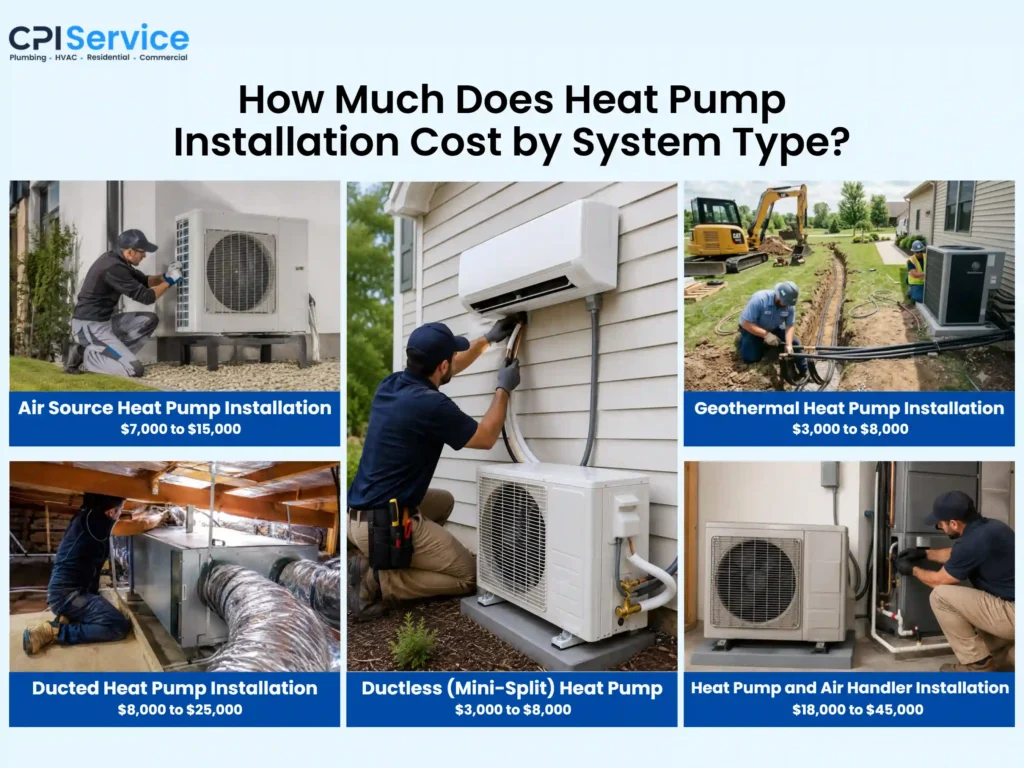
How Much Does Heat Pump Installation Cost by System Type?
Heat pump installation costs in San Jose range from $7,000 to $15,000 for air source systems, $8,000 to $25,000 for ducted systems, $3,000 to $8,000 for single-zone ductless mini-splits, and $9,000 to $15,000 for multi-zone systems. Geothermal heat pump installations cost $18,000 to $45,000, while heat pump and air handler installations range from $12,000 to $22,700. Equipment requirements, installation complexity, and long-term operating price vary by system type, making a professional HVAC evaluation essential before selecting the right solution.
What Does Air Source Heat Pump Installation Cost?
Air source heat pump installation in San Jose costs $7,000 to $15,000, depending on equipment efficiency, the condition of existing ductwork, and whether electrical upgrades are required. It is one of the most common and cost-effective heat pump systems for residential homes, transferring heat between indoor and outdoor air for year-round comfort. Installation includes the outdoor unit, indoor air handler, refrigerant lines, electrical connections, labor, and permits.
What Does Ducted Heat Pump Installation Cost?
A ducted heat pump installation in San Jose costs $8,000 to $25,000, with pricing determined by existing ductwork, equipment efficiency, and labor. It provides whole-home heating and cooling through an existing or newly installed duct system. Installation includes the heat pump, air handler, duct connections, thermostat, labor, and permits, making it well suited for homes with central HVAC distribution.
What Does Ductless (Mini-Split) Heat Pump Installation Cost?
Ductless (mini-split) heat pump installation in San Jose costs $3,000 to $8,000 for a single-zone system and $9,000 to $15,000 for a multi-zone system, depending on the number of indoor zones and the installation layout. It delivers heating and cooling without ductwork through individual indoor air handlers. Installation includes the indoor and outdoor units, refrigerant lines, electrical work, labor, and permits.
What Does Geothermal Heat Pump Installation Cost?
Geothermal heat pump installation in San Jose ranges from $18,000 to $45,000, with pricing influenced by property conditions, ground-loop design, and excavation or drilling requirements. The system transfers heat through buried piping to provide highly efficient heating and cooling. Installation includes excavation, the ground loop, indoor HVAC equipment, labor, and permits. A professional site assessment confirms project feasibility before selecting supporting equipment.
What Does Heat Pump and Air Handler Installation Cost?
Heat pump and air handler installation in San Jose costs $12,000 to $22,700, depending on the equipment efficiency, permit fees, and installation complexity. This system combines an outdoor heat pump with an indoor air handler to provide complete heating and cooling for a standard single-family home. Installation pricing includes the equipment, labor, and permits. For example, installing a 3-ton Rheem two-piece split heat pump system may cost around $18,373.
How Much Does Each Part of a Heat Pump Installation Cost?
Heat pump installation costs include $3,500 to $8,500 for the heat pump equipment, $2,500 to $6,500 for an indoor air handler, $2,900 to $7,000 for an outdoor unit, and $200 to $550 for a thermostat. Additional costs include $500 to $5,000 for electrical upgrades, $1,000 to $3,000 for ductwork installation or modification, $200 to $600 for permits, and $2,000 to $6,000 for professional labor. Equipment accounts for approximately 50% to 70% of the total installation cost, while labor represents the remaining 30% to 50% of the project.
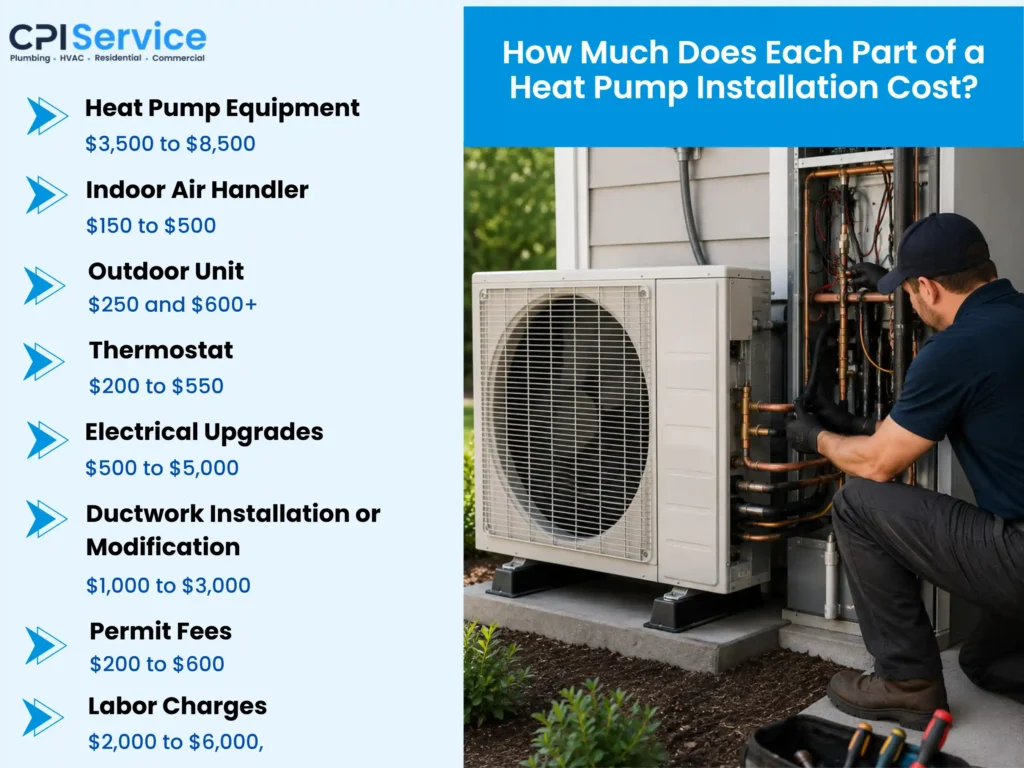
The breakdown below explains the function and pricing of every installation component:
- Heat Pump Equipment
Heat pump equipment costs $3,500 to $8,500 and includes the outdoor compressor and primary system components that provide heating and cooling. Equipment quality represents the largest share of the installation price. Capacity, efficiency rating, and brand influence pricing. Proper installation and system commissioning are essential for reliable operation and compliance with the manufacturer’s warranty.
- Indoor Air Handler
An indoor air handler costs $2,500 to $6,500 and circulates conditioned air throughout the home. It works with the outdoor heat pump to maintain indoor comfort. Capacity, variable-speed technology, and compatibility with the heat pump affect pricing. Professional installation is required to ensure proper airflow, refrigerant performance, and overall system efficiency.
- Outdoor Unit
An outdoor heat pump unit costs $2,900 to $7,000 and transfers heat between the indoor system and outdoor air. It directly affects heating and cooling performance. Equipment size, efficiency rating, brand, and installation location influence pricing. Having the system installed and charged correctly helps provide safe operation and long-term reliability.
- Thermostat
A thermostat costs $200 to $550, depending on its features and compatibility with the heat pump. It controls system operation and indoor temperature settings. Smart thermostats and communicating controls increase the purchase price. Proper installation helps ensure correct wiring, programming, and compatibility with the heat pump for efficient performance.
- Electrical Upgrades
Electrical upgrades for heat pump installation in San Jose cost $500 to $5,000, depending on the home’s existing electrical system. Basic upgrades, including adding a dedicated 240V, 30- to 40-amp circuit, range from $500 to $1,500. Older homes requiring a 100-amp to 200-amp electrical service panel upgrade can add $3,000 to $5,000 to the total installation cost.
- Ductwork Installation or Modification
Ductwork installation or modification costs $1,000 to $3,000 in San Jose, depending on the amount of new ductwork and the extent of repairs required. Installing brand-new ductwork costs about $690 to $1,500 per register or $1.50 to $12 per linear foot. Properly designed ducts improve airflow and system efficiency, while home layout, duct condition, and material selection influence the final installation cost. Professional inspection is recommended before installation.
- Permit Fees
Permit fees for heat pump installation in San Jose range from $200 to $600 and cover inspections required by local building authorities before and after installation. Permit costs contribute to the overall project budget and help verify code compliance. Municipal requirements influence pricing. Licensed HVAC contractors obtain permits and coordinate inspections during the installation process.
- Labor Charges
Labor charges for heat pump installation in San Jose range from $2,000 to $6,000, with HVAC technicians charging $75 to $141 per hour per worker, depending on experience and project complexity. Labor includes equipment installation, refrigerant charging, system testing, and startup. Electrical work, duct modifications, and challenging installation conditions increase labor time and overall costs. Experienced professionals help ensure safe, code-compliant installation.
What Factors Affect Heat Pump Installation Cost in San Jose?
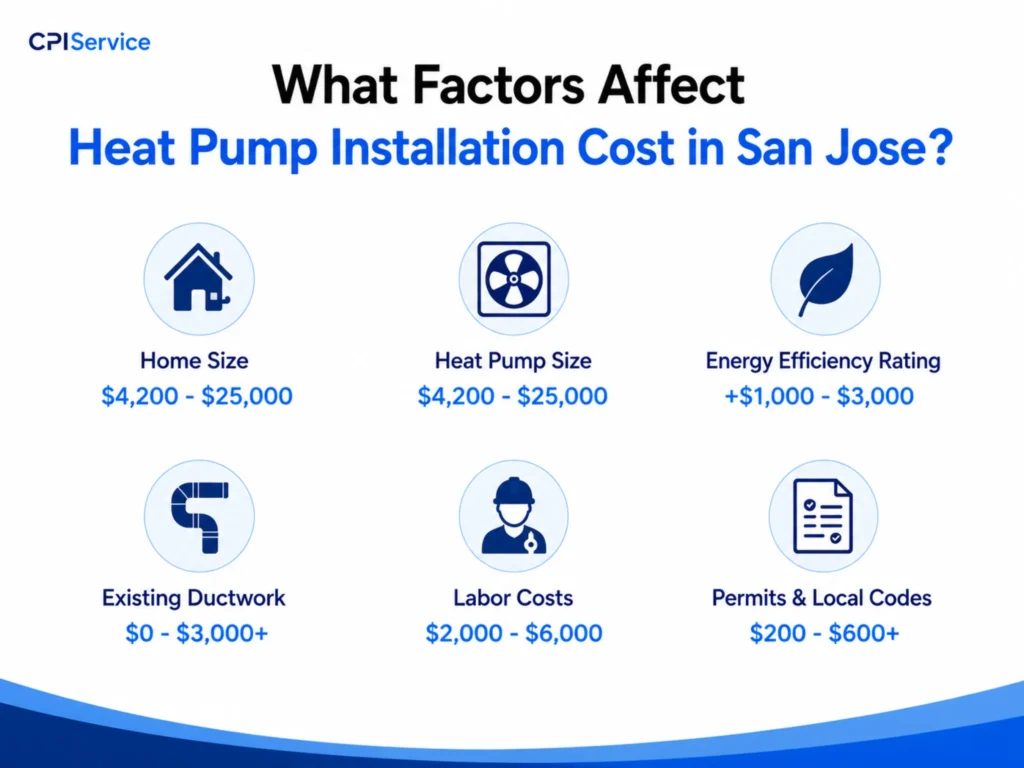
The factors affecting heat pump installation cost in San Jose include the type of heat pump, home size, heat pump capacity, energy efficiency rating, existing ductwork, and local labor, permit, and code requirements. Equipment, property characteristics, efficiency, ductwork condition, and local compliance can all increase or reduce the final installation estimate. A licensed HVAC contractor should inspect the home before providing a quote to determine the most accurate installation cost for each factor.
How Does the Type of Heat Pump Affect Installation Cost?
The type of heat pump directly affects installation costs because each system has different equipment, labor, and installation requirements. Air source systems cost less than geothermal systems, while ducted, ductless mini-split, and dual-fuel systems fall between these price ranges based on installation complexity. San Jose homes may require electrical or ductwork upgrades depending on the system selected. Homeowners should verify system compatibility, installation requirements, and long-term operating costs with a licensed HVAC contractor.
Below are the most common heat pump types and their installation cost considerations:
- Air Source Heat Pump: Air source heat pumps have the lowest installation costs because they use standard outdoor equipment and require less labor than other system types. As a result, installation generally ranges from $7,000 to $15,000.
- Ducted Heat Pump: Ducted heat pumps cost more because installation may involve repairing, sealing, modifying, or installing ductwork in addition to the HVAC equipment. These additional requirements increase installation costs to $8,000 to $25,000.
- Ductless Mini-Split Heat Pump: Ductless mini-split systems become more expensive as additional indoor air handlers and refrigerant lines are added. Single-zone systems cost $3,000 to $8,000, while multi-zone installations range from $9,000 to $15,000.
- Dual-Fuel Heat Pump: Dual-fuel heat pumps increase installation costs because they combine a heat pump with a gas furnace, requiring additional equipment, controls, and installation work. Installation costs $10,000 to $20,000, depending on the system configuration.
How Does Home Size Affect Heat Pump Installation Cost?
Heat pump installation costs range from $4,200 to $25,000 in San Jose, increasing as home size increases because larger homes require higher-capacity systems and more installation materials. Smaller homes may cost $4,200 to $14,600, while larger properties often require systems costing $10,000 to $25,000. Additional ductwork, refrigerant lines, and electrical upgrades can raise costs. Homeowners should request a Manual J load calculation from an HVAC contractor instead of relying on square footage alone.
How Does Heat Pump Size Affect Installation Cost?
Heat pump size influences installation costs because higher-capacity systems require larger equipment and more extensive installation work. A 2-ton heat pump costs $4,200 to $14,600, while a 5-ton system ranges from $10,000 to $25,000 in San Jose. Selecting the wrong capacity can reduce comfort and efficiency. Homeowners should confirm the recommended heat pump size with a licensed HVAC contractor.
How Do Energy Efficiency Ratings Affect Installation Cost?
Higher energy-efficiency ratings increase installation costs because premium heat pumps feature advanced compressors and variable-speed technology. Standard-efficiency systems cost less upfront, while high-efficiency models often add $1,000 to $3,000 to the installation price. These systems can reduce long-term energy bills and qualify for incentives. Homeowners should compare efficiency ratings, operating costs, and available rebates with an HVAC contractor.
How Does Existing Ductwork Affect Installation Cost?
Existing ductwork can reduce or increase heat pump installation costs depending on its condition. Homes with properly sized ducts avoid major modifications, while damaged or undersized ductwork can add $1,000 to $3,000 to the project cost. Installing brand-new ductwork costs about $690 to $1,500 per register or $1.50 to $12 per linear foot. Homeowners should schedule a professional duct inspection before finalizing an installation estimate.
How Do Labor, Permits, and Local Codes Affect Installation Cost in San Jose?
Labor, permit fees, and local building codes significantly affect heat pump installation costs in San Jose. Labor charges range from $2,000 to $6,000, with HVAC technicians charging $75 to $141 per hour per worker, while permit fees range from $200 to $600. Electrical upgrades and code compliance can further increase the final estimate. Homeowners should verify that the contractor’s quote includes all required permits, inspections, and labor.
How Can Homeowners Reduce Heat Pump Installation Cost?
Homeowners can reduce heat pump installation costs through federal tax credits, California rebates, manufacturer and utility rebates, whole HVAC system replacement, off-season installation, proper system sizing, and reusing existing ductwork. These savings methods can lower upfront installation expenses, reduce long-term operating costs, or both, depending on eligibility, home conditions, and equipment selection. Reviewing these options before installation helps maximize overall project value.
7 ways homeowners can reduce heat pump installation costs are:
- Federal Tax Credits and Incentives
According to the Energy Efficient Home Improvement Credit (Section 25C), homeowners can claim a federal tax credit covering 30% of the price of qualified heat pump equipment and installation, up to a maximum of $2,000, for eligible air-source heat pumps and heat pump water heaters installed in a primary residence. This incentive reduces upfront installation costs. Homeowners should verify that both the equipment and installation meet current IRS eligibility requirements before claiming the credit.
- California Rebates and Clean Energy Programs
State-sponsored clean energy programs provide rebates that reduce the purchase and installation price of qualifying heat pump systems. Eligibility varies by program, property location, and equipment efficiency. These rebates primarily reduce upfront expenses. Homeowners should confirm which programs are available and their application deadlines before installation.
- Manufacturer and Utility Rebates
Equipment manufacturers, utility companies, and San José Clean Energy (SJCE) offer rebates that reduce the upfront cost of qualifying heat pump installations. SJCE provides rebates of up to $12,000 for eligible heat pump HVAC systems and interest-free financing of up to $5,000 through its EcoHome Payment Plan. Homeowners must obtain SJCE pre-installation approval to qualify, so they should confirm rebate eligibility and application requirements before installation begins.
- Whole HVAC System Replacement
Replacing the heating and cooling systems simultaneously can reduce overall project costs by consolidating labor and installation. This approach also improves system compatibility and long-term performance. Savings apply to both upfront and operating costs. Homeowners should compare complete system replacement with partial equipment upgrades.
- Off-Season Installation
Scheduling installation during periods of lower contractor demand can reduce labor costs and improve appointment availability. Many HVAC contractors offer 15% to 20% discounts on equipment and labor outside peak heating and cooling seasons. This strategy lowers upfront installation expenses while providing greater scheduling flexibility. Homeowners should ask about seasonal promotions and available discounts before scheduling the installation.
- Proper System Sizing
Selecting equipment that matches the home’s heating and cooling load prevents unnecessary installation and operating expenses. Correct sizing improves efficiency while avoiding oversized or undersized systems. This lowers both upfront and long-term costs. Homeowners should request a Manual J load calculation before choosing a heat pump.
- Existing Ductwork Utilization
Reusing ductwork that is in good condition eliminates the cost of installing a new distribution system. Savings depend on the ducts being properly sized, sealed, and structurally sound. This approach reduces upfront installation costs. Homeowners should schedule a professional duct inspection before deciding to reuse existing ductwork.
When Should You Repair a Heat Pump Instead of Replacing It?
You should repair a heat pump if it is under 10 years old, still under warranty, or the repair cost of about $150 to $650 is less than half the replacement cost of $8,000 to $20,000 for a new heat pump installation in San Jose. Repairs also make financial sense when the system has required few previous repairs and continues to provide reliable heating and cooling. Warranty coverage can significantly reduce out-of-pocket repair expenses, making repair the more economical choice.
Replacement becomes the better option when the heat pump is 10 to 15 years old, breaks down frequently, struggles to maintain indoor comfort, or causes rising energy bills. These signs often indicate declining efficiency and worn components that increase operating costs. A licensed HVAC contractor should compare repair expenses with the cost of a new installation before recommending the most cost-effective solution.
Is Heat Pump Installation Worth the Cost in San Jose?
Yes, installing a heat pump is worth the cost in San Jose for many homeowners, as the city’s mild climate allows heat pumps to deliver efficient heating and cooling year-round. Although installation prices range from $8,000 to $18,000, lower energy consumption can reduce long-term utility bills. Federal tax credits, California rebates, and utility incentives can also lower the upfront investment, improving the overall return on the system.
Heat pump installation may not be worthwhile if the existing HVAC system is relatively new, the home requires extensive electrical or ductwork upgrades, or the homeowner does not expect to stay in the property long enough to recover the investment. A licensed HVAC contractor should evaluate the home’s heating and cooling requirements, existing equipment, and available incentives before recommending the most cost-effective solution.
When Should You Call a Professional for Heat Pump Installation in San Jose?
Homeowners should call a professional when an aging HVAC system, rising energy bills, frequent repairs, uneven indoor comfort, or the need for a more energy-efficient system indicates that replacing the heat pump in San Jose may be more practical than continued repairs. A professional heat pump installation service can evaluate the home’s heating and cooling needs, identify installation requirements, and recommend the most suitable heat pump system.
The following signs indicate that professional heat pump installation may be necessary:
- Replacing an Aging HVAC System
An HVAC system that is 10 to 15 years old may lose efficiency and become more expensive to maintain. A contractor should inspect the equipment, ductwork, and electrical system to determine whether a new heat pump is a better long-term investment. Professional installation ensures safe operation and reliable performance.
- Increasing Energy Bills
Higher utility bills often indicate declining HVAC efficiency or aging equipment. A contractor should evaluate system performance, airflow, and energy consumption to identify the cause. Replacing an inefficient system with a heat pump can lower operating costs and improve year-round comfort when professionally installed.
- Frequent Heating and Cooling Repairs
Repeated repairs often signal that major components are nearing the end of their service life. A contractor should inspect the compressor, refrigerant system, electrical components, and overall condition before recommending replacement. Professional installation improves reliability and reduces the likelihood of recurring repair costs.
- Uneven Indoor Comfort
Rooms that are consistently too warm or too cold may indicate improper system sizing, airflow issues, or failing HVAC equipment. A contractor should inspect the ductwork and insulation and perform a Manual J load calculation before installation. Correctly installed heat pumps provide more balanced heating and cooling throughout the home.
- Upgrading to an Energy-Efficient Heat Pump
Replacing an older HVAC system with a high-efficiency heat pump can reduce energy consumption while providing both heating and cooling from one system. A contractor should verify equipment sizing, electrical capacity, available rebates, and system compatibility before installation. Professional installation helps maximize efficiency, comfort, and long-term performance.

