
Why Is My HVAC Not Blowing Warm Air? Heat Pump Causes & Fixes
Table of Contents
- What Should You Check First When Your HVAC Won’t Blow Warm Air?
- 10 Common Causes Your HVAC Isn’t Blowing Warm Air
- 1. Thermostat Issues and Incorrect Settings
- 2. Clogged or Dirty Air Filters
- 3. Pilot Light and Ignition System Problems
- 4. High-Limit Switch Tripping
- 5. Blocked or Dirty Burners
- 6. Leaky or Damaged Ductwork
- 7. Electrical System Problems
- 8. Low Refrigerant Levels in Heat Pumps
- 9. Blower Motor Failure or Malfunction
- 10. Furnace Overheating and Safety Shutdowns
- Heat Pump Causes of Cool Air
- How Can You Troubleshoot Your HVAC Not Blowing Warm Air?
- When Should You Call a Professional HVAC Technician?
- Heating Problems in South Bay Homes
- Frequently Asked Questions
When your heating runs but the vents blow cool air, the cause depends on the system. With a heat pump, common in South Bay homes, short bursts of cool air are often a normal defrost cycle; longer stretches point to thermostat settings, a dirty filter, low refrigerant, a stuck reversing valve or a failed outdoor fan.
With a furnace, cold air usually means the burners aren’t lighting or staying lit, or the furnace overheated and shut them off. In San Jose and the South Bay, where many homes have switched to heat pumps, defrost questions are some of the most common winter calls.
Many causes are simple: a wrong thermostat setting, a tripped breaker, a clogged filter or blocked vents. Others, such as a failed igniter, dirty burners, an overheating furnace, low refrigerant or a failing blower motor, need a technician. Start with the quick checks below; if the system still won’t heat, makes grinding or banging noises, leaks water or refrigerant, or keeps tripping a breaker, call a licensed HVAC technician.
This guide focuses on heat pumps and covers furnaces more briefly. For a gas furnace, the full guide is furnace blowing cold air, and CPI handles furnace repair in San Jose; if your heater won’t turn on at all, start with why is my heater not working.
What Should You Check First When Your HVAC Won’t Blow Warm Air?
Three checks solve a surprising number of no-heat calls: the thermostat, the power and the air filter.
1. Check Your Thermostat Settings
Set the thermostat to Heat (not Cool, Off or Auto), 3 to 5 degrees above the room temperature, and set the fan to Auto. With the fan on On, the blower runs between heating cycles and pushes room-temperature air that feels cool. If the display is blank, replace the batteries; if it still doesn’t respond, it may need to be replaced.
2. Verify System Power and Circuit Breakers
Check the main electrical panel for a tripped breaker, make sure the power switch on or near the furnace or air handler is On, and on a heat pump, check that the outdoor disconnect box has its pull-out handle or fuse block in place. If the system still has no power, it needs an electrical diagnosis.
3. Inspect Your Air Filter
A clogged filter restricts airflow, which can overheat a furnace or freeze up a heat pump. Replace it if it’s dirty, with the airflow arrow pointing toward the furnace or air handler. Check it every month during the heating season and replace it every 1 to 3 months; it’s one of the tasks on our HVAC maintenance checklist.
10 Common Causes Your HVAC Isn’t Blowing Warm Air
Most cases come down to something that stops heat from being made (ignition, burners, refrigerant), stops the system from running (thermostat, power, safety switches) or stops warm air from reaching the rooms (filter, blower, ducts).
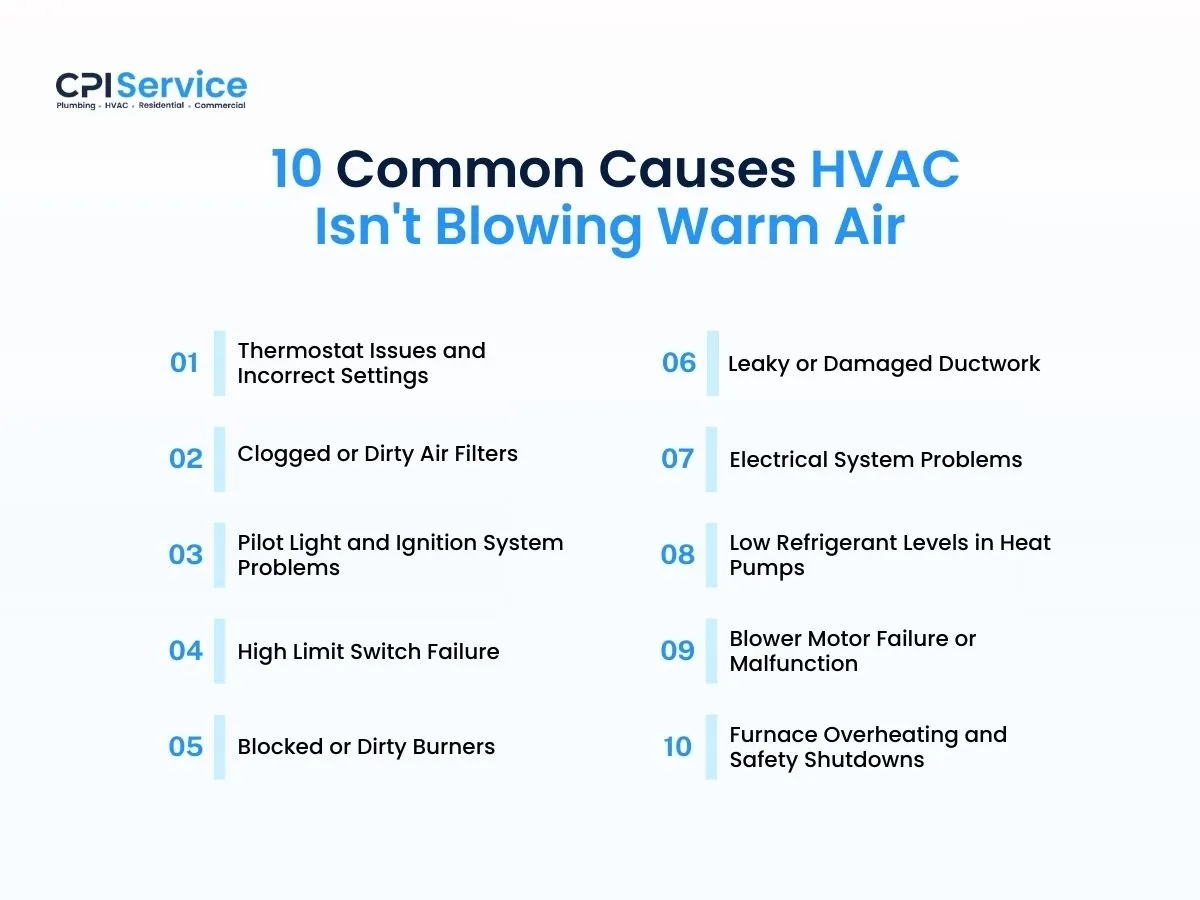
1. Thermostat Issues and Incorrect Settings
If the thermostat is set to Cool, set too low, or has the fan on On, the system runs without calling for heat and the vents blow cool air. Fix: set it to Heat, 3 to 5 degrees above room temperature, fan on Auto. Replace dead batteries; if it’s still unresponsive or reads the wrong temperature, recalibrate or replace it.
2. Clogged or Dirty Air Filters
A dirty filter restricts airflow, so the system works harder, loses efficiency and can shut down from overheating; see HVAC airflow issues. Fix: turn the system off, check the filter and replace it if it’s caked with dust. If airflow is still weak with a clean filter, have the system inspected.
3. Pilot Light and Ignition System Problems
On an older gas furnace with a standing pilot, a draft, a clogged pilot tube or a faulty thermocouple can let the pilot go out, and the burners can’t light. Newer furnaces use a hot-surface igniter and a flame sensor instead; a cracked igniter or a dirty flame sensor stops the burners from lighting or staying lit, so the blower moves cold air or nothing at all. Fix: to relight a pilot, follow the lighting instructions on the label inside the furnace door exactly, and never try if you smell gas. A flame sensor can be cleaned with the power and gas off; see how to clean a furnace flame sensor, or have a technician do it. Igniter replacement is technician work; see furnace not igniting.
4. High-Limit Switch Tripping
The high-limit switch is a safety device that shuts off the burners when the furnace gets too hot, while the blower keeps running to cool it down. The house gets cool air, and the cycle repeats. The usual cause is restricted airflow from a dirty filter, closed vents or a weak blower; the switch itself can also fail. Fix: replace the filter and open all vents. If it keeps tripping, call a technician: repeated overheating can damage the heat exchanger, and a limit switch must never be bypassed. See furnace blowing cold air.
5. Blocked or Dirty Burners
Dust, rust or soot on the burners causes delayed or uneven ignition, and the flame sensor may not prove the flame, so the furnace shuts the gas off while the blower keeps running. Fix: burner cleaning and gas valve work should be done by a technician during a tune-up, which also checks combustion and the heat exchanger.
6. Leaky or Damaged Ductwork
Ducts carry warm air from the furnace or air handler to each room. Gaps, loose joints and crushed sections let that air escape into the attic or crawl space, so the vents get weak, lukewarm air even though the system is heating. ENERGY STAR estimates a typical duct system loses 20 to 30 percent of its air through leaks and poor connections. Fix: check the ducts you can reach for loose joints and crushed runs, and seal small gaps with duct mastic or metal foil tape, not cloth duct tape. Disconnected or badly damaged ducts need duct repair and airflow testing.
7. Electrical System Problems
A tripped breaker, failed capacitor, loose connection or shorted wire can keep heating components from getting power. Signs include humming at startup, buzzing, repeated breaker trips, cycles that stop partway, and unexpected shutdowns. Fix: check the panel for a tripped breaker and look for burn marks or a burning smell, without opening the equipment. Repeated trips, buzzing or shutdowns need a licensed technician; capacitors hold a charge and HVAC wiring carries 240 volts.
8. Low Refrigerant Levels in Heat Pumps
A heat pump moves heat with refrigerant, so a leak reduces how much heat it can bring indoors. Run times get longer, the air feels lukewarm, and heating and cooling both suffer. Fix: oily spots on the lines or coil, or a hissing sound, point to a leak. Refrigerant work requires EPA certification: a technician finds and repairs the leak, then charges the heat pump to the manufacturer’s specification.
9. Blower Motor Failure or Malfunction
Worn bearings, a failed capacitor or a control board fault can slow or stop the blower, so heat stays in the furnace or air handler instead of reaching the rooms. Signs include weak airflow, grinding or squealing, uneven room temperatures, and a furnace that runs without delivering warm air. Fix: with the power off, check the vents and the blower compartment for obvious blockages. If the problem continues, a technician should test the motor and capacitor; see blower motor replacement cost.
10. Furnace Overheating and Safety Shutdowns
When a furnace overheats, its safety controls shut the burners off while the blower keeps running, so warm air turns cool and the furnace may stop completely. Common causes are a clogged filter, closed vents, a failing blower, loose wiring and wear on an older furnace. Watch for unusual noises, burning smells and repeated shutdowns. Fix: replace the filter, open the vents and clear the area around the furnace. If it keeps shutting down, schedule a professional inspection.
Heat Pump Causes of Cool Air
A heat pump has a few causes of its own that a furnace doesn’t.
Defrost Cycle
In cold, damp weather, frost builds on the outdoor coil, and the heat pump reverses for a few minutes to melt it. The air at the vents feels cool and you may see steam rising from the outdoor unit. That’s normal; the heat comes back on its own.
Stuck Reversing Valve
This valve switches the heat pump between heating and cooling. If it sticks in the cooling position, you get cool air in heat mode. A technician tests the valve and its solenoid.
Outdoor Fan or Coil Problems
A failed outdoor fan, or a coil caked in ice that defrost never clears, stops the heat pump from picking up heat from the outdoor air.
Auxiliary Heat Problems
If your heat pump has backup heat strips, a failure there shows up during defrost or on the coldest mornings, when the heat pump needs help.
How Can You Troubleshoot Your HVAC Not Blowing Warm Air?
Work from the simplest causes to the more involved ones, and stop at any step that calls for a technician.
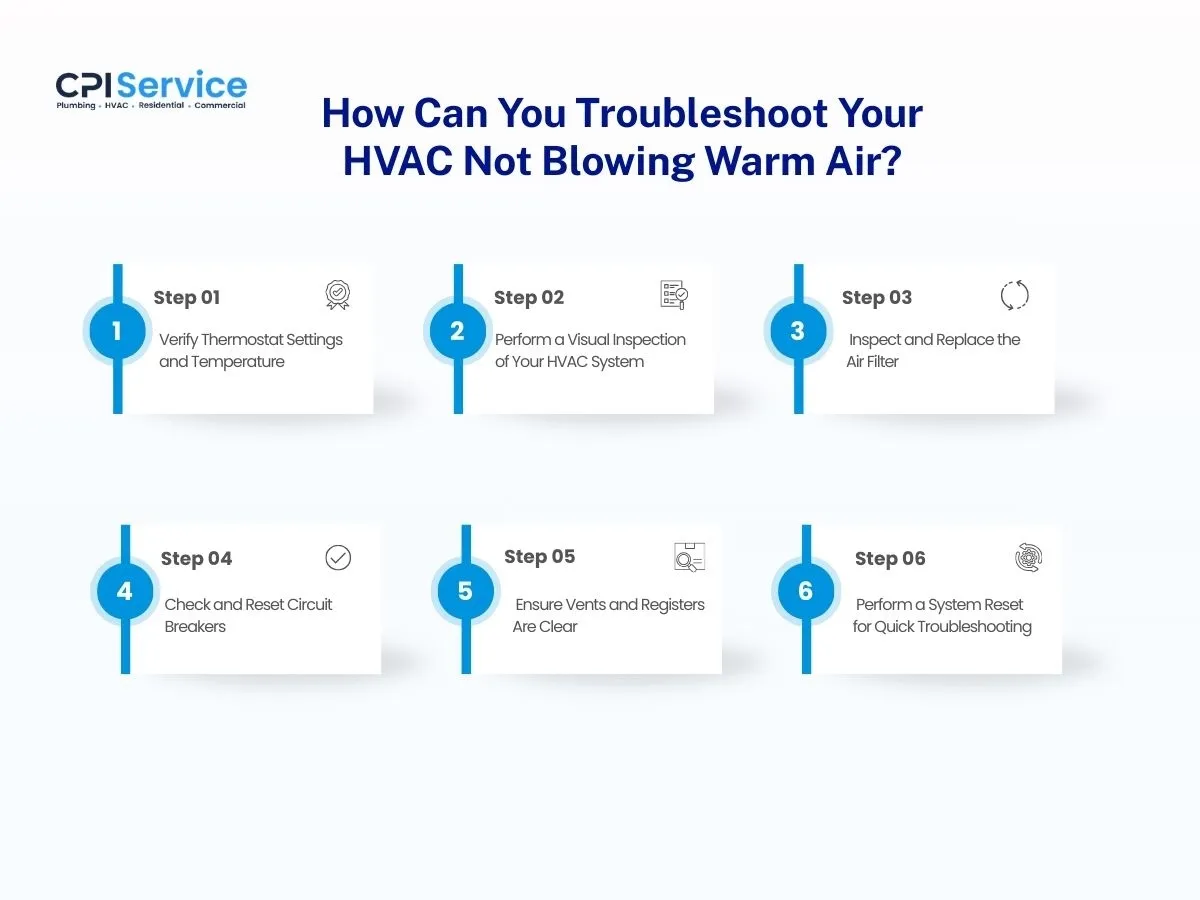
Step 1: Verify Thermostat Settings and Temperature
- Set the mode to Heat, not Cool or Off.
- Raise the setting 3 to 5 degrees above the indoor temperature.
- Set the fan to Auto so the blower runs only when the system is heating.
- Replace the batteries if the screen is blank or dim, and confirm the thermostat responds.
Step 2: Perform a Visual Inspection of Your HVAC System
- With the power off, look at the indoor unit for rust, damage or water pooled underneath, which can mean a drainage problem. Don’t touch wiring or components.
- Clear leaves and debris from around the outdoor unit; on a heat pump, check that the fan runs and the coil isn’t encased in ice.
- Look at the ducts you can reach in the attic or crawl space for loose or disconnected sections.
- Listen while it runs. Banging, grinding or constant humming from the furnace, blower or heat pump points to a mechanical or electrical problem.
- Wait 15 to 20 minutes and feel the air again: a heat pump may have been in defrost.
Step 3: Inspect and Replace the Air Filter
- Turn the system off at the thermostat.
- Remove the filter from the return grille or the furnace or air handler and check for heavy dust.
- Slide in a new filter of the same size with the airflow arrow pointing toward the furnace or air handler, and close the access panel.
- Restore power and check whether the air warms up.
Step 4: Check and Reset Circuit Breakers
- Find the main electrical panel, often in the garage or a utility closet. Make sure your hands are dry and you’re not standing in water.
- Look for breakers labeled Furnace, Air Handler, AC/Heat Pump or Electric Heat; heat pumps and heat strips usually use a double-pole 240-volt breaker.
- A tripped breaker sits in the middle or feels loose. Push it fully to Off, then back to On.
- If it trips again, don’t reset it a second time. Call a technician.
- Make sure the indoor power switch is On and, for a heat pump, the outdoor disconnect is in place.
Step 5: Ensure Vents and Registers Are Clear
- Move furniture, rugs and curtains away from supply vents and return grilles.
- Open the lever or thumbwheel on every register fully.
- Vacuum dust and pet hair from the covers; lift floor registers and remove any objects you can reach in the duct opening.
- In the attic or crawl space, make sure flexible ducts aren’t crushed, kinked or disconnected.
- On a high-efficiency furnace, make sure the outdoor intake and exhaust pipes are free of leaves, debris and nests.
Step 6: Perform a System Reset
- Set the thermostat to Off, then turn off the power switch on or near the furnace or air handler.
- Wait about a minute. Don’t touch internal parts, which may be hot.
- Turn the power back on and set the thermostat to Heat. Leave it alone while the control board runs its startup check.
- On a gas furnace, you should hear the inducer fan, then see the igniter glow and the burners light; the blower starts a minute or so later. A heat pump has no burners: the outdoor unit and indoor blower start instead.
- Check the vents for warm air. If it’s still cool, call for service.
When Should You Call a Professional HVAC Technician?
Call a technician when the system runs but won’t produce warm air even with the right thermostat settings, or when the problem involves a motor, refrigerant, a furnace that won’t ignite, repeated breaker trips or safety controls. Handling these without training can damage the system or create a safety hazard. It’s urgent if you hear grinding or banging, smell burning, see water or refrigerant leaks, or the system shuts down on a cold night. Rising energy bills and rooms that stay cold while the system runs are also signs of a developing failure.
If you smell gas, leave the home and call 911 and PG&E from outside. Regular maintenance prevents most of these problems; see HVAC maintenance plans or our membership plans.
Heating Problems in South Bay Homes
- Heat pumps are taking over. Many South Bay homeowners have replaced gas furnaces with heat pumps, helped by local rebates. Their air feels warm rather than hot, and occasional defrost cycles are normal.
- Mild winters. San Jose’s winters are mild, so a properly sized, working heat pump rarely needs its backup heat. If yours runs on auxiliary heat often, have it checked.
- First cold nights. Systems that sat idle all summer often show their problems on the first cold evening; run the heat briefly in early fall.
CPI Service repairs heat pumps and furnaces throughout San Jose and the South Bay. See our HVAC services, request a free estimate or call (408) 978-3093.
Frequently Asked Questions
Why is my HVAC blowing cold air instead of warm?
The most common reasons are thermostat settings (Cool mode, or the fan set to On so it blows between heating cycles), a clogged filter, a tripped breaker, or an ignition problem on a gas furnace. Other causes include dirty burners, an overheating furnace tripping its high-limit switch, leaky ducts, electrical faults, low refrigerant in a heat pump and a failing blower motor.
Why is my heat pump blowing cold air in heat mode?
For a few minutes at a time, it's usually a defrost cycle clearing frost from the outdoor coil, which is normal. If it blows cool air for a long time, check the thermostat mode and filter; ongoing cool air points to low refrigerant, a stuck reversing valve, a failed outdoor fan or a defrost control problem.
Why does heat pump air feel cooler than furnace air?
A heat pump delivers air that's warm but not hot, often in the 90s °F at the vents, compared with a furnace's hotter air. It runs longer, steadier cycles instead. Air that's cooler than your skin, though, means it isn't heating properly.
What is emergency or auxiliary heat?
Electric heat strips that back up some heat pumps during defrost or very cold weather. In San Jose's mild winters it should rarely run; if it's running a lot, the heat pump may not be heating properly.
How often should I replace my HVAC air filter?
Every 1 to 3 months for a standard 1-inch filter, and more often if it looks clogged or the home has pets, allergies or smokers. Thicker 4- to 5-inch media filters last longer; follow the manufacturer's guidance.
How much does it cost to fix an HVAC system that's not heating in San Jose?
It depends on the part. Typical San Jose ranges: flame sensor $150–$350, furnace igniter $200–$450, pressure switch $250–$500, capacitor or contactor $400–$600, blower motor $400–$900 ($800–$2,000 for a variable-speed ECM motor), and an inducer motor, gas valve or control board $500–$1,500. CPI quotes each repair as a fixed price before work starts.
When should I replace my HVAC system instead of repairing it?
ENERGY STAR suggests considering replacement when a heat pump or air conditioner is more than 10 years old or a furnace is more than 15, or when the equipment needs frequent repairs and energy bills keep rising. A major failure such as a cracked heat exchanger or a failed compressor on an older system, or a system that still uses R-22 refrigerant, also points toward replacement.
Our new heat pump system has just been installed and we are very pleased with CPI and the new equipment. We are especially grateful for the knowledgeable and hard-working technician Bunhak, who worked throughout our recent heatwave to finish the job. We would highly recommend CPI for any HVAC installation or maintenance.
Linda G., Google review
Read more reviews →Serving San Jose and the South Bay
CPI Service is based at 2880 Aiello Dr in San Jose and serves homes and businesses across the South Bay and the Peninsula. See all the areas we serve.